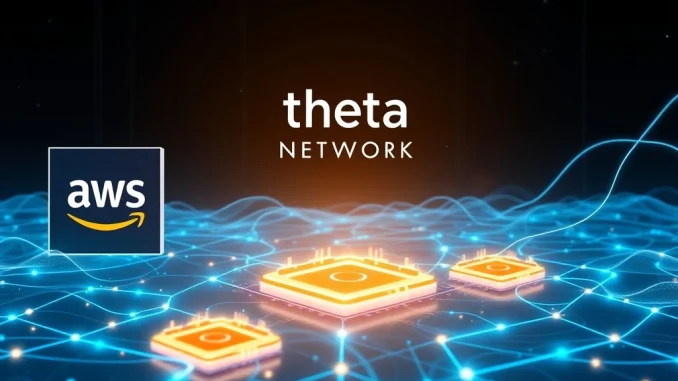
In a groundbreaking move that could redefine the landscape of digital innovation, the Theta Network has announced a pivotal integration set to revolutionize decentralized computing. Imagine a world where artificial intelligence, the very engine of future innovation, is no longer confined to massive, centralized data centers. This vision is rapidly becoming a reality as Theta becomes the first blockchain network to directly incorporate Amazon’s specialized AI chipsets: Trainium and Inferentia. This strategic collaboration is not just a technical upgrade; it’s a bold statement about the future of AI development, promising unprecedented levels of efficiency, scalability, and cost-effectiveness for next-generation applications.
What’s the Big Deal? Theta Network’s Groundbreaking Integration
The core of this monumental announcement lies in Theta Network’s strategic decision to leverage Amazon’s purpose-built silicon. For years, the bottleneck in large-scale AI model training and inference has been the immense computational power required, often leading to prohibitive costs and scalability issues within traditional centralized cloud services. Theta Network, known for its innovative approach to decentralized video and data delivery, is now tackling this challenge head-on by integrating Amazon Trainium and Inferentia chips into its EdgeCloud Hybrid infrastructure.
- Amazon Trainium: Designed specifically for high-performance deep learning model training, Trainium chips accelerate the iterative process of teaching AI models, significantly reducing training times and computational costs. This makes it ideal for developing complex AI models that power everything from natural language processing to advanced computer vision.
- Amazon Inferentia: Built for efficient and cost-effective AI inference, Inferentia chips excel at deploying trained models for real-time applications, ensuring rapid responses and lower operational expenses for AI-driven services. Think of it as the engine that makes AI predictions and decisions lightning fast.
This integration marks a significant leap forward, aligning perfectly with Theta’s overarching mission: to democratize access to decentralized cloud resources. By combining its distributed user-contributed computing power with the specialized capabilities of Amazon’s AI hardware, Theta aims to create a robust, accessible, and highly efficient platform for AI, media, and entertainment applications. This synergy addresses the computational demands of advanced AI, promising to unlock new possibilities for developers and businesses alike, fostering innovation previously constrained by centralized infrastructure.
How Do Amazon AI Chips Supercharge Decentralized AI?
The power of this integration truly shines when we look at how these specialized chips enhance the capabilities of Decentralized AI. Traditional AI development often relies on a few large players, leading to concerns about data privacy, censorship, and single points of failure. Decentralized AI, by contrast, distributes computing power across a network, fostering greater resilience and accessibility, but often struggles with the raw computational horsepower needed for cutting-edge AI models.
Theta’s EdgeCloud Hybrid infrastructure is specifically designed to optimize AI workloads by intelligently routing tasks to the most efficient resources. Here’s how the Amazon chips fit in, transforming the potential of decentralized AI:
| Chipset | Primary Function | Benefit to Theta Network | Impact on AI Workloads |
|---|---|---|---|
| Amazon Trainium | High-performance AI model training | Accelerates training cycles for complex deep learning models, making iterative development faster and more economical. | Enables rapid model development, more sophisticated AI capabilities, and faster innovation for decentralized AI applications. Developers can experiment more freely. |
| Amazon Inferentia | Cost-efficient AI inference (real-time prediction) | Ensures efficient deployment and execution of trained models at scale, reducing operational costs for live AI services. | Achieves lower latency and reduced per-computation costs for real-time AI services, such as live content moderation, personalized recommendations, and interactive AI agents. |
This powerful combination allows Theta to process complex AI workloads faster and more economically than ever before. For instance, imagine real-time content moderation for live streams or highly personalized content recommendations generated on the fly for millions of users. These resource-intensive tasks, which often strain centralized systems, can now be handled with lower latency and higher scalability within Theta’s decentralized framework. This dramatically reduces barriers to entry for decentralized AI development, fostering a new wave of innovation by making advanced AI tools accessible to a broader community of developers and creators.
The EdgeCloud Hybrid Advantage: A New Era for Blockchain Computing
Theta’s EdgeCloud Hybrid infrastructure is more than just a buzzword; it represents a paradigm shift in Blockchain Computing. By seamlessly blending distributed, user-contributed computing resources (like those from Edge Nodes operated by the community) with powerful Amazon EC2 instances equipped with Trainium and Inferentia, Theta creates a uniquely flexible and robust environment. This hybrid model offers the best of both worlds: the distributed resilience and cost-efficiency of a decentralized network, combined with the raw, specialized power of leading-edge centralized hardware for specific, compute-intensive tasks.
Consider the typical challenges faced by developers building AI applications in a purely centralized or purely decentralized environment:
- Scalability: How to handle sudden spikes in demand without massive upfront investment or network congestion? Theta’s hybrid approach dynamically scales by utilizing both community resources and AWS.
- Cost: How to keep operational expenses low for resource-intensive AI tasks, especially when dealing with large datasets or complex models? Distributed processing and specialized chips reduce per-computation costs.
- Latency: How to ensure real-time performance for interactive AI applications, where even milliseconds matter? Inferentia chips are specifically designed for low-latency inference.
- Decentralization: How to avoid reliance on a single provider and ensure censorship resistance, while still accessing cutting-edge hardware? Theta’s model aims to balance these aspects, using centralized components as accelerators for a fundamentally decentralized system.
Theta’s EdgeCloud Hybrid model directly addresses these points. The decentralized network distributes workloads, mitigating single points of failure and inherently reducing operational costs. When specific, high-performance tasks requiring specialized hardware arise, the integration with Amazon’s EC2 instances (now powered by their custom AI chips) ensures that these demands are met with unparalleled efficiency. This approach attracts developers and enterprises who are seeking to build cutting-edge AI applications without being solely dependent on traditional, centralized cloud providers. It accelerates the adoption of blockchain-based solutions in critical sectors like media and entertainment, where real-time AI processing is increasingly vital for personalized experiences and content generation.
Navigating the Future of AI Infrastructure
While the integration of Amazon’s AI chips marks a significant competitive advantage for Theta, it also brings forth important considerations for the future of AI Infrastructure within a decentralized context. Theta is pioneering the deployment of specialized, centralized hardware within a blockchain network, a move that highlights the growing convergence of these two transformative technologies. Decentralized infrastructure inherently offers resilience and cost advantages over traditional centralized models, but challenges remain that require careful management:
- Integration Complexity: Seamlessly integrating high-performance centralized hardware into a distributed, decentralized framework requires sophisticated engineering, robust API management, and continuous optimization to ensure smooth data flow and task allocation.
- Dependency Management: While leveraging Amazon’s cutting-edge technology provides immense power, Theta must carefully manage its dependencies on a third-party provider to preserve its decentralized ethos and ensure long-term autonomy. This involves strategic partnerships and potentially diversifying hardware providers in the future.
- Security and Interoperability: Maintaining robust security protocols across both centralized and decentralized components, and ensuring seamless interoperability for data and computational tasks, will be crucial for the platform’s integrity, user trust, and widespread adoption.
The strategic adoption of Amazon’s chipsets aligns with broader industry trends where AI models are growing exponentially in complexity, intensifying the demand for scalable and cost-effective computing solutions. Theta’s approach of distributing workloads across a decentralized network, augmented by specialized hardware, is a powerful answer to this demand, offering a compelling alternative to solely centralized cloud solutions and paving the way for more resilient and accessible AI.
Why This Matters: Benefits and Broader Implications
This integration is not just a technical footnote; it carries profound implications for the entire ecosystem. Here are some key benefits and broader implications that highlight its significance:
- Democratization of AI: By making high-performance AI compute more accessible and affordable, Theta lowers the barrier to entry for innovators, fostering a more diverse and decentralized AI development landscape. This means smaller teams and individual developers can compete with large corporations.
- Enhanced Media & Entertainment: The ability to perform real-time AI processing with lower latency opens doors for revolutionary applications in content creation, personalized streaming, interactive experiences, virtual reality, and advanced analytics for media consumption.
- Competitive Edge: Being the first blockchain network to deploy Amazon’s AI-specific hardware firmly establishes Theta as a leader in high-performance decentralized computing, attracting more developers, enterprises, and projects to its ecosystem who are seeking cutting-edge AI capabilities.
- Model for Future Blockchain Projects: Theta’s success in this integration could serve as a blueprint for other blockchain projects looking to combine the strengths of decentralized networks with specialized centralized hardware for specific, high-demand tasks, accelerating the overall maturity of the Web3 space.
- Economic Efficiency: By optimizing resource allocation and leveraging purpose-built hardware, Theta can offer more cost-effective AI solutions compared to general-purpose cloud computing, passing savings onto developers and users.
This pivotal step signals Theta’s commitment to pushing the boundaries of what’s possible in decentralized computing. It’s about building a future where AI’s transformative power is distributed, resilient, and available to all, rather than concentrated in the hands of a few tech giants.
Conclusion: Redefining Decentralized Computing in the AI Era
The Theta Network‘s integration of Amazon AI chips is more than just a technical upgrade; it’s a bold declaration of intent. By strategically adopting Trainium and Inferentia, Theta is not only enhancing its EdgeCloud Hybrid infrastructure but also setting a new standard for decentralized AI development. This move places Theta at the vanguard of a crucial technological convergence, where the resilience and transparency of blockchain meet the raw computational power of advanced AI. While challenges related to managing centralization dependencies and navigating integration complexities will need careful navigation, the potential for groundbreaking innovation is immense. As AI technologies continue their rapid evolution, Theta’s capacity to adopt emerging hardware advancements will be vital to sustaining its competitive advantage and realizing its vision of a truly democratized, high-performance decentralized computing platform. This integration solidifies Theta’s position at the forefront of the convergence between blockchain and AI, promising a future where cutting-edge AI applications are built on a foundation of decentralization, resilience, and unparalleled efficiency.
Frequently Asked Questions (FAQs)
1. What are Amazon Trainium and Inferentia chips?
Amazon Trainium and Inferentia are specialized Artificial Intelligence (AI) chipsets developed by Amazon Web Services (AWS). Trainium is designed for high-performance deep learning model training, accelerating the process of teaching AI algorithms. Inferentia is optimized for efficient and cost-effective AI inference, which involves deploying trained models to make predictions or perform real-time tasks.
2. How does Theta Network integrate these AI chips?
Theta Network integrates Amazon AI chips into its EdgeCloud Hybrid infrastructure. This unique setup combines Theta’s decentralized network of user-contributed computing resources (Edge Nodes) with Amazon EC2 instances that are now equipped with Trainium and Inferentia chips. This allows Theta to route complex AI model training and inference tasks to the most efficient hardware, whether decentralized or specialized centralized.
3. What are the main benefits of this integration for Theta Network?
The integration brings several key benefits: improved performance for AI workloads, enhanced efficiency in processing complex tasks, significant cost reduction for AI computations, and greater scalability. It enables faster AI model development, lower latency for real-time applications, and democratizes access to high-performance AI computing within a decentralized framework.
4. What kind of AI applications can benefit from this?
This integration can support a wide range of next-generation AI applications, particularly those requiring intensive computational power and low latency. Examples include real-time content moderation for live streams, advanced personalized content recommendations, AI-driven media creation, complex data analysis, and decentralized machine learning initiatives.
5. Does this integration compromise Theta Network’s decentralization?
This is a key consideration. While Theta leverages centralized Amazon hardware for specialized AI tasks, its core EdgeCloud Hybrid infrastructure maintains a decentralized approach by distributing other workloads across its global network of Edge Nodes. The challenge lies in balancing the benefits of cutting-edge centralized technology with the fundamental ethos of decentralization, ensuring the network remains robust and censorship-resistant. Theta aims to use these chips to *enhance* its decentralized offerings, not replace them.
6. How does this move position Theta Network in the broader market?
By being the first blockchain network to integrate Amazon’s AI-specific hardware, Theta Network establishes itself as a leader in high-performance decentralized computing. This move enhances its competitive edge, attracting developers and enterprises seeking robust, scalable, and cost-effective solutions for AI applications, particularly in media and entertainment, and positions it at the forefront of the convergence between blockchain and AI.