In the fast-paced world where innovation often sets the pace for market sentiment, even tech giants like Tesla can face significant headwinds. While the cryptocurrency market often dances to its own tune, the performance of major tech stocks, particularly those pioneering AI and autonomous technologies, can offer crucial insights into broader investor confidence and the viability of ambitious tech-driven visions. The recent 8% dip in Tesla stock, triggered by a substantial 16% drop in vehicle deliveries, serves as a stark reminder that even the most charismatic leadership can’t always outrun market realities. This isn’t just about cars; it’s about the future of AI, robotics, and the audacious promises that drive investor interest – areas that increasingly intertwine with decentralized technologies and crypto innovation.
Tesla Stock Plunge: Why Investors Are Wary
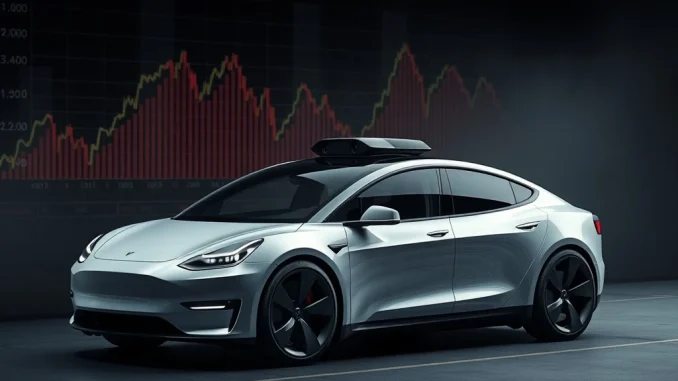
The latest quarterly earnings report delivered a jolt to investors, revealing a significant 16% year-over-year drop in vehicle deliveries. This decline, particularly noticeable in key European and California markets, has fueled growing investor skepticism regarding Tesla’s immediate growth trajectory. Despite the Nasdaq’s 9% gains year-to-date, TSLA stock remains down nearly 22% in the same period, signaling a disconnect between broader market optimism and specific concerns surrounding the EV giant. The numbers speak volumes, highlighting that even Elon Musk’s ambitious long-term visions are struggling to counteract present-day challenges.
| Metric | Nasdaq (YTD) | Tesla (TSLA) (YTD) |
|---|---|---|
| Performance | +9% | -22% |
| Investor Sentiment | Optimistic | Skeptical |
The Autonomous Driving Dream vs. Reality
A central pillar of Tesla’s future valuation, as often touted by CEO Elon Musk, lies in its autonomous driving capabilities and the promise of a vast robotaxi network. However, Wall Street is growing impatient. Musk’s repeated assurances that Tesla vehicles will soon operate fully autonomously and generate passive income for owners haven’t translated into tangible progress that satisfies market demands. During the recent earnings call, Musk highlighted plans to scale robotaxi trials in Austin, Texas, with an ambitious goal to reach half of U.S. households by year-end, contingent on regulatory approvals. Yet, the stock’s subsequent 8% fall underscored deep-seated unease over a pattern of unmet deadlines for self-driving milestones and a noticeable lack of updated financial guidance. Analysts point out that Tesla’s autonomy timeline has been delayed for over a decade, raising questions about the feasibility of its bold projections.
Robotaxi Roadblocks: Navigating Regulatory Hurdles
The path to widespread robotaxi deployment is fraught with regulatory complexities, a significant hurdle that appears to be slowing Tesla’s progress. Unlike competitors who have gained substantial real-world experience, Tesla faces an uphill battle in securing necessary approvals. For instance, the company has yet to file crucial applications with California’s DMV or Public Utilities Commission, which currently restrict driverless operations to chauffeur-operated fleets. While Tesla seeks approvals in states like Nevada and Arizona, the lack of transparency surrounding its technical readiness has drawn criticism from industry observers. Competitors like Waymo and Apollo Go are making significant strides, logging millions of miles in diverse public road conditions, contrasting sharply with Tesla’s more controlled, limited pilot tests in Austin. This disparity highlights the gap between aspirational timelines and the rigorous demands of real-world autonomous deployment.
Autonomous Mileage Comparison: Tesla vs. Competitors
- Waymo: Over 100 million miles logged in public roads across ten cities.
- Tesla (Austin pilot): Approximately 7,000 miles in controlled conditions using safety drivers.
Shifting Gears in the Global EV Market
Beyond the ambitious autonomous driving promises, Tesla is also navigating an increasingly competitive EV market. The 16% delivery drop points to broader challenges, including intense pressure from rapidly expanding Chinese EV manufacturers who are aggressively tightening their grip on global markets. This growing competition exacerbates concerns over Tesla’s competitive positioning, especially as traditional automakers also ramp up their EV offerings. Analysts from Goldman Sachs and Jefferies described Tesla’s robotaxi update as ‘a bit dull’ and ‘still small,’ respectively, reflecting a tempered outlook. While Canaccord Genuity maintained a ‘buy’ rating, emphasizing long-term potential, they stressed the critical need for improved profitability. The company’s Q2 results, coupled with Musk’s recent audacious $20 trillion valuation claim for Tesla, reveal a stark disconnect between soaring forecasts and current market realities. Without tangible progress on autonomy and sustained revenue growth, investor skepticism is likely to intensify, making the road ahead for Tesla increasingly challenging.
Concluding Thoughts: Navigating the Crossroads of Innovation and Reality
Tesla stands at a critical juncture, balancing its visionary long-term goals of becoming an AI and robotics leader with the immediate demands of vehicle production, market competition, and regulatory compliance. The recent Tesla stock decline is more than just a momentary dip; it reflects a growing call from investors for concrete achievements rather than just ambitious promises. For those in the crypto space, this scenario offers a valuable lesson: even the most disruptive technologies and charismatic leaders must eventually deliver tangible results and navigate real-world constraints. As the EV market evolves and the race for truly autonomous driving intensifies, Tesla’s ability to bridge the gap between its grand vision and operational realities will determine its trajectory. The coming quarters will be crucial in demonstrating whether the company can truly accelerate into its self-proclaimed future or if its robotaxi dreams remain just beyond the horizon, continuing to fuel investor skepticism.
Frequently Asked Questions (FAQs)
Q1: Why did Tesla stock fall by 8%?
A1: Tesla’s stock fell primarily due to a significant 16% year-over-year drop in vehicle deliveries reported in its latest quarterly earnings, coupled with growing investor skepticism over the company’s ambitious autonomous driving and robotaxi timelines.
Q2: What are the main reasons for investor skepticism regarding Tesla?
A2: Investors are skeptical due to repeated delays in achieving self-driving milestones, a lack of updated financial guidance, declining sales in key markets, and the perception that CEO Elon Musk’s ambitious forecasts (like the $20 trillion valuation) are disconnected from current realities.
Q3: How do Tesla’s autonomous driving efforts compare to competitors like Waymo?
A3: Competitors like Waymo have logged over 100 million miles on public roads across multiple cities, demonstrating more extensive real-world testing. In contrast, Tesla’s Austin pilot has tested around 7,000 miles in controlled conditions using safety drivers, indicating a significant gap in real-world deployment and experience.
Q4: What regulatory challenges does Tesla face for its robotaxi plans?
A4: Tesla faces significant regulatory hurdles, particularly in states like California, where it has yet to file necessary applications with the DMV or Public Utilities Commission. Current regulations in some areas restrict driverless operations to chauffeur-operated fleets, complicating Tesla’s path to widespread robotaxi deployment.
Q5: How is the competition from Chinese EV manufacturers impacting Tesla?
A5: Chinese EV manufacturers are rapidly expanding and tightening their grip on global markets, intensifying competition for Tesla. This increased competition, combined with Tesla’s own delivery declines, raises concerns about its competitive positioning and market share in the evolving global EV market.
Q6: What is the long-term outlook for Tesla according to analysts?
A6: While some analysts, like Canaccord Genuity, maintain a ‘buy’ rating based on long-term potential, they emphasize the critical need for Tesla to demonstrate improved profitability and tangible progress on its autonomy initiatives to alleviate investor skepticism and sustain revenue growth.