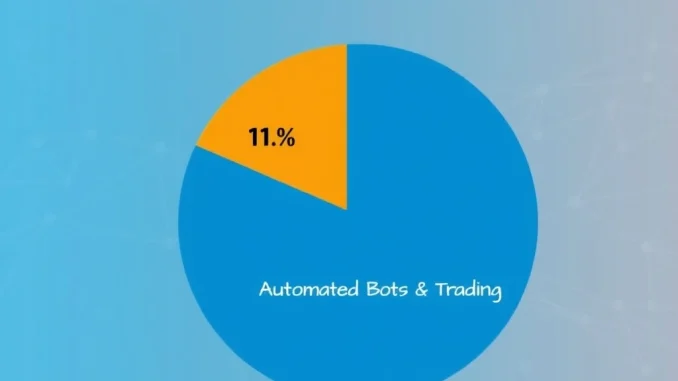
Seoul, South Korea, April 2025: A groundbreaking study from the Korea Institute of Finance delivers a stark revelation about the true nature of the multi-trillion dollar stablecoin market. Contrary to popular narratives of digital dollars revolutionizing everyday commerce, the data shows a shocking reality: a mere 0.1% of all U.S. dollar-pegged stablecoin transactions are actually used for retail payments. This finding, based on transaction volume reaching $5.42 trillion as of November last year, forces a fundamental reassessment of what stablecoins are primarily used for in today’s financial ecosystem. The vast majority of this colossal activity, a staggering 77.6% or $4.21 trillion, is attributed not to human users but to automated bots operating across decentralized finance (DeFi) protocols and trading platforms.
Stablecoin Transactions: Deconstructing the $5.42 Trillion Reality
The report, titled “Trends and Implications of Stablecoin Utilization as a Payment Method,” provides an unprecedented granular look at on-chain activity. The headline figure of $5.42 trillion in total transaction volume for dollar stablecoins like Tether (USDT) and USD Coin (USDC) underscores their massive scale. However, the breakdown of this volume tells a more complex story. The study meticulously separates bot-driven activity from general transactions. Automated bots, programmed for arbitrage, liquidity provision, and algorithmic trading, account for $4.21 trillion. This leaves $1.21 trillion in transactions classified as general, non-bot activity. It is within this remaining pool that the research team searched for evidence of retail payment use—purchases of goods and services by consumers.
The result was a minuscule $7.5 billion. To put this in perspective, the retail payment volume of stablecoins is equivalent to roughly 0.14% of the total transaction volume and just 0.62% of the non-bot general transaction volume. This data challenges the core premise that stablecoins are currently functioning as a widespread digital cash alternative for the average person. The transaction patterns instead paint a picture of a highly specialized financial tool dominated by institutional and algorithmic players.
The Dominance of Automated Bots in Crypto Finance
The attribution of 77.6% of stablecoin volume to automated bots is not an anomaly but a defining feature of modern cryptocurrency markets. These bots are the engine rooms of decentralized finance. They perform critical, albeit non-consumer-facing, functions that define the market’s liquidity and efficiency.
- Arbitrage Bots: These algorithms constantly scan dozens of exchanges and DeFi protocols for minute price discrepancies in stablecoin pairs or related assets. They execute trades in milliseconds to capture profit from these differences, a process that requires moving large volumes of stablecoins rapidly across blockchains.
- Liquidity Provider (LP) Bots: In Automated Market Makers (AMMs) like Uniswap, bots manage liquidity pools. They automatically rebalance holdings, add or remove liquidity based on preset conditions, and harvest yield farming rewards, generating massive transaction volumes in the process.
- Algorithmic Trading Bots: Beyond simple arbitrage, sophisticated bots execute complex trading strategies, using stablecoins as the base pair for entering and exiting positions in volatile cryptocurrencies like Bitcoin and Ethereum.
This bot-driven activity creates a “velocity” of money that inflates the total transaction volume metric. While economically significant for the crypto ecosystem, it represents financial plumbing rather than consumer adoption. The high volume is a testament to the automated, programmatic nature of crypto finance, not to mass-market payment usage.
Contextualizing the Retail Payment Gap
The meager 0.1% figure for retail payments must be understood within the broader history of digital payments. Credit card networks like Visa process tens of thousands of consumer transactions per second. Mobile payment apps like Venmo, Zelle, and Apple Pay have achieved deep penetration by integrating seamlessly with existing bank accounts and merchant systems. Stablecoins, by contrast, face a formidable array of barriers to retail adoption.
First, there is a significant technical and knowledge barrier. Using stablecoins for payment requires a digital wallet, an understanding of blockchain networks and gas fees, and the ability to handle long cryptographic addresses. Second, regulatory uncertainty looms large. Consumers and merchants alike are wary of adopting an asset whose legal status as a payment instrument remains unclear in many jurisdictions, particularly in the United States. Third, price stability, while pegged to the dollar, is not absolute. Historical de-pegging events, though rare, create perceived risk. Finally, the merchant adoption infrastructure is nascent. While payment processors like BitPay exist, integration into mainstream point-of-sale systems is limited compared to traditional card networks.
Implications for Regulators and the Future of Digital Money
The findings of the Korea Institute of Finance report carry profound implications for financial regulators worldwide, particularly those crafting legislation for stablecoins. Policymakers in the U.S., E.U., and U.K. are actively debating frameworks that often categorize stablecoins as a novel form of electronic money or payment stablecoin. This study suggests that regulating them primarily as retail payment instruments may be addressing a use case that is, for now, marginal.
Instead, the data indicates that the primary systemic importance of stablecoins lies in their role as the central settlement asset and liquidity layer for the broader cryptocurrency and DeFi ecosystem. Their risks—related to reserve backing, operational resilience, and their interconnection with trading platforms—may stem more from their bot-driven, wholesale financial functions than from consumer protection in payments. This could shift regulatory focus toward oversight of issuers’ treasury management, transparency of reserves, and the stability of the protocols where most stablecoins circulate.
Furthermore, the report highlights a critical divergence in the digital currency landscape. Central bank digital currencies (CBDCs), currently in research or pilot phases in over 100 countries, are explicitly designed for retail payments and general public use. The stablecoin market, as evidenced, has organically evolved to serve a different, institutional-grade purpose. The future may see a coexistence where CBDCs handle everyday digital cash functions, while regulated, transparent stablecoins serve as the preferred settlement rail for the digital asset economy.
Conclusion
The revelation that retail payments account for just 0.1% of U.S. stablecoin transactions is a pivotal data point for understanding the true state of the cryptocurrency market. It dismantles the simplistic view of stablecoins as digital cash ready for mass adoption and replaces it with a nuanced picture of a sophisticated financial tool. The $5.42 trillion volume is real, but it is overwhelmingly the product of automated bots providing liquidity and efficiency to the DeFi and trading landscape. For entrepreneurs and developers aiming to push stablecoins into mainstream commerce, the study serves as a clear benchmark and a challenge. The path to significant retail payment adoption remains long, fraught with technical, regulatory, and usability hurdles that must be overcome. For now, the story of stablecoin transactions is one of financial infrastructure, not consumer checkout lines.
FAQs
Q1: What percentage of stablecoin volume is from retail payments?
According to the Korea Institute of Finance study, only 0.1% of the total $5.42 trillion transaction volume of U.S. dollar-pegged stablecoins is used for retail payments.
Q2: What is the main driver of stablecoin transaction volume?
The vast majority, 77.6% or $4.21 trillion, is driven by automated bots performing functions like arbitrage, liquidity provision, and algorithmic trading in decentralized finance (DeFi) protocols.
Q3: Does this mean stablecoins are failing?
No, it means they are succeeding in a different domain. The data shows stablecoins have become the essential settlement and liquidity layer for the crypto economy, a role distinct from mass-market consumer payments.
Q4: What are the biggest barriers to stablecoin retail adoption?
Key barriers include technical complexity for users, regulatory uncertainty, perceived stability risks during rare “de-peg” events, and a lack of widespread integration into merchant payment systems.
Q5: How should this data influence stablecoin regulation?
The data suggests regulators should consider frameworks that address stablecoins’ primary role as a wholesale financial market infrastructure, focusing on issuer transparency and reserve management, alongside any rules for their potential future use in payments.