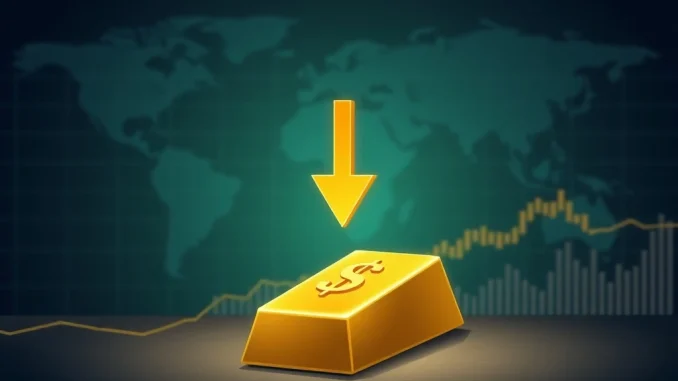
The financial world is buzzing with recent developments in the commodities sector. Notably, the **spot gold price** has registered a significant decline, falling below the critical threshold of $4,000 per ounce. This unexpected dip has sparked considerable discussion among investors and market analysts alike. Understanding the forces behind this movement is crucial for anyone with an interest in precious metals or broader market trends.
Decoding the Drop in Spot Gold Price
The recent plunge in the **spot gold price** marks a pivotal moment for the precious metals market. This price point, once considered a strong support level, has now been breached. Consequently, this development signals a shift in investor sentiment and market dynamics. Gold, often seen as a safe-haven asset, typically attracts demand during times of economic uncertainty. However, current market conditions appear to be challenging this traditional role.
Several immediate factors likely contributed to this downward pressure. For instance, a strengthening U.S. dollar often makes gold more expensive for holders of other currencies, thus reducing demand. Furthermore, rising interest rates can diminish gold’s appeal. Gold does not offer a yield, so higher returns on bonds or other interest-bearing assets make it less attractive by comparison. Therefore, investors may reallocate capital away from gold.
Key Economic Factors Influencing the Gold Market
The **gold market** is a complex ecosystem, influenced by a multitude of global **economic factors**. These factors often interact in intricate ways, creating both opportunities and challenges for investors. Understanding these drivers is essential for forecasting future price movements.
- Interest Rate Hikes: Central banks globally are raising interest rates to combat inflation. Higher rates increase the opportunity cost of holding non-yielding assets like gold.
- U.S. Dollar Strength: A stronger dollar typically exerts downward pressure on gold prices. Gold is priced in dollars, so a stronger dollar makes gold more expensive for international buyers.
- Inflation Expectations: While gold is a traditional hedge against inflation, aggressive monetary policy to curb inflation can paradoxically weaken its short-term appeal.
- Geopolitical Stability: Periods of calm can reduce the demand for safe-haven assets. Conversely, increased tensions often boost gold’s price.
Each of these elements plays a vital role in shaping the current **investment outlook** for gold. Investors must carefully weigh these considerations when making portfolio decisions.
The Broader Precious Metals Landscape
The decline in gold prices is not occurring in isolation. It reflects broader trends across the **precious metals** sector. While gold is the most prominent, other metals like silver, platinum, and palladium also experience similar pressures, albeit with their own unique market dynamics. For example, industrial demand heavily influences silver and platinum prices, in addition to their investment appeal. Therefore, a slowdown in global manufacturing can impact these metals significantly.
The interrelationship between these metals is noteworthy. Often, they move in tandem, reflecting general investor sentiment towards commodities. However, divergences can occur due to specific supply and demand factors. Platinum, for instance, has strong ties to the automotive industry. Therefore, shifts in car production or technological advancements in catalytic converters directly affect its price. Similarly, silver serves both as an industrial metal and an investment vehicle, making its price susceptible to a wider array of influences.
Historical Context and Future Projections
Gold has a rich history as a store of value and a medium of exchange. Its price movements over decades show periods of both stability and extreme volatility. For example, during the 1970s, gold prices soared amid high inflation and geopolitical instability. More recently, the financial crisis of 2008 and the COVID-19 pandemic saw gold’s value surge as investors sought safety. Thus, understanding these historical patterns provides valuable context for current events.
Looking ahead, market analysts are divided on the future trajectory of the **spot gold price**. Some believe the current dip is a temporary correction, anticipating a rebound as inflation persists or economic uncertainties resurface. Others suggest that the era of ultra-low interest rates, which greatly benefited gold, might be over. This new environment could usher in a prolonged period of consolidation or even further declines. Consequently, long-term investors are carefully re-evaluating their positions.
Impact on Global Investment Outlook
The falling **spot gold price** inevitably influences the broader **investment outlook**. Investors traditionally view gold as a diversification tool and a hedge against inflation and market volatility. When gold underperforms, it prompts a re-evaluation of portfolio strategies. Some investors might shift capital to other asset classes, such as equities, real estate, or even alternative investments like cryptocurrencies, depending on their risk appetite and market perception. For example, some argue that Bitcoin, often called ‘digital gold,’ could attract investors looking for a decentralized store of value.
Moreover, the decline impacts central bank reserves. Many nations hold significant gold reserves as a hedge against currency fluctuations and economic crises. A sustained drop in gold value could affect their balance sheets and financial stability. Therefore, governments worldwide monitor gold prices closely. Furthermore, mining companies face reduced profitability, which could lead to cuts in exploration and production. This, in turn, could affect future supply dynamics.
Strategies for Investors Amidst Gold’s Decline
In light of the recent price movements, investors are considering various strategies. Those holding gold might face difficult decisions. Some may choose to hold, believing in gold’s long-term value proposition. Others might opt to sell to cut losses or reallocate funds. New investors, however, might see the current lower prices as an attractive entry point. It is crucial to conduct thorough due diligence and consider personal financial goals before making any investment decisions.
Diversification remains a cornerstone of sound investment strategy. Spreading investments across different asset classes can mitigate risks associated with the volatility of any single asset. Furthermore, staying informed about global **economic factors** and geopolitical developments is paramount. Market sentiment can shift rapidly, often in response to breaking news or unexpected economic data. Therefore, continuous monitoring is key to navigating volatile markets successfully.
Analyzing the Gold Market Beyond Price
Beyond the immediate price, the **gold market** encompasses various facets, including supply, demand, and technological advancements. Gold supply primarily comes from mining and recycling. Any disruptions in mining operations, such as labor disputes or regulatory changes, can impact supply. Similarly, advancements in recycling technologies can increase the availability of gold without new extraction.
Demand for gold is diverse. It includes jewelry, industrial uses, central bank purchases, and investment demand. Jewelry demand, particularly from countries like India and China, remains a significant component. Industrial demand, while smaller, is critical for specific high-tech applications. Central banks’ buying or selling activity can also have a substantial impact on prices. Understanding these demand drivers provides a more complete picture of the market.
The Role of Speculation and Derivatives
Speculation plays a significant role in the short-term movements of the **spot gold price**. Traders use futures contracts, options, and other derivatives to bet on future price directions. These instruments can amplify price swings. Large speculative positions can create momentum, either upward or downward. Therefore, tracking commitment of traders reports can offer insights into market sentiment. However, these positions are often short-lived and can reverse quickly.
Moreover, the advent of exchange-traded funds (ETFs) backed by physical gold has democratized gold investment. These funds allow retail investors to gain exposure to gold without the complexities of physical storage. However, the buying and selling of these ETF shares can also influence the underlying **gold market**. Consequently, these financial instruments have become integral to modern gold trading.
Conclusion: Navigating the New Gold Reality
The fall of the **spot gold price** below $4,000 per ounce represents a notable event in financial markets. It underscores the dynamic nature of commodity prices and the pervasive influence of global **economic factors**. While gold has historically served as a resilient asset, its current performance highlights the evolving landscape for safe-haven investments. Investors must remain vigilant, adapting their strategies to prevailing market conditions. Furthermore, continuous analysis of the broader **precious metals** sector and the overall **investment outlook** will be essential for making informed decisions in this new reality.
Frequently Asked Questions (FAQs)
Q1: What does ‘spot gold price’ mean?
The spot gold price refers to the current market price at which gold can be bought or sold for immediate delivery. It reflects the price for physical gold right now, as opposed to future delivery.
Q2: Why is gold considered a safe-haven asset?
Gold is considered a safe-haven asset because it tends to retain or increase its value during times of economic uncertainty, political instability, or high inflation. Investors often flock to gold when they lose confidence in traditional financial markets or fiat currencies.
Q3: How do interest rates affect the gold market?
Rising interest rates generally have a negative impact on the gold market. Since gold does not offer interest or dividends, higher returns on interest-bearing assets like bonds make gold less attractive by comparison, leading investors to sell gold for better-yielding alternatives.
Q4: What other precious metals are influenced by similar factors?
Other precious metals like silver, platinum, and palladium are also influenced by similar economic factors, including interest rates, the strength of the U.S. dollar, and global economic stability. However, they also have unique industrial demands that can affect their prices independently.
Q5: Should I invest in gold after this price drop?
Whether to invest in gold after a price drop depends on individual investment goals, risk tolerance, and market analysis. Some investors view a dip as a buying opportunity, while others may wait for more clarity. It is always advisable to consult with a financial advisor.
Q6: What role do economic factors play in gold’s long-term investment outlook?
Economic factors, such as inflation rates, central bank policies, global GDP growth, and geopolitical events, are crucial in determining gold’s long-term investment outlook. These factors influence both the demand for gold as a safe haven and its attractiveness compared to other assets.