In the dynamic world of cryptocurrencies, understanding global economic shifts is paramount. As digital assets continue to intertwine with traditional finance, a robust global economy provides a stable backdrop. This week, all eyes are on South Korea, a nation often at the forefront of technological adoption and a significant player in the crypto space. Its recent Q2 GDP figures offer a fascinating glimpse into a resilient economy navigating complex global trade currents, providing crucial insights for investors and enthusiasts alike.
Decoding South Korea’s Q2 Economic Growth: What Drove the Surge?
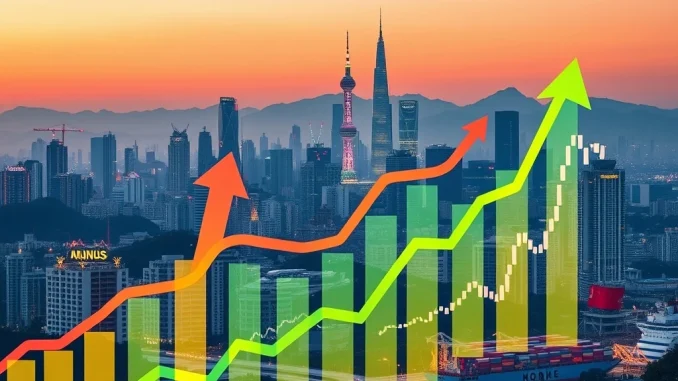
South Korea, a global economic powerhouse and the world’s fourth-largest exporter, recently announced its Q2 2025 GDP figures, revealing a 0.6% annualized growth. This crucial expansion helped the nation narrowly avoid a technical recession, following a 0.2% contraction in the first quarter. The positive outcome surpassed economists’ expectations of 0.5%, signaling a vital turnaround. This impressive turnaround in South Korea GDP was primarily fueled by a combination of strategic government spending and a significant surge in exports.
Key drivers behind this unexpected rebound include:
- Robust Government Spending: Public sector investments in infrastructure and social programs provided a much-needed short-term stimulus, effectively countering some sector-specific challenges, particularly in construction investments.
- Resilient Consumer Spending: Private consumption saw a 0.5% increase, demonstrating the resilience of domestic demand even amidst rising inflation and higher interest rates.
- Accelerated Exports: A substantial 4.2% rise in semiconductor and chemical exports played a pivotal role. This acceleration was largely driven by multinational corporations placing pre-emptive orders.
The timing of these export orders, especially ahead of a key U.S. regulatory deadline in July 2025, temporarily boosted demand for South Korean goods across various sectors, including semiconductors, automobiles, and machinery. This proactive ordering strategy was a game-changer for the quarter.
The Export Surge: A Double-Edged Sword?
While the significant export surge was undoubtedly a primary driver of Q2’s positive GDP figures, analysts caution that this rebound might be more fragile than it appears. The surge was partly a result of businesses stockpiling goods in anticipation of the U.S. regulatory deadline, rather than a reflection of sustained global demand. This phenomenon, often referred to as a ‘pull-forward’ of demand, suggests that future quarters might see a normalization or even a dip in export figures as this temporary effect fades.
This situation highlights a fundamental vulnerability in South Korea’s economic model: its heavy reliance on exports. Shifting trade dynamics, particularly with major partners like the U.S. and China, can have disproportionate impacts on the Korean economy. While the immediate boost was welcome, it underscores the need for diversification and strengthening of domestic demand to ensure long-term stability.
Navigating Korean Economy Challenges: Beyond the Headlines
Despite the positive Q2 figures, the Korean economy continues to grapple with several entrenched domestic challenges that could constrain long-term growth. High household debt remains a significant concern, potentially limiting future consumer spending and increasing financial instability. Additionally, a shrinking labor force poses a structural hurdle, impacting productivity and innovation capacity over time.
The Bank of Korea (BoK) has maintained a cautious stance, acknowledging the need for balanced policies. Their focus remains on addressing inflationary pressures while simultaneously supporting sustainable growth. Analysts suggest that further monetary easing could be on the horizon, but only if inflation stabilizes, providing the central bank with more flexibility to stimulate the economy without exacerbating price rises.
Market reactions to the Q2 growth have been notably muted. The Kospi index, South Korea’s benchmark stock market index, rose only marginally (0.1%) in early July. This indicates a degree of investor skepticism about the durability of the rebound, reflecting concerns over the temporary nature of the export boost and the underlying domestic challenges.
Future Outlook: Can South Korea Maintain its Economic Growth?
Looking ahead, projections offer a cautiously optimistic outlook for South Korea’s economic growth. IC Markets Asia projects real GDP growth averaging 0.9% in 2025, 1.1% in 2026, and 1.3% in 2027. These projections are contingent on several factors, including the easing of global trade tensions and the continued effectiveness of domestic stimulus measures. However, the path to sustained growth is not without its hurdles.
For South Korea to maintain its growth trajectory and build true resilience, a focus on structural reforms is paramount. This includes:
- Investment in Innovation: Shifting towards higher-value manufacturing and fostering innovation in cutting-edge technologies will reduce reliance on traditional export sectors and enhance global competitiveness.
- Diversifying Trade Partnerships: Exploring new markets and strengthening existing ones beyond traditional major partners can mitigate risks associated with geopolitical shifts.
- Addressing Domestic Vulnerabilities: Policies aimed at managing household debt and mitigating the impact of a shrinking labor force are crucial for long-term stability.
The Q2 recovery highlights the interplay between external trade dynamics and domestic policy interventions. While the government’s fiscal measures provided immediate relief, the true test lies in addressing inherent vulnerabilities in its export-driven model and fostering a more balanced and sustainable economic foundation.
Conclusion: A Glimmer of Hope Amidst Economic Crosscurrents
South Korea’s Q2 GDP growth is a testament to its economy’s capacity to adapt and respond to external shocks. The proactive measures by businesses to front-load orders ahead of the trade deadline, coupled with robust government and consumer spending, provided a much-needed boost. However, the underlying fragility stemming from a temporary export surge and persistent domestic challenges cannot be overlooked. For the Korean economy to transition from a temporary rebound to sustained, robust economic growth, strategic structural reforms and a continued focus on innovation will be key. This journey, while complex, holds valuable lessons for global markets and offers a fascinating case study in economic resilience in an ever-changing world.
Frequently Asked Questions (FAQs)
1. What was South Korea’s GDP growth rate in Q2 2025?
South Korea’s economy grew by 0.6% in the second quarter of 2025, successfully avoiding a technical recession after a 0.2% contraction in Q1.
2. What were the primary drivers of this Q2 economic growth?
The growth was primarily driven by robust government spending, resilient private consumption, and a significant surge in exports, particularly semiconductors and chemicals, accelerated by pre-emptive orders ahead of a U.S. trade deadline.
3. Why is the recent export surge considered potentially ‘fragile’?
The export surge is viewed as potentially fragile because it was largely influenced by businesses stockpiling goods before a U.S. regulatory deadline, rather than reflecting a sustained increase in global demand. This suggests the boost might be temporary.
4. What are the main long-term economic challenges facing South Korea?
Long-term challenges for the Korean economy include high household debt, which could constrain domestic consumption, and a shrinking labor force, impacting productivity and future growth potential.
5. What is the Bank of Korea’s current stance on monetary policy?
The Bank of Korea maintains a cautious stance, prioritizing the need for balanced policies to address inflationary pressures while also supporting economic growth. Further monetary easing is considered, but only if inflation stabilizes.
6. How do South Korea’s economic trends relate to the broader global financial landscape?
As a major global exporter and a technologically advanced nation, South Korea’s economic performance offers insights into global trade dynamics and supply chain resilience. Its ability to navigate challenges and achieve growth provides a barometer for broader financial stability, indirectly influencing investor sentiment across traditional and digital asset markets like cryptocurrency.