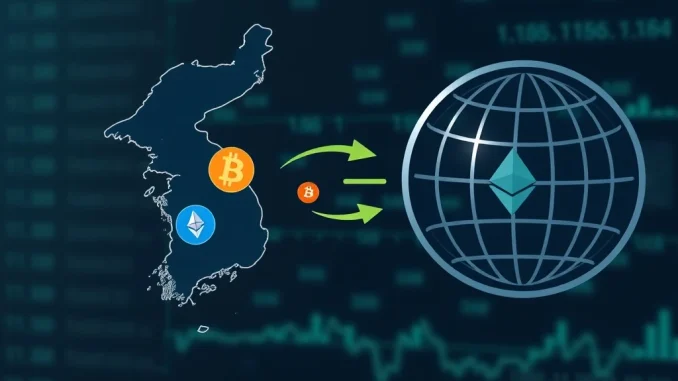
A significant financial shift is underway in the South Korean cryptocurrency market. Specifically, an **alarming** trend of substantial funds moving from domestic platforms to international ones has emerged. This **South Korea crypto outflow** has drawn considerable attention from financial analysts and regulators alike.
Massive Crypto Fund Transfers Signal Market Shift
Between January and September of this year, a staggering 124.3 trillion won, equivalent to approximately **$92.1 billion**, was transferred from South Korea’s five largest cryptocurrency exchanges. These funds migrated to various **overseas crypto platforms**, as reported by the Chosun Ilbo on October 13. This information originates from data provided by the office of Park Soo-young, a People Power Party lawmaker serving on the National Assembly’s Strategy and Finance Committee. The scale of these **crypto fund transfers** underscores a notable change in investor behavior within the nation.
The volume of this nine-month outflow is nearly on par with the entire sum transferred throughout the previous year. In 2022, the total outflow reached 125.8 trillion won, or **$93.2 billion**. Furthermore, this year’s figure represents a dramatic 2.7-fold increase compared to the 45.5 trillion won (**$33.7 billion**) recorded in 2023. This accelerating trend highlights a growing preference among Korean investors for international crypto avenues. The five prominent domestic exchanges affected by this movement include **Upbit, Bithumb**, Korbit, Coinone, and Gopax. These platforms collectively represent the core of the **Korean crypto exchanges** market.
Why the Surge in Overseas Crypto Platforms Usage?
Several factors likely contribute to the escalating **South Korea crypto outflow**. Firstly, investors may be seeking greater access to a wider variety of digital assets not available on domestic platforms. Global exchanges often list a broader range of altcoins and emerging tokens. Secondly, regulatory differences play a crucial role. South Korea maintains strict regulations, including the ‘travel rule’ and real-name account requirements. These rules, while aimed at combating money laundering, can sometimes be perceived as restrictive by some traders. Consequently, some investors might seek less stringent environments found on **overseas crypto platforms**.
Moreover, global platforms often offer more diverse trading options, such as futures, options, and leverage trading, which might not be as readily available or as competitively priced on **Korean crypto exchanges**. Competitive fees and higher liquidity on international exchanges could also attract large volume traders. Finally, the search for privacy or the desire to circumvent certain domestic tax implications might motivate some of these **crypto fund transfers**. Each of these reasons, individually or in combination, contributes to the observed shift.
Impact on Upbit, Bithumb, and Other Domestic Exchanges
The continuous and substantial **South Korea crypto outflow** poses significant challenges for domestic exchanges like **Upbit, Bithumb**, Korbit, Coinone, and Gopax. A sustained outflow of capital can lead to several negative consequences. Firstly, it reduces the trading volume on these platforms, potentially impacting their revenue streams from transaction fees. Secondly, it could diminish their market liquidity, making it harder for large trades to execute without significant price impact. This could, in turn, make domestic exchanges less attractive to both retail and institutional investors.
Furthermore, a decrease in domestic market activity might hinder innovation and growth within the local crypto ecosystem. As funds move abroad, the ability of Korean platforms to compete globally could weaken. Regulators might also view this trend with concern, as it could complicate efforts to monitor financial flows and ensure investor protection. The long-term health and competitiveness of **Korean crypto exchanges** depend on their ability to retain investor capital and attract new users.
Regulatory Responses and Future Outlook for Crypto Fund Transfers
The increasing **South Korea crypto outflow** is likely to prompt a closer look from regulators. Policymakers may explore measures to understand and potentially mitigate this trend. This could involve re-evaluating existing regulations to ensure they strike a balance between investor protection and market competitiveness. Alternatively, regulators might tighten controls on cross-border **crypto fund transfers** to gain better oversight.
For the average Korean crypto investor, this trend highlights the dynamic nature of the global crypto market. While domestic exchanges offer localized support and regulatory compliance, the allure of international platforms remains strong. The ongoing debate between strict domestic regulation and the global, borderless nature of cryptocurrency will continue to shape the future of the market in South Korea. The performance of key players like **Upbit Bithumb** will be critical indicators of the market’s direction. Understanding these movements is crucial for anyone involved in the digital asset space.
FAQs on South Korea’s Crypto Outflow
Q1: What is the main finding regarding South Korea’s crypto market?
A1: South Korea’s five major cryptocurrency exchanges saw approximately $92.1 billion (124.3 trillion won) transferred to overseas platforms between January and September of this year.
Q2: How does this year’s outflow compare to previous years?
A2: The nine-month outflow is nearly equivalent to the total $93.2 billion (125.8 trillion won) transferred throughout all of last year and is 2.7 times the $33.7 billion (45.5 trillion won) recorded in 2023.
Q3: Which South Korean exchanges are primarily affected by this trend?
A3: The five major domestic exchanges experiencing this outflow are Upbit, Bithumb, Korbit, Coinone, and Gopax.
Q4: What are some potential reasons for the increase in crypto fund transfers to overseas platforms?
A4: Possible reasons include investors seeking a wider variety of digital assets, regulatory arbitrage, competitive fees, higher liquidity on global exchanges, and the desire for more diverse trading options or perceived privacy benefits.
Q5: What are the potential implications of this outflow for the South Korean crypto market?
A5: The outflow could lead to reduced trading volume and liquidity on domestic exchanges, impact their revenue, hinder local market innovation, and prompt regulators to re-evaluate existing policies on cross-border crypto transfers.
Q6: How does this situation affect the competitiveness of Korean crypto exchanges like Upbit and Bithumb?
A6: A sustained outflow of capital challenges the ability of Korean crypto exchanges to compete with international platforms, potentially diminishing their attractiveness to investors and impacting their long-term growth and market share.