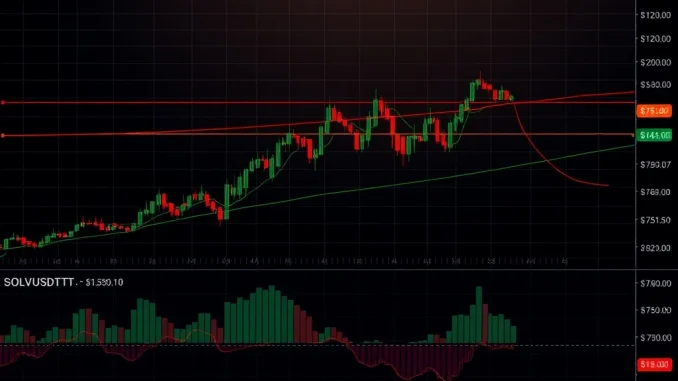
Are you keeping a close eye on the dynamic world of cryptocurrency? If so, you’ve likely noticed that while some assets surge, others settle into intriguing patterns, signaling potential future moves. Today, we’re diving deep into Solv Protocol (SOLVUSDT) to unravel its recent 24-hour performance and what its technical indicators suggest for the days ahead. Understanding these subtle shifts can be crucial for any trader looking to navigate the volatile crypto landscape.
Understanding Solv Protocol’s Recent Moves
Over the past 24 hours, Solv Protocol (SOLVUSDT) showcased a classic case of market indecision, trading within a remarkably tight range. Opening at $0.04109 on July 25, 2025, at 12:00 ET, the pair reached a high of $0.04176 before closing at $0.0414. This narrow band, specifically between $0.04112 and $0.04176, indicates a period of significant contention between buyers and sellers. Despite a total volume of 5,966,047.0 and a notional turnover of $246,644.67, the bearish close near the 24-hour low suggests sellers had the slight upper hand by the end of the period.
Key price levels were repeatedly tested, with a notable resistance at $0.04161 and support at $0.04141 proving resilient. No clear breakouts occurred, painting a picture of a market gathering its breath before a potentially significant move. Volume activity was concentrated in the afternoon and early evening, but this wasn’t consistently matched by notional turnover, hinting at weak conviction behind some of these price probes.
Deep Dive into SOLVUSDT Analysis: What Do the Charts Reveal?
To truly understand the current state of SOLVUSDT analysis, we need to zoom into the finer details of its price action. The 15-minute chart provides a clear visual of a range-bound structure, with prices oscillating between the aforementioned support at $0.04141 and resistance at $0.04161. This pattern is often a precursor to either a strong continuation or a reversal, making it a critical zone for traders to monitor.
Early in the 24-hour cycle, a bearish engulfing pattern emerged near the $0.04161 resistance. This candlestick formation typically signals a potential reversal from an uptrend. Following this, a doji candlestick appeared near $0.04156, indicating market indecision and a balance between buying and selling pressures. These formations collectively suggest that the price is consolidating, building energy for a future breakout or breakdown. For traders, recognizing these patterns in SOLVUSDT analysis is key to anticipating future movements.
What Do Crypto Technical Indicators Tell Us About SOLVUSDT?
Beyond raw price action, crypto technical indicators offer invaluable insights into market momentum, volatility, and potential future direction. Let’s break down what these tools are signaling for Solv Protocol:
- Moving Averages: On the 15-minute chart, the 20-period and 50-period moving averages are closely intertwined, a classic sign of a lack of clear trend. The 50-period line positioned slightly above the 20-period line suggests a mild bearish bias in the short term. Looking at the daily chart, the convergence of the 50, 100, and 200-period lines further reinforces a neutral to bearish outlook for SOLVUSDT.
- MACD & RSI: The Moving Average Convergence Divergence (MACD) line turned negative in the early hours, confirming a waning of bullish momentum. The Relative Strength Index (RSI) largely hovered between 50 and 60, with brief ventures into overbought territory. This sustained neutrality, despite minor excursions, points to a market lacking strong conviction in either direction, potentially gearing up for a correction.
- Bollinger Bands: Volatility saw a brief expansion during the early hours, pushing the price to the upper band at $0.04176. However, it quickly contracted back towards the middle band. With the current price of $0.0414 sitting near the lower band, this setup suggests that SOLVUSDT could be due for either a bounce back towards the mean or a further breakdown, depending on the next significant market impulse. These crypto technical indicators collectively paint a picture of a market in suspense.
Is Market Consolidation the Main Theme for Solv Protocol?
The evidence strongly suggests that market consolidation is the dominant theme for Solv Protocol (SOLVUSDT) right now. The tight trading range, coupled with indecisive candlestick patterns like the doji, points to a battle for control where neither bulls nor bears have managed to secure a decisive victory.
A crucial observation is the divergence between volume and turnover. While volume spiked in the afternoon and early evening (particularly between 15:00 and 19:00 ET) coinciding with a failed attempt to break above $0.04161, the notional turnover did not follow suit. This divergence is a red flag, indicating that the buying pressure during these spikes lacked strong conviction. Such discrepancies often hint at potential exhaustion in the prevailing trend, further supporting the narrative of market consolidation.
Applying Fibonacci retracements to the recent 15-minute swing from $0.04112 to $0.04176, we find the 38.2% retrace level at $0.04146 and the 61.8% level at $0.04130. The current price hovering near the 61.8% level suggests this zone could act as a crucial support in the immediate 24 hours, reinforcing the idea of a temporary equilibrium.
Crafting Your SOLVUSDT Trading Strategy: What’s Next?
Given the current state of market consolidation, what should your trading strategy be for SOLVUSDT? The key lies in observing the breakout from the established $0.04141–$0.04161 range. Here are some actionable insights:
- Bullish Scenario: A sustained break and close above the $0.04161 resistance level could signal a rekindling of bullish momentum. This would be a crucial indicator for traders looking for an upward move.
- Bearish Scenario: Conversely, a decisive close below the $0.04141 support level may indicate a deeper correction is on the cards. This would suggest that sellers have gained control and could push prices lower.
- Caution with Divergences: Always remain cautious of divergences between price and volume/turnover. As observed, spikes in volume not matched by turnover suggest weak conviction, which can lead to false breakouts. Your trading strategy should account for this nuance.
- Patience is Key: In a period of market consolidation, patience is paramount. Waiting for a clear, confirmed breakout or breakdown from the established range will significantly reduce risk and improve the probability of successful trades.
Ultimately, Solv Protocol (SOLVUSDT) is at a pivotal point, consolidating before a potential significant move. While the short-term indicators lean slightly bearish or neutral, the market is poised for a directional shift. Keeping a close watch on the key support and resistance levels, alongside volume confirmation, will be essential for navigating the next phase of this crypto asset’s journey. Stay informed, stay cautious, and let the market reveal its next move before committing to a position.
Frequently Asked Questions (FAQs) About Solv Protocol (SOLVUSDT) Technical Analysis
Q1: What does the tight trading range for SOLVUSDT signify?
A tight trading range, as observed for SOLVUSDT between $0.04112 and $0.04176, signifies a period of market indecision and consolidation. It indicates that neither buyers nor sellers are currently strong enough to push the price decisively in one direction, often preceding a significant breakout or breakdown.
Q2: How do moving averages indicate a mild bearish momentum for SOLVUSDT?
On the 15-minute chart, the 50-period moving average being slightly above the 20-period moving average, despite their close alignment, suggests a mild bearish bias. On the daily chart, the convergence of the 50, 100, and 200-period lines further supports a neutral to slightly bearish outlook, indicating a lack of strong upward trend.
Q3: What is the significance of the divergence between volume and notional turnover?
A divergence where volume spikes are not matched by corresponding increases in notional turnover suggests weak conviction behind the price moves. This means that while many trades might be occurring, the total value of those trades isn’t significant enough to indicate strong buying or selling pressure, often hinting at potential exhaustion of the current trend or a lack of institutional interest.
Q4: How can Fibonacci retracement levels help in SOLVUSDT analysis?
Fibonacci retracement levels help identify potential support and resistance zones based on previous price swings. For SOLVUSDT, the 61.8% retrace level at $0.04130 acts as a potential support zone. If the price holds above this level, it suggests a possible bounce; a break below could signal further downside.
Q5: What are the key price levels to watch for a SOLVUSDT breakout or breakdown?
Traders should closely monitor the resistance at $0.04161 and support at $0.04141. A sustained break above $0.04161 could signal renewed bullish momentum, while a close below $0.04141 may indicate a deeper correction is underway. These levels are critical for formulating a future trading strategy.