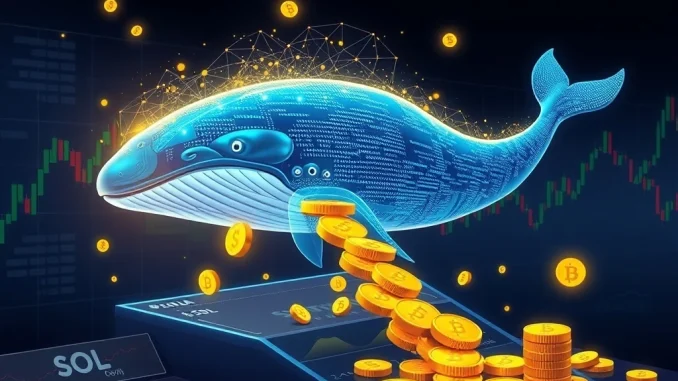
A significant event recently caught the attention of the cryptocurrency community. An anonymous Solana whale executed a substantial transaction. This entity deposited 113,207 SOL tokens, valued at approximately $23.65 million, to a centralized exchange. This move often signals potential selling activity. Therefore, it warrants close observation from market participants.
Massive Solana Deposit Raises Eyebrows
Blockchain analytics firm Lookonchain first reported this notable exchange deposit. The whale’s address, beginning with HsYrgw, transferred the large sum just hours ago. Such large-scale transfers by a single entity, often termed a ‘crypto whale,’ invariably draw significant scrutiny. Many analysts interpret these deposits as a precursor to liquidating assets. This action could introduce selling pressure into the market. Consequently, it often impacts the asset’s price dynamics.
Furthermore, Lookonchain’s analysis highlighted an interesting detail. The whale would incur a loss of around $1.81 million if these SOL tokens were sold at current prices. This suggests the whale’s average acquisition cost was higher than the current market valuation. This scenario adds another layer of complexity to the potential motivations behind the deposit. Investors often wonder why a whale would realize such a loss.
Understanding Crypto Whale Behavior and Market Impact
Crypto whales are individuals or entities holding vast amounts of a particular cryptocurrency. Their actions can significantly influence market sentiment and price. When a whale moves a large sum of assets to an exchange, it typically indicates one of a few possibilities:
- Intention to Sell: The most common interpretation. Whales deposit funds to exchanges to sell them for fiat currency or other cryptocurrencies.
- Market Rebalancing: A whale might be shifting their portfolio, perhaps moving from one asset to another.
- Providing Liquidity: Less common for such large, direct deposits, but possible in some scenarios.
The sheer volume of this particular Solana transaction makes it especially impactful. A sale of 113,207 SOL could absorb considerable liquidity from the market. This could potentially drive down the price of Solana. Therefore, traders are closely monitoring the situation for any subsequent moves.
The $1.81 Million Loss: A Strategic Move?
The potential $1.81 million loss presents a curious aspect of this crypto whale activity. Typically, large investors aim to maximize profits. Realizing a loss suggests several possible strategies:
- Tax-Loss Harvesting: Selling assets at a loss to offset capital gains for tax purposes.
- Urgent Liquidation: The whale might need immediate liquidity for other ventures or obligations.
- Belief in Further Decline: The whale might anticipate a more significant price drop for SOL. They might be cutting losses now to avoid larger future losses.
This decision, however, carries significant weight. It could signal a lack of confidence in Solana‘s short-term price trajectory from this specific large holder. Conversely, it might simply be a calculated financial maneuver unrelated to Solana’s fundamental value. The crypto market often sees such strategic plays by large investors.
Broader Market Implications for SOL
This substantial exchange deposit could have various repercussions for the broader Solana ecosystem. Solana has emerged as a prominent blockchain. It is known for its high transaction throughput and low fees. The network supports a rapidly growing ecosystem of decentralized applications (dApps), NFTs, and DeFi protocols. Its native token, SOL, plays a crucial role in network governance and transaction fees.
Large sales can sometimes trigger panic among smaller investors. This often leads to cascading sell-offs. Therefore, the market will be keenly watching for any confirmation of a sale. The overall market impact depends heavily on the whale’s next actions. If the tokens are indeed sold, the immediate price reaction could be negative. However, if the tokens remain on the exchange or are moved elsewhere without selling, the impact might be minimal.
In conclusion, the anonymous whale’s deposit of $23.7 million in SOL to an exchange is a significant development. It underscores the influence of large holders in the volatile cryptocurrency market. While the immediate interpretation points towards a potential sale and a realized loss, the ultimate motivations remain speculative. Market participants will continue to monitor the whale’s address and exchange movements closely. This will help understand the full market impact of this crucial transaction.
Frequently Asked Questions (FAQs)
What is a crypto whale?
A crypto whale is an individual or entity that holds a very large amount of a particular cryptocurrency. Their transactions are often significant enough to impact market prices and sentiment.
Why are large deposits to exchanges considered bearish?
Large deposits to exchanges are typically seen as bearish because they often precede a sale. When a whale moves a significant amount of cryptocurrency to an exchange, it suggests an intention to convert those assets into fiat currency or other cryptocurrencies, thereby increasing selling pressure.
What is Solana (SOL)?
Solana (SOL) is a high-performance blockchain platform. It is designed for decentralized applications (dApps) and crypto projects. It is known for its fast transaction speeds and low costs. SOL is its native cryptocurrency, used for transaction fees and staking.
Could this Solana whale deposit be for reasons other than selling?
While selling is the most common interpretation, other reasons exist. The whale might be rebalancing their portfolio, preparing for an over-the-counter (OTC) trade, or even using the funds for a specific financial product offered by the exchange. However, a direct deposit usually points to liquidation intentions.
How does a $1.81 million loss factor into this whale’s decision?
A whale realizing a loss suggests several strategic possibilities. These include tax-loss harvesting, urgent need for liquidity, or a belief that the asset’s price will drop further. Such a decision is rarely made without careful consideration by a large investor.