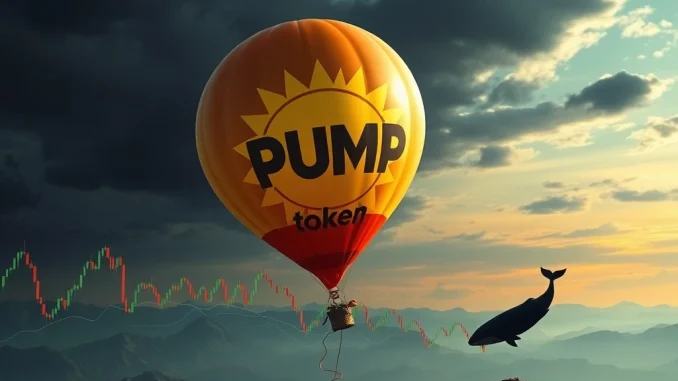
The world of cryptocurrency is a rollercoaster, and nowhere is this more apparent than in the fast-paced realm of meme coins. A recent event involving Pump.fun’s PUMP token has sent ripples across the market, highlighting the extreme Solana meme coin volatility that continues to challenge investors and developers alike. What was intended as a stabilizing move—a substantial token buyback—instead turned into a stark lesson in market dynamics, with millions of dollars vanishing in days.
What Went Wrong with Pump.fun’s Token Buyback?
Between July 12 and 16, 2025, Pump.fun initiated a massive token buyback, investing 120,450 SOL, which was valued at $19.5 million at the time, to repurchase 3.07 billion PUMP tokens. The goal? To reduce circulating supply and theoretically boost the token’s price through deflationary measures. However, the outcome was far from the desired effect. Within days, the acquired assets plummeted in value, depreciating to a mere $8.2 million. This sharp decline underscores the precarious liquidity dynamics often seen in retail-driven crypto assets.
This treasury operation, rather than providing a stable foundation, instead amplified the challenges of maintaining value in an ecosystem dominated by speculative behavior. As Aggregate Institutional Research pointed out, meme coin treasuries can be leveraged as ‘weaponized tools,’ but their effectiveness in providing price support remains highly uncertain when faced with rapid shifts in retail sentiment.
Why Are Meme Coins So Volatile? Unpacking Crypto Volatility
The incident with the PUMP token serves as a potent reminder of the inherent crypto volatility in the meme coin sector. Unlike traditional assets, meme coins often lack fundamental utility or a robust development roadmap. Their value is primarily driven by community sentiment, social media trends, and speculative trading. This makes them susceptible to rapid price swings, often independent of broader market conditions.
- Sentiment-Driven: Prices are heavily influenced by hype, social media trends, and community excitement rather than underlying technology or adoption.
- Low Liquidity: Many meme coins have shallow liquidity pools, meaning large buy or sell orders can drastically impact prices.
- Concentrated Ownership: A significant portion of tokens can often be held by a few ‘whales,’ making them vulnerable to manipulation.
- Lack of Fundamentals: Without strong use cases, their long-term viability is questionable, making them purely speculative investments.
How Do Whales Impact Solana Meme Coin Prices?
The Pump.fun buyback revealed a concerning concentration of influence. A single whale wallet (3vkpy5YHqnqJTnA5doWTpcgKyZiYsaXYzYM9wm8s3WTiG8CcfRffqZWHSAQJXLDfwbAkGE95SddUqVXnTrL4kqjm) played a pivotal role in driving price fluctuations. Analysts described this as a ‘price cycling’ effect, where large holders temporarily inflate prices before liquidating their positions, exacerbating market instability. This phenomenon is particularly prevalent in the Solana meme coin space, where new tokens can gain immense traction quickly.
Coincu research highlighted that while treasury buybacks can theoretically reduce circulating supply, their execution in retail-centric markets often amplifies volatility by centralizing control and signaling speculative intent. When a major player, or even the project’s treasury itself, becomes a dominant market participant, it can inadvertently trigger these whale-driven price cycles, where liquidity is manipulated to prioritize short-term gains over long-term stability.
What Does the PUMP Token Incident Mean for the Solana Ecosystem?
Despite the turbulence observed with tokens like PUMP, the broader Solana ecosystem remains robust. SOL itself continues to show active participation, trading at $188.80 with a market capitalization exceeding $101 billion. The network’s resilience contrasts sharply with the challenges faced by its niche meme token segments. A 5.33% 24-hour price swing and a 31.17% 30-day gain for SOL reflect a healthy, active blockchain, yet these metrics also underscore the risks inherent in segments where liquidity is vulnerable to sudden shifts.
The post-buyback depreciation of the PUMP token has raised critical questions about the sustainability of treasury-driven strategies in meme coin projects. While Solana’s market dominance, currently at 2.62%, suggests that meme coins will remain a significant component of its blockchain landscape, institutional observers caution that buybacks alone do not inherently stabilize prices in environments where sentiment and liquidity are dictated by retail participation. The Pump.fun case serves as a cautionary example for investors and developers, illustrating the need for prudent treasury management and transparent communication to mitigate systemic risks.
Strategic considerations for Solana-based meme coins now hinge on balancing deflationary tokenomics with sustainable liquidity provisions. While platforms like Pump.fun aim to innovate through treasury interventions, the PUMP token’s experience underscores the fragility of price stability in markets where speculative cycles and whale activity dominate. Investors and project teams must navigate these dynamics with caution, prioritizing long-term resilience over short-term gains in an environment where volatility is both a feature and a liability.
Frequently Asked Questions (FAQs)
Q1: What was the purpose of Pump.fun’s PUMP token buyback?
The Pump.fun buyback aimed to reduce the circulating supply of PUMP tokens by repurchasing them with SOL, thereby attempting to stabilize and potentially increase the token’s price through deflationary measures.
Q2: Why did the PUMP token’s value depreciate after the buyback?
Despite the buyback, the PUMP token’s value depreciated due to factors like precarious liquidity dynamics, dominant speculative behavior, and the influence of large ‘whale’ wallets that can trigger ‘price cycling’ effects, leading to rapid sell-offs after temporary price inflations.
Q3: How do ‘whales’ affect meme coin markets on Solana?
Whales, or large token holders, can significantly impact Solana meme coin markets by executing large trades that temporarily inflate prices (known as ‘price cycling’) before liquidating their positions. This exacerbates market instability and makes prices dependent on the actions of a few influential actors rather than fundamental economic principles.
Q4: Does the PUMP token incident indicate issues with the broader Solana ecosystem?
While the PUMP token incident highlights extreme volatility within the meme coin segment, the broader Solana network itself remains robust, with strong market capitalization and active participation. The incident primarily underscores the risks inherent in niche, retail-driven segments within the ecosystem, rather than a systemic issue with Solana’s core blockchain.
Q5: What lessons can investors and developers learn from this event?
Investors should exercise extreme caution when dealing with meme coins, understanding their inherent volatility and susceptibility to manipulation. Developers and project teams should prioritize prudent treasury management, ensure transparent communication, and focus on sustainable liquidity provisions to build long-term resilience rather than relying solely on short-term deflationary tactics like buybacks.