The regulatory landscape for digital assets often appears complex and uncertain. However, a recent statement from a key figure offers some much-needed clarity. SEC Commissioner Atkins has once again emphasized a crucial distinction in the world of cryptocurrencies. This perspective is vital for both innovators and investors in the rapidly evolving crypto market. It helps delineate which digital assets fall under strict securities laws and which do not.
SEC Commissioner Atkins Provides Definitive Guidance on Crypto Assets
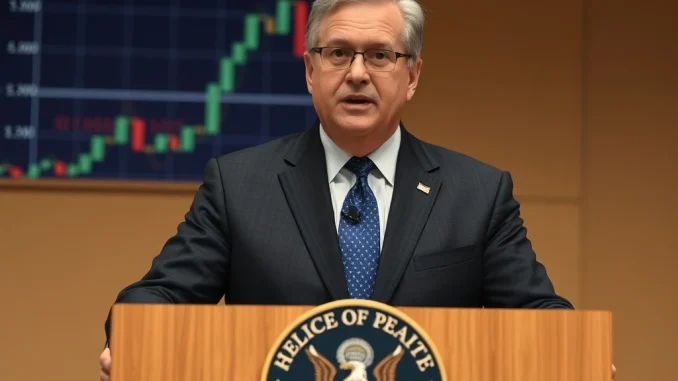
U.S. SEC Commissioner Paul Atkins recently reiterated a significant point: most cryptocurrencies, including popular network tokens and even memecoins, should not be classified as securities. This statement provides a clearer understanding of the Securities and Exchange Commission’s (SEC) stance. Atkins underscored that a token qualifies as a security only if it involves an expectation of profit. This profit must stem from the managerial efforts of a third party. Crucially, such a promise needs to be explicit and unambiguous for the classification to apply.
This perspective aligns with long-standing principles derived from the Howey Test. The Howey Test is a legal framework used to determine if a transaction qualifies as an “investment contract.” Consequently, an investment contract falls under U.S. securities law. Commissioner Atkins’ remarks bring specific attention to the nuanced nature of digital assets. Many tokens function primarily as utility tokens within a network. Others operate as decentralized currencies without a central management team driving their value. Therefore, distinguishing these from traditional securities is paramount for appropriate cryptocurrency regulation.
Understanding the “Investment Contract” Test for Tokens as Securities
The core of determining whether a token is a security lies in the “investment contract” test. This test, established by the Supreme Court in the 1946 case *SEC v. W.J. Howey Co.*, outlines four key criteria:
- An investment of money.
- In a common enterprise.
- With an expectation of profit.
- Derived solely from the efforts of others.
Commissioner Atkins specifically highlighted the last point. He stressed that the expectation of profit must come from the managerial efforts of a third party. Moreover, this promise must be explicit and unambiguous. For instance, a decentralized network token that allows participation in governance, without a central entity promising returns, might not meet this criterion. Conversely, an initial coin offering (ICO) where a development team promises future profits based on their work would likely be considered a security. Understanding this distinction is fundamental for developers and investors alike when evaluating tokens as securities.
Many digital assets exist primarily as a medium of exchange. Others facilitate access to a specific network or service. These types of tokens often lack the centralized managerial effort that defines a security. Hence, their regulatory treatment should differ. The SEC’s approach, as articulated by Atkins, seeks to apply existing laws judiciously to new technologies. This prevents stifling innovation while still protecting investors from fraudulent schemes.
Navigating SEC Crypto Jurisdiction: Where the Lines Are Drawn
Despite the clarifications, Commissioner Atkins made it clear: token securities *do* fall under the SEC’s regulatory jurisdiction. This distinction is crucial. It means that while many cryptocurrencies may not be securities, those that *are* must adhere to the rigorous disclosure and registration requirements of federal securities laws. The SEC’s role is to ensure investor protection and market integrity for all assets under its purview. Therefore, projects issuing token securities must comply with these regulations. This ensures transparency and fairness for all participants.
The SEC’s authority over crypto assets that meet the security definition remains undisputed. This includes oversight of offerings, trading, and intermediaries dealing with such assets. Furthermore, the agency actively pursues enforcement actions against those who violate these laws. This dual approach aims to provide both clarity and accountability. It distinguishes between genuine utility and speculative investments managed by a central team. The ongoing dialogue around SEC crypto oversight highlights the complexities of fitting novel digital assets into existing legal frameworks.
The Push for a Comprehensive Market Structure Bill
Looking ahead, Commissioner Atkins also confirmed the SEC’s commitment to working with the U.S. Congress. Their goal is to enact a comprehensive market structure bill for cryptocurrencies in the near future. This legislative effort is widely anticipated by the industry. Currently, the lack of a clear, unified framework creates regulatory uncertainty. Different agencies sometimes have overlapping or unclear jurisdictions. A dedicated bill could provide much-needed legal certainty. It would clarify roles for various regulatory bodies, including the SEC and the Commodity Futures Trading Commission (CFTC).
Such a bill would aim to establish a tailored regulatory regime for digital assets. It would consider their unique characteristics. For instance, it might differentiate between digital commodities, digital securities, and stablecoins. A well-crafted market structure bill could foster innovation. It would also enhance investor protection and promote financial stability within the digital asset ecosystem. This collaborative approach between the SEC and Congress signifies a maturing understanding of the crypto space. Ultimately, it aims to create a robust and predictable environment for all stakeholders.
Implications for the Cryptocurrency Ecosystem
Commissioner Atkins’ remarks offer significant implications for the broader cryptocurrency ecosystem. Firstly, they provide a degree of reassurance to projects that are genuinely decentralized. These projects can operate with less fear of being inadvertently classified as securities. Secondly, they reinforce the SEC’s commitment to regulating legitimate token securities. This protects investors from potentially fraudulent or non-compliant offerings. The clarity helps market participants understand their obligations and risks.
Moreover, the emphasis on a forthcoming market structure bill signals a proactive move towards a more harmonized regulatory environment. This could unlock further institutional adoption and innovation within the U.S. crypto sector. As the industry continues to grow, clear rules are essential for its sustainable development. The ongoing dialogue and legislative efforts demonstrate a commitment to integrating digital assets into the broader financial system responsibly. This evolving landscape requires continuous adaptation from both regulators and market participants.
In conclusion, SEC Commissioner Paul Atkins’ recent statements are pivotal. They offer vital distinctions regarding the classification of cryptocurrencies. His emphasis on the explicit nature of profit expectation from third-party efforts clarifies what constitutes a security. Furthermore, his confirmation of the SEC’s intent to collaborate on a market structure bill underscores a proactive approach. This aims to bring comprehensive and tailored regulation to the digital asset space. These developments are crucial for shaping the future of cryptocurrency regulation in the United States.
Frequently Asked Questions (FAQs)
Q1: What did SEC Commissioner Paul Atkins state regarding cryptocurrencies?
A1: SEC Commissioner Paul Atkins reiterated that most cryptocurrencies, including network tokens and memecoins, should not be classified as securities. He emphasized that a token is only a security if there’s an explicit and unambiguous expectation of profit from the managerial efforts of a third party.
Q2: What is the primary criterion for a token to be considered a security by the SEC?
A2: The primary criterion is the expectation of profit derived from the managerial efforts of a third party. This expectation must be explicit and unambiguous, aligning with the principles of the Howey Test.
Q3: Does the SEC have jurisdiction over all crypto assets?
A3: No, the SEC does not claim jurisdiction over all crypto assets. Commissioner Atkins clarified that the SEC’s regulatory jurisdiction applies specifically to *token securities*. Cryptocurrencies that do not meet the definition of a security are typically outside the SEC’s direct purview as securities.
Q4: What is a “market structure bill” for cryptocurrencies?
A4: A market structure bill for cryptocurrencies is proposed legislation designed to create a comprehensive and clear regulatory framework for digital assets in the U.S. It aims to clarify jurisdictional lines between agencies like the SEC and CFTC, provide tailored rules for different types of crypto assets, and foster innovation while protecting investors.
Q5: How will a market structure bill impact the crypto industry?
A5: A market structure bill is expected to bring greater regulatory certainty and predictability to the crypto industry. This could encourage innovation, facilitate institutional adoption, enhance investor protection, and establish clearer operational guidelines for businesses dealing with digital assets.