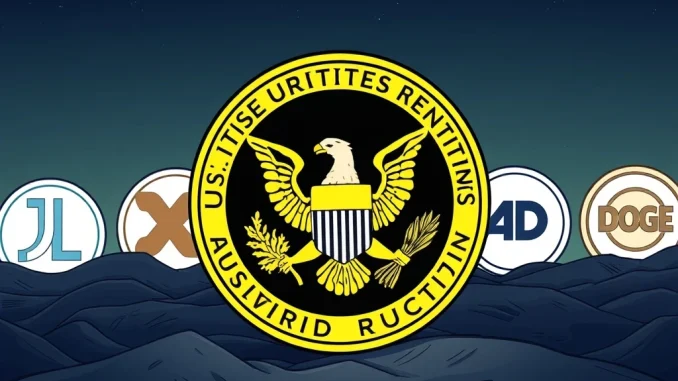
The landscape for cryptocurrency investment products recently saw a significant development. The U.S. Securities and Exchange Commission (SEC) has reportedly requested that issuers proposing ETFs for various altcoins withdraw their 19b-4 filings. This surprising move affects prominent digital assets such as Litecoin (LTC), Ripple (XRP), Solana (SOL), Cardano (ADA), and Dogecoin (DOGE).
According to Eleanor Terrett, a host of Crypto in America, these withdrawals could commence as early as this week. This directive marks a pivotal moment for firms seeking to launch exchange-traded funds based on these cryptocurrencies. It signals a shift in the regulatory approach towards digital asset ETFs, moving away from previous individual approval processes.
Understanding the Significance of 19b-4 Filings
The SEC’s request for withdrawal directly impacts the process of bringing crypto ETFs to market. To clarify, a 19b-4 filing is a formal proposal submitted to the SEC by an exchange. This filing seeks a rule change allowing the listing and trading of a new financial product, such as an ETF. For any new ETF, especially those involving novel assets like cryptocurrencies, this filing is an essential regulatory step.
Historically, each cryptocurrency ETF required its own separate approval. This process often involved extensive back-and-forth communication with the SEC. Issuers meticulously crafted these filings, outlining market surveillance, custody arrangements, and investor protection measures. Therefore, a request to withdraw these filings indicates a fundamental change in the regulatory strategy. It suggests that the existing proposals are no longer suitable under an evolving framework. The withdrawal of these 19b-4 filings is not merely a procedural formality; it represents a re-evaluation of how such products gain market access.
A New Comprehensive Listing Framework for Crypto ETF Approval
The SEC’s directive is reportedly linked to a new comprehensive listing framework. This framework aims to streamline the approval process for certain types of ETFs. Previously, each cryptocurrency ETF application faced individual scrutiny. This often resulted in prolonged delays and numerous rejections, particularly for spot crypto products. However, the new system promises a different approach.
Under this evolving framework, ETFs meeting specific criteria might gain listing approval without needing separate, individual SEC reviews. This could significantly accelerate the introduction of compliant digital asset products. Consequently, the current batch of 19b-4 filings for altcoin ETFs has become obsolete. The SEC believes these existing applications do not align with the requirements or spirit of the new, broader listing guidelines. This development suggests the SEC is seeking a more standardized and perhaps more efficient pathway for future Crypto ETF approval, aiming for consistency across the board.
Impact on Leading SEC Altcoin ETFs
The immediate consequence of this request is a pause, if not a complete reset, for several proposed SEC altcoin ETFs. Prominent cryptocurrencies like LTC, XRP, SOL, ADA, and DOGE are directly affected. These digital assets represent a significant portion of the altcoin market. Their respective issuers had invested considerable resources into preparing and submitting their ETF applications. The withdrawal request forces these issuers to reconsider their strategies.
For investors, this news might initially appear as a setback. However, it could also pave the way for a more robust and predictable regulatory environment. Instead of a piecemeal approach, the SEC appears to be moving towards a holistic strategy for approving these products. This could ultimately benefit the market by providing clearer guidelines. The long-term implications for these specific SEC altcoin ETFs remain to be seen, but a new application process will likely emerge.
Navigating the Digital Asset ETFs Landscape
This regulatory action extends beyond individual altcoins; it reshapes the broader landscape for Digital asset ETFs. The SEC’s consistent emphasis on investor protection and market integrity drives these decisions. By implementing a new comprehensive framework, the commission aims to ensure that all listed crypto-related products adhere to stringent standards. This move underscores the SEC’s commitment to regulating the nascent but rapidly growing digital asset space.
The development highlights the ongoing maturation of the cryptocurrency market. As institutional interest grows, so does the demand for regulated investment vehicles. The SEC’s actions, while sometimes perceived as cautious, ultimately seek to establish a stable foundation for these products. This will likely lead to greater clarity for issuers and enhanced confidence for investors looking to gain exposure to various Digital asset ETFs. The market awaits further details on the specifics of this new framework.
Historical Precedent and Evolving SEC Cryptocurrency Stance
The SEC’s history with cryptocurrency products is well-documented. For years, the commission expressed concerns regarding market manipulation, custody, and investor protection. These concerns often led to the rejection of numerous Bitcoin spot ETF applications. However, the eventual approval of Bitcoin spot ETFs marked a significant turning point. This demonstrated the SEC’s evolving understanding and willingness to adapt to market innovations.
This latest request for altcoin ETF withdrawals follows a similar pattern of cautious progression. It suggests the SEC is not simply rejecting these products outright. Instead, it appears to be guiding the industry towards a more structured and standardized approach. The commission seeks to establish a consistent regulatory pathway for all crypto-based investment products. This careful approach reflects the complex challenges associated with regulating novel assets. The evolution of the SEC cryptocurrency stance continues to shape the future of digital finance.
Industry Reactions and Future Prospects
The cryptocurrency industry is closely monitoring these developments. Issuers affected by the withdrawal request will likely engage with the SEC to understand the new framework’s specifics. This collaborative effort could help shape the future of altcoin ETFs. Furthermore, the market will keenly observe the criteria outlined in the new comprehensive listing framework. These criteria will dictate the path forward for subsequent applications.
Many experts believe this move, while disruptive in the short term, could ultimately lead to a more streamlined and efficient approval process. A clearer regulatory roadmap would reduce uncertainty for issuers and investors alike. The focus now shifts to how quickly the industry can adapt to these new guidelines. The prospect of compliant and regulated altcoin ETFs remains a strong possibility under the new system.
Expert Insights on Market Dynamics
Industry analysts generally view this development as a consolidation of regulatory power. It demonstrates the SEC’s desire to control the narrative around crypto investment products. “This isn’t a rejection of altcoins themselves,” stated one hypothetical market analyst. “It’s a refinement of the regulatory pipeline. The SEC wants to ensure uniformity and robust investor safeguards across all digital asset classes.”
Another expert suggested, “The new framework could lead to a more mature market. It could attract more traditional financial institutions once the rules are crystal clear.” This shift could enhance market stability and reduce volatility associated with regulatory ambiguities. Ultimately, the long-term impact on market dynamics depends on the transparency and fairness of the new guidelines. The crypto community awaits further clarification.
The SEC’s request for altcoin ETF issuers to withdraw their 19b-4 filings represents a significant moment. It signals a shift towards a new, comprehensive listing framework for digital asset ETFs. While the immediate action may cause uncertainty, it underscores the SEC’s commitment to a structured regulatory environment. This development could pave the way for a more standardized and efficient approval process for future crypto-based investment products. The market will undoubtedly watch closely for further details on this evolving regulatory landscape.
Frequently Asked Questions (FAQs)
Q1: What are 19b-4 filings in the context of ETFs?
A 19b-4 filing is a proposal submitted by a stock exchange to the SEC. It requests a rule change to allow the listing and trading of a new financial product, such as an Exchange Traded Fund (ETF). For crypto ETFs, this filing is crucial for obtaining regulatory approval to offer the product to the public.
Q2: Why did the SEC ask altcoin ETF issuers to withdraw their 19b-4 filings?
The SEC reportedly asked for withdrawals due to a new comprehensive listing framework. This new system aims to standardize the approval process. Existing filings were deemed obsolete or not compliant with the criteria of this upcoming framework.
Q3: Which altcoins are specifically affected by this request?
The request specifically targets proposed ETFs for Litecoin (LTC), Ripple (XRP), Solana (SOL), Cardano (ADA), and Dogecoin (DOGE). Issuers for these particular digital assets received the withdrawal directive.
Q4: Does this mean altcoin ETFs will never be approved?
No, not necessarily. The withdrawal request does not signify a permanent ban. Instead, it indicates a shift in the regulatory process. Issuers will likely need to re-file their applications under the new comprehensive listing framework once its details become clear. This could lead to a more streamlined approval path in the future.
Q5: How does this new framework differ from the previous process?
The previous process required individual SEC approval for each cryptocurrency ETF. The new framework aims to allow ETFs meeting certain predefined criteria to be listed without needing separate, individual approvals. This change intends to create a more efficient and standardized pathway for digital asset ETFs.