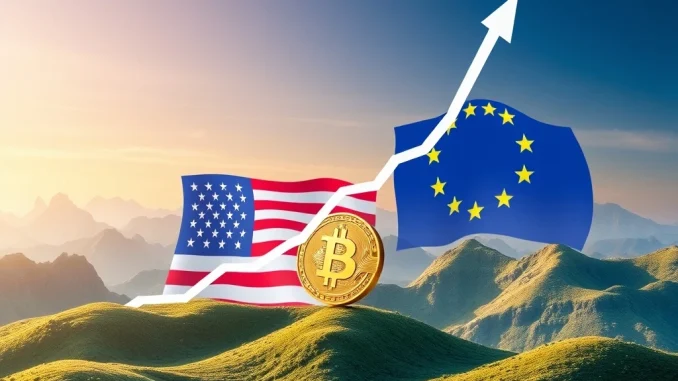
The financial world is buzzing! In a monumental turn of events, the S&P 500 has not just reached, but decisively surged past, the 6,400 mark for the very first time in history. This breathtaking ascent wasn’t just a ripple; it was a wave, carrying with it a broad market rally that reverberated across asset classes, including a remarkable Bitcoin price surge. What triggered this cascade of optimism? A groundbreaking agreement between the United States and the European Union to significantly reduce tariffs on EU goods.
The Landmark US-EU Tariff Deal: A Game Changer?
The core of this market euphoria lies in the freshly minted US-EU Tariff Deal. Confirmed by U.S. President Donald Trump on July 24, 2025, this agreement slashes the previously threatened 30% tariff on EU goods down to a more palatable 15%. This wasn’t merely a reduction; it was a resolution to a long-standing point of contention that had cast a shadow of uncertainty over transatlantic trade. The deal included reciprocal tariff cuts, signaling a mutual commitment to fostering smoother trade relations, and an impressive $600 billion in new EU investments earmarked for the U.S. economy.
For months, businesses and investors alike had braced for the potential fallout of escalating trade protectionism. Supply chains, particularly in the technology and manufacturing sectors, faced significant disruption risks. This agreement, however, provided a much-needed sigh of relief, offering a clearer, more predictable path forward for international commerce. Analysts have been quick to highlight how this deal addresses these uncertainties, paving the way for renewed confidence and investment across borders.
S&P 500’s Unprecedented Ascent: Riding the Wave of Optimism
The immediate reaction to the tariff news was nothing short of spectacular. The S&P 500 futures climbed 0.3%, while Nasdaq 100 futures saw a 0.4% rise, signaling the market’s instant approval. By July 27, the S&P 500 closed at an impressive 6,388.64, marking its 14th record finish for 2025. This sustained upward trajectory reflects a profound shift in investor sentiment, moving from cautious apprehension to robust optimism about reduced trade tensions and their positive implications for corporate earnings.
The rally wasn’t just fueled by the tariff news alone. Underlying macroeconomic stability and exceptionally strong corporate earnings played a significant supporting role. Over 80% of S&P 500 companies surpassed their profit estimates in the quarter, reinforcing investor confidence in the resilience and growth potential of American businesses. This combination of favorable trade policy and robust corporate performance created a powerful upward momentum for the index, propelling it into uncharted territory.
Beyond Equities: Bitcoin Price Surge and Gold’s Resilience
The ripple effect of the US-EU deal extended far beyond traditional equities. In a significant development for the crypto community, Bitcoin’s price surge saw it reach $120,000, hitting its highest level in nearly two weeks. This indicates a broader ‘risk-on’ sentiment spreading across financial markets, where investors are more willing to embrace assets perceived as higher risk but with greater return potential.
Even traditionally safe-haven assets felt the impact, albeit with a nuanced response. Gold, often seen as a hedge against uncertainty, neared $3,335 an ounce. Fund managers notably increased their bullish positions on gold to the highest level in 16 weeks, suggesting that while trade tensions eased, broader geopolitical uncertainties continue to drive demand for precious metals. This simultaneous rise in both risk-on assets like Bitcoin and traditional safe havens like gold highlights the complex interplay of factors influencing global markets.
A Broad Market Rally: Confidence Returns to Global Markets
The positive sentiment emanating from the US-EU agreement ignited a truly broad market rally. European indices, such as the STOXX Europe 600, also experienced significant gains as traders began pricing in improved cross-border trade dynamics. The currency markets reacted swiftly, with the euro-dollar pair rising to 1.175, reflecting increased confidence in the European economy.
While Asian-Pacific markets showed mixed reactions, with Hong Kong’s Hang Seng Index gaining 0.49%, mainland China’s CSI 300 remained flat, perhaps in anticipation of upcoming U.S.-China trade talks. This varied response underscores that while the US-EU deal was a major catalyst, other regional and bilateral trade dynamics continue to influence specific markets. Overall, the global financial landscape demonstrated a collective sigh of relief, with investors pivoting towards growth-oriented narratives and away from cost-of-living concerns that had previously dominated headlines.
Navigating Global Trade Tensions: A New Era of Predictability?
The timing of this deal couldn’t have been more critical, arriving just as markets geared up for a week packed with corporate earnings reports, a Federal Reserve meeting, and crucial inflation data. The S&P 500’s record close, spurred by the tariff agreement, highlighted how pivotal trade policy is in shaping global equity performance and overall investor confidence. The market’s reaction also revealed an evolving perception of trade policy’s economic impact, differing from earlier bearish responses to similar proposals in April 2025.
The agreement’s emphasis on predictability over short-term cost savings aligns with a broader trend towards stabilizing global trade networks. This is particularly crucial for sectors like renewable energy and advanced manufacturing, which rely heavily on intricate international supply chains. By ensuring access to these critical supply chains, the deal fosters an environment where long-term investment and innovation can thrive, rather than being hampered by unpredictable trade barriers.
Conclusion
The recent US-EU tariff deal has undeniably injected a potent dose of optimism into global financial markets, propelling the S&P 500 to historic highs and triggering a significant Bitcoin price surge. This landmark agreement not only eased immediate trade tensions but also signaled a broader commitment to stabilizing global trade networks. While other factors like strong corporate earnings contributed, the deal’s role in fostering predictability and reducing uncertainty cannot be overstated. As markets continue to digest these developments, the focus remains on sustained growth and the long-term implications for international commerce and investment across all asset classes.
Frequently Asked Questions (FAQs)
Q1: What was the key outcome of the US-EU tariff deal?
The key outcome was the reduction of tariffs on EU goods to 15% from a previously threatened 30%, coupled with reciprocal tariff cuts and $600 billion in new EU investments in the U.S. This significantly eased trade tensions and fostered greater predictability in transatlantic trade.
Q2: How did the S&P 500 react to the tariff deal?
The S&P 500 surged past 6,400 for the first time in history, marking its 14th record close of 2025. This reflected heightened optimism about reduced trade tensions and strong corporate earnings.
Q3: What impact did the deal have on Bitcoin?
The deal triggered a significant Bitcoin price surge, pushing it to $120,000, its highest level in nearly two weeks. This indicates a broader ‘risk-on’ sentiment in the market, where investors are more willing to embrace higher-risk assets.
Q4: Did other assets also benefit from the market rally?
Yes, the market rally was broad. Nasdaq 100 futures also rose, European indices like the STOXX Europe 600 gained, gold neared $3,335 an ounce (with increased bullish positions), and commodities generally benefited from the risk-on sentiment.
Q5: How does this deal impact global trade long-term?
The deal’s emphasis on predictability over short-term cost savings is seen as a positive step towards stabilizing global trade networks, particularly in sectors reliant on complex supply chains like renewable energy and advanced manufacturing. It fosters an environment for sustained investment and innovation.