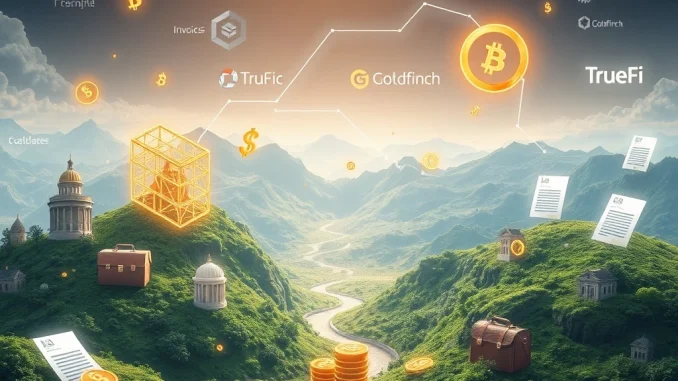
The financial world is undergoing a seismic shift, and at its core is the burgeoning trend of RWA tokenization. Imagine a world where traditional assets – from real estate and invoices to private credit – can be seamlessly integrated into the transparent, efficient, and globally accessible realm of decentralized finance (DeFi). This isn’t just a futuristic vision; it’s happening now, spearheaded by innovative projects like Centrifuge, TrueFi, and Goldfinch. These trailblazers are not just talking about bridging traditional and DeFi markets; they are actively building the infrastructure to make it a reality, creating unprecedented opportunities and driving significant market movements, including a notable CFG surge.
Unlocking Capital with Centrifuge: The Power of Invoice Tokenization
Centrifuge (CFG) stands out as a pioneering force in the RWA tokenization space, particularly for its innovative approach to empowering small and mid-sized businesses (SMEs). For too long, these businesses have struggled with access to affordable capital, often due to lengthy approval processes, high collateral requirements, or simply being overlooked by traditional financial institutions. Centrifuge tackles this head-on by tokenizing real-world assets like invoices and supply chain receivables. This process converts illiquid assets into collateral that can be used to secure loans on DeFi platforms, unlocking immediate liquidity for enterprises that desperately need it.
The beauty of Centrifuge lies in its ability to generate yield from tangible economic activity. Instead of relying purely on speculative crypto assets, investors can earn returns from real-world invoice financing, providing a more stable and understandable income stream. This utility has resonated deeply within the market, as evidenced by the recent price action of its native token. The CFG/USD daily chart recently showcased a compelling breakout above critical resistance levels, consolidating robustly near $0.26 after successfully testing the $0.20–$0.22 support range multiple times. Market analysts are optimistic, suggesting that CFG could realistically target $0.30 in early August if the current momentum holds. This CFG surge is more than just price speculation; it reflects growing confidence in a project delivering verifiable economic impact.
TrueFi: Bridging Institutional Lending with DeFi Liquidity
Another pivotal player in the RWA tokenization landscape is TrueFi (TRU), which has carved a unique niche by merging traditional lending practices with the agility and transparency of blockchain technology. TrueFi’s hybrid model enables yield generation not only from crypto borrowers but also from established real-world entities. This diversified approach offers a blend of flexibility and resilience, a crucial advantage in a market often perceived as volatile and dominated by speculative assets.
TrueFi has become a go-to platform for institutions seeking to access blockchain-based capital without compromising on stringent compliance requirements. Its liquidity pools are designed to facilitate credit flows between regulated finance and decentralized ecosystems, making it a vital conduit for mainstream adoption. The TRU/USD chart reflects a strong recovery from a prolonged downtrend, with its price impressively surging past the $0.037 Fibonacci level and now approaching $0.041. A sustained push towards $0.048 would unequivocally validate renewed demand and institutional interest. TrueFi’s core value proposition lies in its role as a secure and compliant bridge, making it an indispensable component of the evolving RWA ecosystem.
Goldfinch: Democratizing Access to Private Credit
Goldfinch (GFI) offers a compelling vision for the future of private credit, focusing on bringing institutional-grade opportunities to the decentralized world. Unlike some other protocols, Goldfinch emphasizes lending to real-world businesses that don’t require crypto collateral, thus expanding the reach of DeFi to a broader audience. Its strategic partnerships with financial giants like Apollo, KKR, and Ares, who collectively manage over $1 trillion in assets, underscore its ambition and credibility. Through Goldfinch Prime, stablecoin holders can gain direct exposure to high-yield private credit markets—opportunities traditionally reserved for a select few institutional investors.
While the GFI/USD chart has shown more sideways movement, trading steadily between $0.70 and $0.74 with robust support at key pivot levels, its long-term potential is undeniable. Goldfinch’s strength lies in its strong fundamentals, backed by established financial firms, which suggest remarkable scalability. Its ‘non-hyping’ approach prioritizes building robust infrastructure for large-scale, sustainable yield generation over short-term speculative gains. This focus on foundational utility positions Goldfinch as a critical component for the long-term growth and stability of the RWA tokenization sector.
Why is RWA Tokenization Gaining Such Momentum?
The convergence of projects like Centrifuge, TrueFi, and Goldfinch highlights a significant maturation in blockchain’s role. No longer just a playground for speculative experimentation, blockchain is now actively solving tangible financial challenges. This shift is driven by several compelling benefits:
- Increased Liquidity: RWAs like real estate or invoices are typically illiquid. Tokenization breaks them into smaller, tradable units, making them more accessible and easier to transfer.
- Democratized Access: High-yield opportunities in private credit or institutional lending, once exclusive, are now available to a broader range of investors through DeFi protocols.
- Enhanced Transparency & Efficiency: Blockchain’s immutable ledger provides unparalleled transparency, reducing fraud and streamlining processes compared to traditional, often opaque, systems.
- New Yield Opportunities: Crypto investors can diversify their portfolios and earn yield from stable, real-world economic activities, moving beyond purely crypto-native yield farming.
- Global Accessibility: DeFi platforms are permissionless and borderless, enabling anyone with an internet connection to participate, fostering financial inclusion on a global scale.
Challenges and the Path Forward for RWA Tokenization
While the potential of RWA tokenization is immense, the journey isn’t without its hurdles. Key challenges include navigating complex regulatory frameworks across different jurisdictions, ensuring legal enforceability of tokenized assets, and establishing robust valuation and custody solutions. Interoperability between various blockchain networks and traditional financial systems also remains a technical challenge that needs continuous innovation.
Despite these challenges, the trajectory for RWA tokenization looks incredibly promising. As regulatory clarity emerges and technological solutions become more sophisticated, we can expect even greater institutional adoption. The market is increasingly recognizing that the true value of blockchain lies in its ability to unlock capital, improve efficiency, and create more inclusive financial systems for everyone.
Actionable Insights: What Does This Mean for You?
For investors and enthusiasts alike, the rise of RWA tokenization presents a fascinating opportunity. Projects like Centrifuge, TrueFi, and Goldfinch are not just building protocols; they are constructing the bridges that will connect the multi-trillion-dollar traditional finance world with the innovative power of DeFi. Keeping an eye on their technical advancements, institutional partnerships, and token performance (like the recent CFG surge) can offer valuable insights into the future of finance.
Diversifying into RWA-backed tokens could offer a compelling alternative to purely speculative crypto assets, providing exposure to real-world economic activity and potentially more stable returns. As August 2025 marks a pivotal moment where institutional interest and technical execution are aligning, the momentum for RWA adoption is undeniable.
The Future is Real-World: A Concluding Thought
The journey of blockchain from speculative experimentation to a cornerstone of global finance is exemplified by the rise of RWA tokenization. Centrifuge, TrueFi, and Goldfinch are not just projects; they are architects of a new financial era, addressing fundamental market inefficiencies and democratizing access to capital. Their collective progress signals a profound maturation of the RWA sector, where success is increasingly measured by tangible economic impact rather than fleeting market speculation. As these projects continue to innovate and onboard more real-world assets, they are paving the way for a more integrated, efficient, and equitable global financial system.
Frequently Asked Questions (FAQs)
What is RWA Tokenization?
RWA Tokenization, or Real-World Asset Tokenization, is the process of converting tangible or intangible assets from the traditional financial world (like real estate, invoices, art, or private credit) into digital tokens on a blockchain. This allows these assets to be traded, managed, and utilized within decentralized finance (DeFi) ecosystems.
How do Centrifuge, TrueFi, and Goldfinch differ in their RWA approach?
Centrifuge focuses on tokenizing invoices and supply chain receivables for SMEs, providing liquidity. TrueFi specializes in uncollateralized lending, bridging traditional institutional capital with DeFi liquidity through compliant pools. Goldfinch emphasizes institutional-grade private credit, partnering with major financial firms to offer access to high-yield opportunities without requiring crypto collateral from borrowers.
What drove the recent CFG surge?
The recent CFG surge is primarily driven by Centrifuge’s growing adoption, its ability to generate yield from real-world economic activity (invoice financing), and strong technical performance breaking above key resistance levels. Increased investor confidence in its utility and potential for broader institutional integration also played a significant role.
Are RWA tokens a safer investment than other cryptocurrencies?
RWA tokens aim to provide more stable yield opportunities by backing investments with tangible, real-world assets, which can potentially reduce volatility compared to purely speculative crypto assets. However, they still carry risks, including market risk, smart contract risk, and legal/regulatory uncertainties related to the underlying assets. Investors should always conduct thorough due diligence.
What are the main benefits of RWA tokenization for traditional finance?
For traditional finance, RWA tokenization offers increased liquidity for illiquid assets, reduced transaction costs, faster settlement times, enhanced transparency, and broader access to capital markets. It also opens new avenues for fractional ownership and securitization of assets that were previously difficult to divide or transfer.