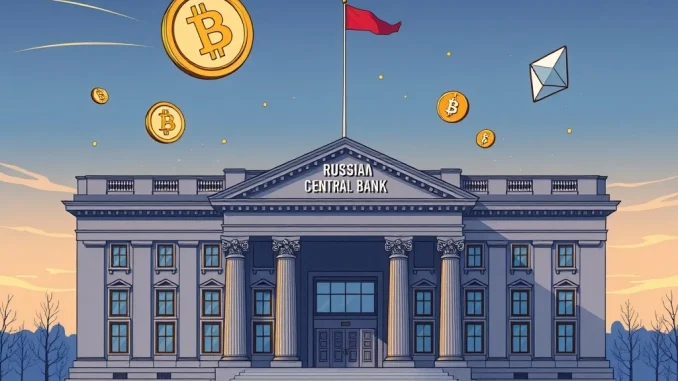
The landscape of digital assets is constantly evolving, and a significant development is brewing in Russia. The Central Bank of Russia (CBR) has signaled a groundbreaking shift, indicating its openness to allowing the creation of **Russia crypto mutual funds**. This move could fundamentally reshape how **Russian investors crypto** assets and participate in the digital economy.
Russia Crypto Mutual Funds: A New Horizon for Investors
For years, the Central Bank of Russia maintained a notably cautious, even restrictive, stance on cryptocurrencies. However, recent discussions at the “Collective Investment Market 2025” conference point towards a potential turning point. Olga Shishlyannikova, head of the CBR’s Department of Investment Financial Intermediaries, revealed the bank’s consideration of mutual funds that would offer Russian investors indirect exposure to digital assets.
This proposal isn’t emerging in a vacuum. It directly responds to increasing demand from market participants, particularly brokerage firms, who have been pushing for structured and regulated avenues to engage with digital assets. While these firms already have limited permissions to offer crypto derivatives to qualified investors, the concept of mutual funds represents a broader, more accessible, albeit still indirect, pathway into the crypto market.
The core idea behind these proposed **Russia crypto mutual funds** is to provide a regulated wrapper around digital assets, mitigating some of the direct risks associated with individual crypto ownership. This approach aligns with the CBR’s methodical philosophy of balancing financial innovation with robust risk management, aiming to avoid past issues seen with unregulated crypto investments.
The Central Bank of Russia’s Cautious Approach
Despite the apparent shift, the **Central Bank of Russia** remains steadfast in its opposition to allowing even qualified investors direct access to underlying digital assets. This firm stance is rooted in concerns over systemic risks, capital outflow, and financial stability. It’s a testament to the CBR’s cautious nature, even as Russians reportedly hold over $25 billion in crypto assets outside traditional financial channels.
The proposed mutual funds would operate under Russia’s existing “experimental legal regime” (ELR) framework. Introduced in March, the ELR was designed to facilitate regulated trading of crypto derivatives, enabling financial firms to offer crypto-linked products to high-net-worth individuals under strict safeguards. This framework provides a controlled environment for testing new financial instruments without fully liberalizing the market.
The path to implementing these funds isn’t immediate. Shishlyannikova noted that significant regulatory changes, requiring formal legislative updates, would be necessary. This process is expected to be prioritized in the bank’s revised annual plan for 2026. This timeline underscores the CBR’s deliberate pace, emphasizing thorough preparation over rapid deployment.
Navigating Crypto Regulations Russia: Balancing Innovation and Risk
The evolving **crypto regulations Russia** reflect a complex balancing act. On one hand, the CBR acknowledges the growing relevance of digital assets and the market’s demand for participation. On the other, it seeks to maintain stringent control over capital flows and prevent the proliferation of unregulated crypto activity that could destabilize the financial system, especially amidst Western sanctions.
Key aspects of Russia’s regulatory philosophy include:
- Indirect Access Preferred: The emphasis is firmly on indirect exposure through regulated funds, rather than direct ownership of cryptocurrencies. This allows the CBR to oversee and control the flow of capital into and out of digital assets.
- Qualified Investor Focus: Initial access to these products remains largely confined to qualified investors, limiting broader retail participation. This strategy aims to contain risk to those deemed capable of understanding and absorbing potential losses.
- Gradual Adoption: While institutions show more enthusiasm for crypto products, retail investor demand has been described as “minimal” so far. This suggests a gradual adoption curve, which the CBR seems to prefer for stability.
This cautious integration is part of a broader strategy to modernize Russia’s financial infrastructure while maintaining control and stability in a challenging geopolitical environment.
Beyond Mutual Funds: The Digital Ruble and Broader Financial Modernization
The discussions around **Russia crypto mutual funds** are not isolated; they are part of a larger, comprehensive strategy by the **Central Bank of Russia** to reshape the nation’s financial landscape. A significant parallel initiative is the planned launch of the **Digital Ruble** in September 2026.
The Digital Ruble, a central bank digital currency (CBDC), aims to provide a secure, efficient, and sovereign digital payment method. Its introduction is expected to further stabilize the financial system, enhance payment infrastructure, and potentially mitigate the impact of external sanctions by offering an alternative to traditional cross-border payment systems.
Concurrently, the CBR plans to enforce stricter penalties for using cryptocurrencies in domestic transactions outside the approved ELR framework. These measures collectively aim to:
- Strengthen the national financial system’s resilience.
- Foster a controlled and regulated environment for digital asset adoption.
- Reduce the influence of unregulated crypto markets.
Analysts suggest that this cautious timeline and incremental approach by the CBR reflect its dual priorities: encouraging innovation in the financial sector while rigorously mitigating the risks associated with unregulated crypto activity. It’s a strategic move to integrate digital assets on the nation’s terms.
What This Means for Russian Investors Crypto
For **Russian investors crypto** is a complex landscape. The proposed mutual funds, while a step forward, highlight the central bank’s preference for institutional, indirect exposure. This means that while high-net-worth individuals and institutional players may gain new avenues for investment, direct crypto ownership for the average retail investor remains off-limits, at least for now.
The move has sparked considerable debate among industry stakeholders:
- Positive View: Some see the mutual funds as a crucial step to attract institutional capital, legitimize crypto within the financial system, and align Russia with global trends in digital asset investment. It could pave the way for more sophisticated financial products.
- Concerns: Others caution that the delayed implementation and limited accessibility (primarily for qualified investors) might reduce Russia’s competitive edge in the rapidly evolving global crypto market. They argue that excluding retail investors from direct exposure might drive them to unregulated offshore platforms.
Despite these debates, the CBR’s insistence on regulatory rigor indicates a long-term vision. The goal is to integrate digital assets into the financial ecosystem in a controlled manner, ensuring stability and preventing financial illicit activities, rather than simply embracing the technology for its own sake.
Conclusion
The **Central Bank of Russia**’s consideration of **Russia crypto mutual funds** represents a significant, albeit cautious, evolution in its approach to digital assets. This shift, driven by market demand and a broader strategy for financial modernization, aims to provide regulated avenues for investment while mitigating systemic risks. While direct access to cryptocurrencies remains prohibited for most **Russian investors crypto**, the introduction of mutual funds under the ELR framework signifies a pivotal step towards integrating digital assets into the mainstream financial system on Russia’s terms. The journey will be methodical, balancing innovation with stringent control, as the nation navigates the complexities of the digital economy.
Frequently Asked Questions (FAQs)
Q1: What are Russia crypto mutual funds?
Russia crypto mutual funds are proposed investment vehicles that would allow Russian investors to gain indirect exposure to cryptocurrencies through a regulated financial product. Instead of directly owning crypto, investors would buy shares in a fund that holds digital assets, managed by professional financial intermediaries.
Q2: Why is the Central Bank of Russia considering these funds now?
The Central Bank of Russia (CBR) is considering these funds due to growing demand from market participants, particularly brokerage firms, for structured ways to engage with digital assets. This move is part of a broader strategy to modernize Russia’s financial infrastructure and integrate digital assets in a controlled manner, balancing innovation with risk management.
Q3: Will retail Russian investors crypto directly?
No, the Central Bank of Russia remains firmly opposed to allowing even qualified investors direct access to underlying digital assets, citing systemic risks. The proposed mutual funds would offer indirect exposure, and initial access is expected to be primarily for qualified investors, not the general retail public.
Q4: What is Russia’s “experimental legal regime” (ELR)?
The experimental legal regime (ELR) is a framework introduced in Russia in March to allow regulated trading of crypto derivatives. It provides a controlled environment for financial firms to offer crypto-linked products to high-net-worth individuals with strict safeguards, acting as a sandbox for new digital asset initiatives.
Q5: How do these crypto mutual funds relate to the Digital Ruble?
Both the proposed crypto mutual funds and the planned launch of the Digital Ruble in September 2026 are part of the Central Bank of Russia’s broader strategy to modernize the nation’s financial infrastructure. While mutual funds address investment in existing cryptocurrencies, the Digital Ruble is a central bank digital currency (CBDC) aimed at enhancing domestic payments and financial stability.
Q6: What is the timeline for these crypto mutual funds?
The Central Bank of Russia expects that regulatory changes, requiring formal legislative updates to facilitate the establishment of such funds, would be prioritized in the bank’s revised annual plan for 2026. This indicates that implementation is not immediate and will follow a methodical process.