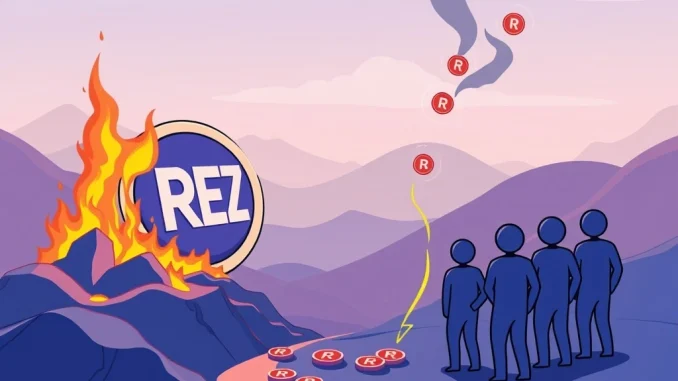
The cryptocurrency world often buzzes with significant community-led initiatives. Currently, the Renzo REZ community has introduced a pivotal governance proposal. This proposal aims to execute a substantial 10% buyback of the total REZ token supply. Such a move could reshape the token’s future trajectory and benefit its dedicated holders.
Understanding the Renzo REZ Buyback Proposal
The core of the recent governance discussion centers on a significant REZ buyback initiative. The Renzo community, a vital part of the Ethereum restaking ecosystem, put forward this proposal. They suggest utilizing protocol revenue to fund the acquisition of 10% of the total REZ supply. This strategic financial maneuver aims to enhance the token’s value proposition.
Furthermore, the proposal outlines a clear distribution strategy for the acquired tokens. A substantial 90% of these tokens will undergo a burning process. This action permanently removes them from circulation. Consequently, it reduces the overall supply of REZ tokens. The remaining 10% of the bought-back tokens will go to ezREZ stakers. This distribution rewards their loyalty and participation within the Renzo ecosystem.
The proposed program has a defined timeline. It plans to run for six months. However, the program would conclude earlier if the 10% buyback target is achieved before the six-month mark. This mechanism ensures efficiency and responsiveness to market conditions. Therefore, the Renzo community demonstrates a proactive approach to token management.
Renzo and the Ethereum Restaking Landscape
Renzo functions as a liquid restaking protocol built on Ethereum. It serves as an essential interface to EigenLayer, a prominent restaking infrastructure. Renzo simplifies the complex process of restaking. It allows users to earn yield on their staked ETH and other liquid staking tokens. Moreover, it aggregates security for actively validated services (AVSs) on EigenLayer. This innovation contributes significantly to the broader Ethereum restaking ecosystem.
The REZ token represents Renzo’s native governance token. Holders of REZ participate in crucial decision-making processes. These include protocol upgrades, parameter adjustments, and treasury management. Consequently, the token empowers the Renzo community to steer the protocol’s direction. Its utility extends beyond simple governance. It aligns incentives between the protocol, its users, and its developers. The recent buyback proposal underscores the token’s integral role.
Mechanics of the REZ Buyback Program
The proposed REZ buyback program intends to use protocol revenue. This revenue stream typically comes from fees generated by Renzo’s operations. The protocol will systematically purchase REZ tokens from the open market. This process creates consistent buying pressure. It directly supports the token’s market price. Transparency in these operations remains a key aspect for the community.
Once acquired, 90% of the tokens enter a burning wallet. This permanent removal reduces the circulating supply. Token burning is a common deflationary mechanism in crypto. It aims to increase the scarcity and potential value of the remaining tokens. Conversely, the remaining 10% of the bought-back tokens are distributed to ezREZ stakers. These stakers hold ezETH, Renzo’s liquid restaking token, which they have staked within the protocol. This reward mechanism incentivizes long-term holding and participation.
The buyback program’s duration is capped at six months. Alternatively, it concludes once 10% of the total REZ supply is repurchased. This flexible timeline ensures the program remains effective. It also prevents prolonged market interventions. Therefore, the design balances immediate impact with sustainable growth. The community’s oversight ensures accountability.
Potential Impact on Renzo REZ Tokenomics
A 10% REZ buyback and subsequent burning could significantly impact the token’s economic model. Firstly, reducing the total supply naturally creates scarcity. This often leads to increased demand relative to available tokens. Consequently, the price of individual REZ tokens could appreciate. This benefits existing holders and strengthens the protocol’s market capitalization.
Secondly, the distribution to ezREZ stakers enhances their overall yield. This additional incentive can attract more users to stake their assets with Renzo. Increased staking activity contributes to the protocol’s security and liquidity. Moreover, it fosters a stronger, more engaged Renzo community. These dynamics create a positive feedback loop. They drive further growth and adoption for Renzo within the Ethereum restaking landscape.
Finally, using protocol revenue for buybacks demonstrates a commitment to value creation. It signals financial health and a sustainable business model. This strategy can build investor confidence. It also aligns the interests of the protocol with its token holders. Ultimately, this proposal represents a strategic move to solidify Renzo’s position in the competitive DeFi space.
The Renzo Community’s Role in Governance
Decentralized governance is a cornerstone of many blockchain projects, including Renzo. The fact that the Renzo REZ buyback proposal originated from the community itself highlights this principle. Token holders actively participate in shaping the protocol’s future. They submit proposals, discuss their merits, and cast votes. This direct involvement ensures that decisions reflect the collective will of the ecosystem participants.
Community governance fosters a sense of ownership among users. It also promotes transparency and accountability. Every proposal undergoes scrutiny. Discussions often occur on forums and social media channels. This open dialogue ensures a robust decision-making process. The outcome of this specific REZ buyback vote will set a precedent. It demonstrates the power of collective action within decentralized autonomous organizations (DAOs).
Broader Implications for Ethereum Restaking
The Renzo community’s proposal holds broader implications for the entire Ethereum restaking sector. As liquid restaking protocols gain traction, their ability to manage tokenomics effectively becomes paramount. A successful buyback program like Renzo’s could inspire similar initiatives across other protocols. It sets a benchmark for how projects can leverage their revenue to benefit token holders.
Furthermore, strong tokenomics can attract more capital to the restaking space. Investors seek projects with clear value accrual mechanisms. The Renzo REZ buyback signals a mature approach to token management. It underscores the potential for sustainable growth within liquid restaking. Ultimately, such moves contribute to the overall health and legitimacy of the decentralized finance (DeFi) ecosystem.
The Renzo community’s proposal for a 10% REZ supply buyback marks a significant development. It showcases a proactive approach to tokenomics and community engagement. This initiative, if approved, promises to reduce token supply, reward ezREZ stakers, and potentially boost the value of Renzo REZ. It reinforces Renzo’s commitment to its ecosystem and its position within the dynamic Ethereum restaking landscape.
Frequently Asked Questions (FAQs)
1. What is the Renzo REZ buyback proposal?
The Renzo REZ buyback proposal is a governance initiative by the Renzo community. It suggests buying back 10% of the total REZ token supply using protocol revenue. The plan is to burn 90% of these tokens and distribute the remaining 10% to ezREZ stakers.
2. How will the REZ buyback be funded?
The REZ buyback will be funded by the protocol’s accumulated revenue. This revenue typically comes from fees generated through Renzo’s operations within the Ethereum restaking ecosystem.
3. Who benefits from the REZ buyback?
Primarily, all REZ token holders could benefit from potential price appreciation due to reduced supply. Specifically, ezREZ stakers will directly receive a portion (10%) of the bought-back tokens as a reward for their participation.
4. What is Ethereum restaking?
Ethereum restaking is a mechanism that allows users to re-purpose their staked ETH or liquid staking tokens to secure other decentralized applications or services (AVSs) on EigenLayer. Renzo is a protocol that facilitates this process, offering liquid restaking solutions.
5. How long will the REZ buyback program last?
The REZ buyback program is planned to last for six months. However, it will conclude earlier if the target of buying back 10% of the total REZ supply is met before the six-month period ends.
6. What is the significance of the Renzo community in this proposal?
The Renzo community plays a crucial role as they initiated and are voting on this governance proposal. This highlights Renzo’s commitment to decentralized decision-making, where token holders actively shape the protocol’s future and economic strategies.