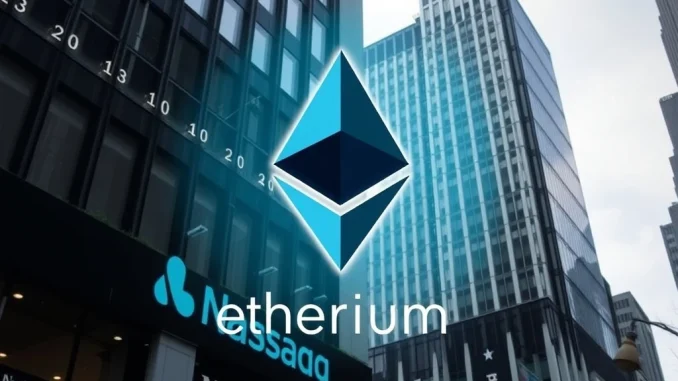
The financial world watches closely as a significant announcement unfolds. Reliance Global Group (RELI), a Nasdaq-listed insurance holding company, has officially completed its first purchase of Ethereum (ETH). This strategic move marks a notable step for a traditional firm venturing into the digital asset space. While the company did not disclose the exact size of this acquisition, its mere occurrence signals a growing trend. This decision by a Nasdaq company to acquire crypto assets, specifically ETH, underscores a broader shift. It highlights increasing corporate Ethereum adoption across various sectors.
Reliance Global Group ETH Purchase: A Strategic Move
Reliance Global Group, known primarily for its insurance services, has now diversified its treasury holdings. Their recent acquisition of Ethereum represents a clear strategic shift. This decision places RELI among a growing number of publicly traded companies embracing digital assets. The company’s management likely views this Reliance Global Group ETH purchase as a way to enhance shareholder value. Furthermore, it could act as a hedge against inflation. This move also demonstrates confidence in the long-term viability of digital currencies.
Many corporations are exploring alternative assets. They seek to optimize their balance sheets in today’s dynamic economic environment. RELI’s entry into the crypto market, especially with Ethereum, is particularly noteworthy. It suggests a thoughtful analysis of market trends. Moreover, it reflects a forward-looking approach to asset management. The undisclosed size of the acquisition leaves room for speculation. However, the announcement itself carries significant weight within the financial community. It validates Ethereum’s position as a legitimate institutional asset.
The Expanding Landscape of Corporate Crypto Adoption
The trend of companies adding cryptocurrencies to their balance sheets continues to gain momentum. Initially, Bitcoin dominated this narrative. However, a noticeable shift towards Ethereum is now evident. Companies like MicroStrategy pioneered corporate crypto adoption. Now, others are following suit. They recognize the potential of digital assets. These assets can offer diversification and growth opportunities. The decision by RELI to execute an RELI ETH purchase further solidifies this trend. It demonstrates a broadening acceptance beyond just Bitcoin.
This evolving landscape suggests a maturation of the cryptocurrency market. More institutional players are entering. They are looking past speculative trading. Instead, they focus on long-term value and utility. Companies are increasingly comfortable with the regulatory environment. They also understand the technological underpinnings of these assets. This growing comfort level drives further integration of digital currencies into traditional finance. It paves the way for wider mainstream acceptance.
Understanding the Allure of Ethereum for Institutional Investors
Why would a Nasdaq-listed company choose Ethereum over other cryptocurrencies? Ethereum offers unique advantages beyond simply being a store of value. It powers a vast ecosystem of decentralized applications (dApps). These include decentralized finance (DeFi), non-fungible tokens (NFTs), and Web3 initiatives. Its utility makes it highly attractive. Therefore, an Institutional ETH investment can be seen as an investment in future technology.
Key reasons for Ethereum’s appeal include:
- Smart Contract Functionality: Ethereum’s network supports smart contracts. These self-executing contracts allow for complex, trustless agreements.
- Deflationary Mechanism: The EIP-1559 upgrade introduced a burning mechanism. This reduces ETH supply over time.
- Proof-of-Stake Transition: The Merge significantly reduced Ethereum’s energy consumption. This makes it more environmentally friendly.
- Vibrant Ecosystem: Ethereum boasts the largest developer community. It has the most established dApp ecosystem in the crypto space.
These features position Ethereum as a crucial infrastructure layer for the digital economy. Investing in ETH means investing in the backbone of innovation. It provides exposure to a rapidly evolving technological frontier.
RELI’s Entry: Implications for the Market
The announcement of RELI’s ETH purchase carries significant implications. It sends a strong signal to other traditional companies. It suggests that digital assets are viable for corporate treasuries. This move could inspire more Nasdaq company crypto acquisitions. Such actions provide further legitimacy to the entire cryptocurrency market. They bridge the gap between traditional finance and decentralized technologies.
Increased institutional involvement often leads to greater market stability. It can also boost liquidity. As more companies allocate capital to digital assets, the market matures. This fosters a more robust and resilient ecosystem. The RELI ETH purchase is not just a company decision. It reflects a broader trend of institutional validation. This validation can attract more cautious investors to the space. Ultimately, it accelerates mainstream adoption.
Navigating the Volatility: Risks and Regulatory Considerations
While the benefits of crypto investment are appealing, companies must also acknowledge the inherent risks. Cryptocurrency markets are known for their volatility. Prices can fluctuate dramatically in short periods. This requires a robust risk management strategy. Furthermore, the regulatory landscape for digital assets is still evolving. This creates an environment of uncertainty for corporate investors.
Companies like Reliance Global Group must consider several factors:
- Market Volatility: Significant price swings can impact balance sheet valuations.
- Regulatory Changes: New laws or interpretations could affect asset classification or taxation.
- Custody Solutions: Securely storing digital assets requires specialized infrastructure.
- Accounting Standards: Clear guidelines for reporting crypto holdings are still developing.
Despite these challenges, many firms believe the long-term potential outweighs the short-term risks. They conduct extensive due diligence. They also consult with legal and financial experts. This ensures compliance and minimizes exposure. The decision to invest in digital assets is therefore a calculated one. It reflects a belief in the future growth of this asset class.
The Future of Digital Assets in Corporate Portfolios
The entry of companies like RELI into the Ethereum market paints a clear picture. Digital assets are becoming an integral part of modern corporate finance. We may see more diverse portfolios in the future. These portfolios will likely include a mix of traditional and digital assets. This trend is driven by several factors. These include technological innovation, changing investor sentiment, and global economic shifts. The increasing corporate Ethereum adoption signifies a broader acceptance of decentralized technologies.
As the digital economy expands, Ethereum’s role as a foundational layer will likely grow. Companies are beginning to understand its potential beyond just a speculative asset. They see it as a programmable platform. It can enable new business models and efficiencies. This long-term perspective guides strategic decisions. It positions firms for future success in a rapidly digitalizing world. The path forward involves continuous learning and adaptation. Businesses must remain agile to capitalize on these emerging opportunities.
Reliance Global Group’s first ETH purchase represents more than just a financial transaction. It symbolizes a growing confidence in the digital asset ecosystem from traditional financial players. As a Nasdaq-listed entity, RELI’s move adds significant weight to the narrative of institutional crypto adoption. This pivotal decision could inspire other corporations to explore similar strategies. Ultimately, it paves the way for a more integrated future between conventional finance and the innovative world of blockchain technology.
Frequently Asked Questions (FAQs)
Q1: What is Reliance Global Group (RELI)?
Reliance Global Group (RELI) is a Nasdaq-listed diversified insurance and financial services company. It operates across various segments, including commercial and personal insurance.
Q2: Why is Reliance Global Group’s ETH purchase significant?
This purchase is significant because it marks the first known direct acquisition of Ethereum by a Nasdaq-listed insurance company. It signals growing institutional confidence in ETH as a treasury asset and highlights broader corporate Ethereum adoption.
Q3: Did Reliance Global Group disclose the size of its ETH acquisition?
No, Reliance Global Group did not disclose the specific size or value of its first ETH acquisition in its announcement.
Q4: What does “corporate Ethereum adoption” mean?
Corporate Ethereum adoption refers to traditional companies, like RELI, integrating Ethereum (ETH) into their financial strategies. This could involve holding ETH on their balance sheets, utilizing Ethereum’s blockchain for business operations, or investing in its ecosystem.
Q5: How does this RELI ETH purchase impact the broader crypto market?
The RELI ETH purchase provides further validation for Ethereum as a legitimate asset class for institutional investors. It can encourage other Nasdaq companies and traditional firms to consider similar investments, potentially increasing market liquidity and stability.
Q6: What are the potential benefits for a Nasdaq company investing in crypto like ETH?
Potential benefits include balance sheet diversification, a hedge against inflation, exposure to a high-growth technological sector, and attracting a new generation of investors interested in digital assets.