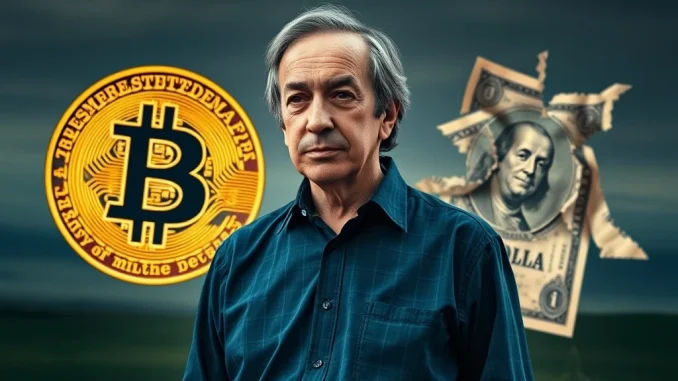
Prominent American hedge fund manager Ray Dalio recently shared his evolving perspective on Bitcoin, signaling a crucial shift in how institutional finance views the digital asset. His latest comments on X suggest that Ray Dalio Bitcoin analysis points to BTC as an attractive alternative. This comes at a time when traditional fiat currencies face increasing scrutiny. Dalio’s insights offer a compelling narrative for investors navigating today’s complex economic landscape.
Ray Dalio Bitcoin: A Shifting Perspective on Digital Gold
Ray Dalio, the founder of Bridgewater Associates, has significantly refined his stance on Bitcoin. He now sees it as a viable alternative currency. Dalio stated that Bitcoin’s inherent limited supply makes it particularly appealing. This appeal grows stronger if the U.S. dollar supply expands significantly or its demand diminishes. Dalio’s comments reflect a growing concern among financial experts. They observe the long-term stability of traditional monetary systems. For many, Bitcoin represents a potential hedge against these systemic risks.
Furthermore, Dalio draws stark parallels between current economic conditions and historical periods. He specifically cites the 1930s and 1970s. These eras were marked by significant economic upheaval and currency instability. Heavily indebted fiat currencies struggled as reliable stores of value during these times. Bitcoin, by contrast, offers a decentralized and immutable ledger. This makes it a distinct proposition in the modern financial world. Dalio’s analysis underscores Bitcoin’s potential as a ‘digital gold’ in an era of unprecedented monetary policy.
Addressing US Dollar Instability Concerns
The core of Dalio’s argument centers on the potential for US Dollar instability. He suggests that an expanding money supply or decreasing demand for the dollar could diminish its purchasing power. This scenario could make alternative assets like Bitcoin more attractive. Historically, periods of high national debt and extensive money printing have eroded confidence in fiat currencies. Dalio believes history may repeat itself. Investors are therefore seeking more resilient stores of value.
Several factors contribute to this potential instability:
- Increased Money Supply: Governments often print more money to stimulate economies or manage debt. This dilutes the value of existing currency.
- Declining Demand: Global geopolitical shifts or economic downturns can reduce international demand for the dollar. This impacts its exchange rate.
- Inflationary Pressures: Persistent inflation erodes purchasing power. It makes traditional savings less valuable over time.
Dalio’s observations highlight a crucial point. The long-term strength of any currency depends on its perceived stability and scarcity. When these attributes are compromised, investors naturally look elsewhere. Consequently, Bitcoin emerges as a strong contender. Its fixed supply cap of 21 million coins offers a stark contrast to the potentially infinite supply of fiat money.
BTC Alternative Currency: A Digital Hedge
Bitcoin’s design positions it as a compelling BTC alternative currency. Unlike government-issued money, Bitcoin operates independently of central banks. Its value is determined by supply and demand within a global network. This decentralization provides a level of autonomy. It shields Bitcoin from direct political influence or unilateral monetary policy decisions. As a result, many investors view Bitcoin as a modern-day safe-haven asset.
Moreover, Bitcoin’s scarcity principle is fundamental to its appeal. Its programmed supply limit creates inherent value. This mirrors the scarcity of precious metals like gold. During times of economic uncertainty, assets with finite supply often perform well. They maintain their value when fiat currencies depreciate. Therefore, Bitcoin offers a unique value proposition. It combines the scarcity of gold with the portability and divisibility of digital assets. This makes it a formidable contender in the evolving global financial system.
Stablecoin Regulation and Potential Risks
Beyond Bitcoin, Dalio also addressed the growing role of stablecoins. These digital assets are typically pegged to the U.S. dollar or other fiat currencies. He does not believe their substantial holdings of U.S. Treasurys will create systemic risk. However, he cautioned about the real purchasing power of these bonds. This power could decline over time. Dalio’s nuanced view recognizes the utility of stablecoins. Yet, he also highlights their underlying vulnerability to the very fiat currencies they mirror.
Significantly, Dalio added that effective stablecoin regulation could mitigate some of these issues. Proper oversight would ensure transparency and stability. It would protect investors from potential market manipulation or insolvency. Without robust regulation, stablecoins could face challenges. Their peg to the dollar might weaken under severe economic stress. Therefore, regulatory clarity is paramount for the long-term health and acceptance of stablecoins in the broader financial ecosystem. This would build trust and ensure their role as a bridge between traditional and decentralized finance.
Portfolio Diversification Strategies for Macroeconomic Headwinds
In late July, Dalio provided practical advice for investors. He recommended allocating at least 15% of a portfolio to gold and Bitcoin. This strategy aims to hedge against macroeconomic risks. Such portfolio diversification is critical during periods of high inflation, geopolitical instability, and currency devaluation. Combining traditional safe havens like gold with emerging digital assets like Bitcoin offers a balanced approach. It protects wealth across different market conditions.
Dalio’s recommendation stems from a deep understanding of market cycles. He recognizes that no single asset class performs optimally in all environments. Therefore, a diversified portfolio can:
- Reduce Volatility: Different assets react differently to market events. This can smooth overall portfolio returns.
- Preserve Capital: Allocating to non-correlated assets helps protect against significant losses in any single sector.
- Capture Growth: Including assets like Bitcoin offers exposure to innovative technologies and potential high growth.
By embracing both gold and Bitcoin, investors can build a more resilient portfolio. This prepares them for various economic scenarios. Dalio’s advice underscores a forward-thinking investment philosophy. It adapts to the rapidly changing global financial landscape.
Conclusion: Navigating a New Financial Era
Ray Dalio’s evolving perspective on Bitcoin and the U.S. dollar offers profound insights for investors worldwide. His recognition of Bitcoin as a compelling alternative currency highlights its growing importance. This is especially true amid concerns over fiat currency stability. Furthermore, his emphasis on proper stablecoin regulation and strategic portfolio diversification provides a roadmap. It guides investors through an increasingly complex financial future. As global economic conditions continue to shift, Dalio’s voice reinforces a critical message: adapt or risk being left behind.
Frequently Asked Questions (FAQs)
1. Why does Ray Dalio consider Bitcoin an attractive alternative to the US dollar?
Ray Dalio views Bitcoin as an attractive alternative due to its limited supply. This contrasts with the potentially increasing supply of the U.S. dollar. He believes that if the dollar’s supply grows or its demand falls, Bitcoin’s scarcity makes it a more reliable store of value. This aligns with his concerns about heavily indebted fiat currencies struggling during economic instability.
2. What historical parallels does Dalio draw regarding currency instability?
Dalio draws parallels to the economic conditions of the 1930s and 1970s. These periods saw significant struggles for heavily indebted fiat currencies. He suggests that current macroeconomic trends, such as high national debt and expansive monetary policies, could lead to similar currency challenges today.
3. What are Dalio’s views on stablecoins and systemic risk?
Dalio does not believe stablecoins’ holdings of U.S. Treasurys will create systemic risk. However, he cautions that the real purchasing power of these bonds could decline over time. He also emphasizes that proper stablecoin regulation is crucial. This would help avoid potential issues and maintain their stability.
4. What is Ray Dalio’s recommendation for portfolio diversification?
Dalio recommends allocating at least 15% of a portfolio to gold and Bitcoin. He suggests this strategy as a hedge against macroeconomic risks. This approach aims to diversify holdings and protect wealth during periods of inflation, currency devaluation, and geopolitical uncertainty.
5. How does Bitcoin’s limited supply make it a unique asset?
Bitcoin’s limited supply, capped at 21 million coins, is a fundamental aspect of its value proposition. This scarcity makes it deflationary by design, contrasting with inflationary fiat currencies. This characteristic positions Bitcoin as a potential ‘digital gold,’ capable of maintaining or increasing its value over time as demand grows against a fixed supply.