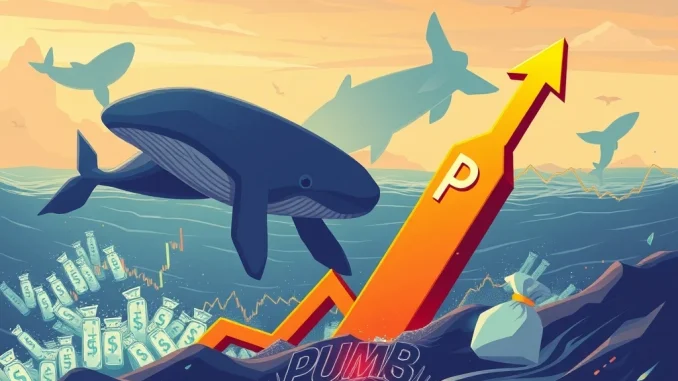
The cryptocurrency market is no stranger to dramatic swings, but the recent unraveling of the PUMP Token has sent ripples through the community. This Ethereum-based meme platform, once touted for its potential for outsized returns, has now plummeted below its crucial presale price of $0.004. This significant drop has triggered a cascade of liquidations among large holders, painting a stark picture of the volatile world of meme coins. What exactly happened, and what can we learn from this rapid decline?
The Unraveling of PUMP Token: A Closer Look at the Price Crash
The PUMP Token experienced a staggering sell-off, with its price falling below the initial presale price of $0.004. This breach of a key psychological and financial benchmark has not only eroded investor confidence but also highlighted the immense power of market dynamics when large players decide to move. On-chain data provides a clear narrative of intensified whale activity, with significant portions of early investors offloading their holdings.
- 31.6% of presale buyers have already sold their tokens.
- 53% of presale buyers transferred their tokens to new wallets, likely destined for centralized exchanges for liquidation.
- Only a meager 12.7% of presale participants are still holding their initial tokens.
- Interestingly, 2.7% of participants even increased their positions during the decline, perhaps seeing a buying opportunity.
This rapid exodus by early investors underscores the speculative nature of meme tokens and the swiftness with which market sentiment can turn.
The Anatomy of Whale Dumping: Profits and Losses
The term Whale Dumping perfectly encapsulates the recent events surrounding PUMP. Whales, or large holders, have a disproportionate impact on token prices due to the sheer volume of their holdings. In this scenario, their actions have directly contributed to the downward pressure on PUMP’s price. However, not all whales faced the same fate; some capitalized handsomely, while others incurred substantial losses.
Who Profited?
Two prominent presale funds, ‘PUMP Top Fund 1’ and ‘PUMP Top Fund 2,’ demonstrated remarkable agility, securing significant profits amidst the chaos. Their strategic exits highlight how institutional players can navigate volatile markets to their advantage.
| Fund Name | Initial Investment (Approx.) | Tokens Deposited/Sold | Realized Value | Profit | Return Percentage |
|---|---|---|---|---|---|
| PUMP Top Fund 1 | Not specified, but held 17.1B tokens | 17.1 Billion | $89.5 Million | $19 Million | 19% |
| PUMP Top Fund 2 | $50 Million | 12.5 Billion (entire stash) | $71.4 Million | $21.4 Million | 43% |
Combined, these two funds walked away with over $40 million in profits, showcasing the lucrative, albeit risky, potential for well-timed exits in the crypto space.
Who Suffered Losses?
In stark contrast, other major whale accounts found themselves on the losing side of this market downturn. Their substantial investments have been hit hard, underscoring the inherent risks even for large-scale investors.
- Whales “8UHpWB” and “9Ucygi,” each having invested a hefty $80 million in presale tokens, are currently trailing by $6.19 million (a 7.7% loss).
- Another significant holder, “2WHL4X,” has lost $3.1 million on a $40 million stake.
- Notably, renowned trader Machi Big Brother, holding 3.55 billion tokens with a 5x leverage, is down $4.06 million. This particular case highlights the extreme fragility of leveraged positions in rapidly shifting markets, where even minor price movements can lead to substantial losses or liquidations.
Can PUMP Recover? A Technical Analysis Perspective
Despite the grim price action, technical analysts are observing patterns that could suggest a potential reversal for the PUMP Token. The token has reportedly formed a falling wedge pattern, which is often considered a bullish indicator.
- The price has consolidated within a narrow range of $0.00355 to $0.00385, which analysts are identifying as an accumulation zone. This suggests that some investors might be buying up tokens at lower prices, anticipating a rebound.
- A clean breakout above $0.00385 could potentially propel the price toward $0.00554, representing a significant 44.1% gain from current levels.
- However, recent dips below key support levels also indicate deliberate efforts to trigger stop-loss orders, further exacerbating the sell-off as automated trading systems execute sell orders.
- While fee collection wallets saw 3.34 billion tokens purchased at $0.00594, accumulation activity has slowed, raising questions about whether sustained demand exists to fuel a recovery.
Broader Implications: What Does This Mean for Meme Coins and Crypto Market Analysis?
The dramatic decline of PUMP Token and the subsequent Whale Dumping have broader implications for the entire crypto ecosystem, especially for meme coins. The erosion of confidence in PUMP’s narrative, which once promised astronomical returns for early investors, is a cautionary tale.
- Credibility Crisis: The breach of the presale price, a symbolic benchmark, has significantly eroded the token’s credibility. For many, this signals a failure to live up to initial promises.
- Liquidity Debate: The market is divided on whether the reduced liquidity resulting from large sell-offs could stabilize the price or if it will simply make the token more vulnerable to further manipulation.
- Shift in Focus: The $40 million profit secured by the two funds also highlights a potential shift in the crypto investment landscape. As institutional players exit volatile meme tokens, the focus may increasingly shift toward more established, utility-driven assets, leaving speculative tokens like PUMP vulnerable to cyclical pumps and dumps.
This event serves as a stark reminder that while meme coins can offer rapid gains, they come with equally rapid and significant risks. A thorough Crypto Market Analysis reveals that such incidents are not isolated but are part of the broader speculative cycles that characterize less established digital assets.
Lessons Learned for Investors
The PUMP Token saga offers several crucial lessons for anyone navigating the volatile world of cryptocurrencies:
- Due Diligence is Key: Always research the project’s fundamentals, team, and utility beyond the hype.
- Understand Whale Behavior: Be aware that large holders can significantly influence market prices. Monitoring on-chain data can provide early warnings.
- Leverage is a Double-Edged Sword: While it can amplify gains, it dramatically increases risk, as demonstrated by Machi Big Brother’s losses.
- Presale Prices Aren’t Guarantees: The initial price is not a floor; tokens can, and often do, fall below it.
- Risk Management: Never invest more than you can afford to lose, especially in high-risk assets like meme coins.
Conclusion
The journey of the PUMP Token, from its promising presale to its current state below its initial offering price, is a compelling narrative of ambition, speculation, and the harsh realities of the crypto market. The massive Whale Dumping and subsequent sell-off, while generating substantial profits for some, have inflicted significant losses on others and severely tested investor confidence. While technical analysis offers a glimmer of hope with a potential bullish reversal, PUMP’s fate ultimately hinges on its ability to regain traction through renewed utility or a significant shift in market sentiment. The intricate interplay of on-chain activity, technical patterns, and the strategic maneuvers of large investors will undoubtedly dictate whether this Meme Coin can rebound or continues its downward trajectory in the ever-evolving Crypto Market Analysis landscape.
Frequently Asked Questions (FAQs)
1. What caused the PUMP Token price to fall below its presale price?
The primary cause was massive whale dumping, where large holders began selling off significant portions of their tokens. This created immense selling pressure, leading to a 31.6% sell-off and pushing the price below its $0.004 presale benchmark, eroding investor confidence.
2. How did some whales profit while others lost money on PUMP Token?
Some early presale funds, like ‘PUMP Top Fund 1’ and ‘PUMP Top Fund 2,’ strategically exited their positions at opportune times, securing over $40 million in combined profits. In contrast, other whales held on or faced liquidations, leading to multi-million dollar losses, particularly for those using high leverage.
3. What is a “falling wedge pattern” in crypto technical analysis?
A falling wedge pattern is a bullish chart formation that typically indicates a potential reversal after a downtrend. It’s characterized by two converging, downward-sloping trend lines, suggesting that selling pressure is diminishing and a breakout to the upside might be imminent if resistance is broken.
4. What does the on-chain data reveal about PUMP Token holders?
On-chain data shows that 31.6% of presale buyers have sold their holdings, and 53% transferred tokens to new wallets (likely for selling). Only 12.7% of presale participants are still holding, while a small 2.7% increased their positions during the decline, indicating a mix of panic selling and accumulation.
5. Is there any hope for PUMP Token to recover?
Technical analysis suggests a potential for recovery if the falling wedge pattern plays out, with a possible target of $0.00554 if it breaks above $0.00385. However, sustained recovery depends on renewed utility, stronger market sentiment, and a reversal of the current selling pressure from large holders.
6. What are the risks associated with investing in meme coins like PUMP?
Meme coins are highly speculative and volatile. Risks include rapid price drops due to whale dumping, lack of inherent utility, reliance on social media hype, potential for rug pulls, and significant losses, especially when using leverage. Investors should exercise extreme caution and only invest what they can afford to lose.