The cryptocurrency market is no stranger to volatility, but the recent dramatic plunge of the PUMP token has sent shockwaves, leaving early investors reeling from significant losses. This isn’t just another price correction; it’s a cautionary tale unfolding in real-time, highlighting the inherent risks in speculative digital assets, especially those tied to unproven utility and ambitious promises like airdrops. If you’ve been watching the markets, the story of the PUMP token is a stark reminder of how quickly fortunes can turn.
What Caused the PUMP Token Plunge?
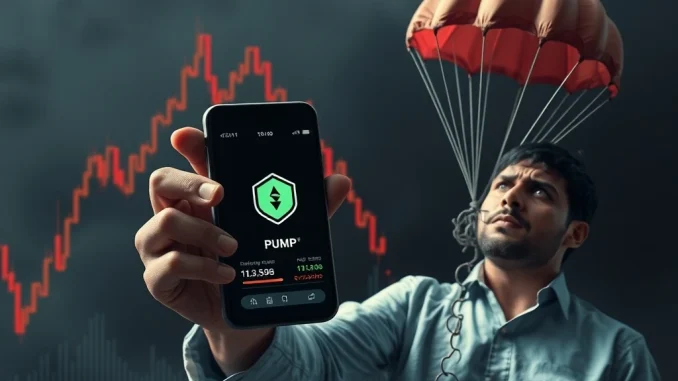
The immediate trigger for the PUMP token‘s dramatic downturn was the unexpected postponement of its highly anticipated airdrop. This news alone caused an immediate 12% price drop, but the underlying issues run deeper. A key event that exacerbated the situation involved a major private sale participant, identified as “PUMP Top Fund 2.” This entity attempted to transfer a staggering 2 billion $PUMP tokens, valued at approximately $12.79 million, to Binance. However, Binance returned these assets unlisted after 23 hours, a critical window during which the token’s price had already fallen significantly. This missed selling opportunity alone resulted in an estimated $6 million loss for the investor.
The premature liquidity move by this large holder injected further volatility into the market. Unable to offload on Binance, the investor then rushed to Bybit to liquidate the tokens, putting immense downward pressure on the price. Compounding this sell-off, two additional wallets subsequently dumped another 1.25 billion PUMP tokens, collectively valued at $3.8 million. These actions created a cascading effect, turning a price correction into a full-blown plunge.
The Ripple Effect of Airdrop Delay on Investor Trust
The official confirmation of the airdrop delay came directly from cofounder Alon Cohen during a live stream. Cohen stated the team’s intention to focus on “expanding the ecosystem and boosting trading volume” before conducting a “meaningful” airdrop. While this might sound like a strategic move, the market reacted with immediate and intense negativity. The token’s price plummeted below its initial coin offering (ICO) level of $0.004 and now stands over 50% lower than its post-ICO peak of $0.0067.
The community’s reaction has been swift and severe. Many early supporters, who had invested based on the promise of an imminent airdrop and ecosystem growth, felt betrayed. One user publicly accused the team of “turning their back” on supporters, while another noted the token hitting an all-time low of $0.00337. This highlights a crucial point: without the immediate incentive of an airdrop, demand must now rely solely on the project’s fundamental utility and long-term vision. The profound impact of this airdrop delay on investor trust cannot be overstated.
Millions Lost: A Cautionary Tale for Crypto Investor Losses
The recent events surrounding the PUMP token serve as a powerful cautionary tale regarding crypto investor losses in highly speculative markets. The figures are stark: millions of dollars evaporated for early participants, not just due to market forces but also due to governance issues and poor communication. The hasty decisions by large early investors to liquidate their holdings on centralized exchanges like Binance, and then Bybit, significantly exacerbated the price instability. This rapid sell-off by those with significant holdings created a panic that smaller investors could not withstand.
Analysts are quick to point out that projects heavily reliant on airdrops for initial momentum often face collapse when these incentives are stalled or removed. The PUMP token’s performance is a prime example of the fragility of hype-driven models that lack robust infrastructure, clear utility, or contingency plans for delays. For those navigating the volatile world of crypto, understanding the mechanisms that lead to such substantial crypto investor losses is paramount.
Pump.fun’s Solana Meme Coin Model Under Scrutiny
Launched on Solana in early 2024, Pump.fun quickly gained traction due to its innovative ability to generate meme coins rapidly, propelling it to nearly $1 billion in revenue. This platform capitalized on the meme coin craze, offering a seemingly low-barrier entry for creating and launching new tokens. However, the core criticism against the Solana meme coin model, particularly as implemented by Pump.fun, is its unproven utility and a perceived lack of sustainable value creation beyond pure speculation.
The recent airdrop delay has starkly exposed governance and communication gaps within the Pump.fun project. Investors voiced significant frustration over unmet expectations, with one user criticizing the team for prioritizing volume growth over community trust. Others questioned whether the platform could maintain momentum solely through hype-driven activity, without a strong, tangible use case or clear development roadmap. The incident casts a long shadow over the long-term viability of the Solana meme coin ecosystem if it relies predominantly on short-term speculation.
Beyond the Hype: The Future of the Pump.fun Project
For the PUMP token to stage a meaningful recovery, the underlying Pump.fun project must pivot significantly towards prioritizing ecosystem utility and transparent governance. Cofounder Alon Cohen’s team has yet to outline a clear roadmap for post-airdrop development, leaving many investors uncertain about the token’s long-term value proposition. Without concrete plans to address community concerns and deliver tangible upgrades that extend beyond mere trading volume, the token remains highly vulnerable to further sell-offs.
The broader crypto market will undoubtedly view this episode as a significant cautionary tale. It underscores the dangers of overreliance on airdrops as a primary value driver and emphasizes the critical importance of balancing short-term incentives with sustainable growth strategies. The future of the Pump.fun project hinges on its ability to evolve beyond a mere meme coin factory and build a resilient, utility-driven ecosystem that can withstand market pressures and rebuild investor confidence.
The dramatic decline of the PUMP token serves as a stark reminder of the volatile and often unforgiving nature of the cryptocurrency market. While quick gains can be alluring, this incident highlights the paramount importance of due diligence, understanding project fundamentals, and recognizing the critical role of transparent governance and communication. For any project, especially one built on hype, building and maintaining community trust is as vital as any technical innovation or marketing blitz. The PUMP token’s journey is far from over, but its path to recovery will demand a fundamental shift in strategy and a renewed commitment to its community.
Frequently Asked Questions (FAQs)
1. What is the PUMP token and what is Pump.fun?
The PUMP token is a cryptocurrency launched on the Solana blockchain. It is associated with Pump.fun, a platform that gained popularity in early 2024 by allowing users to quickly create and launch new meme coins. Pump.fun facilitates the rapid generation and trading of these tokens.
2. Why did the PUMP token price drop significantly?
The PUMP token experienced a dramatic 12% price drop primarily due to the postponement of its anticipated airdrop. This delay, coupled with large early investors attempting to liquidate significant holdings on exchanges like Binance and Bybit, triggered a massive sell-off and exacerbated market volatility.
3. Who is Alon Cohen and what was his role in the airdrop delay?
Alon Cohen is a cofounder of the Pump.fun project. He publicly confirmed the airdrop delay during a live stream, stating the team’s focus was on expanding the ecosystem and boosting trading volume before a “meaningful” airdrop could occur. His announcement was a key factor in the immediate market reaction.
4. What are the key risks highlighted by the PUMP token incident for crypto investors?
The PUMP token incident highlights several risks for crypto investors, including over-reliance on speculative hype and airdrops, the fragility of projects without clear utility, the impact of large investor liquidity moves, and the critical need for transparent governance and communication from project teams. It underscores the potential for significant crypto investor losses in volatile markets.
5. How can the PUMP token and Pump.fun project potentially recover?
For the PUMP token and the Pump.fun project to recover, they need to prioritize building genuine ecosystem utility beyond meme coin creation. This includes establishing transparent governance, improving communication with the community, and outlining a clear, actionable roadmap for long-term development that instills investor confidence rather than relying solely on short-term incentives like airdrops.