Investors in the cryptocurrency space closely watch macroeconomic signals. These broader economic trends often dictate market sentiment. Therefore, a recent statement from Federal Reserve Chair Jerome Powell carries significant weight for everyone, including digital asset holders. His comments on job growth have certainly captured attention across financial markets.
Jerome Powell Addresses Near-Zero Job Growth
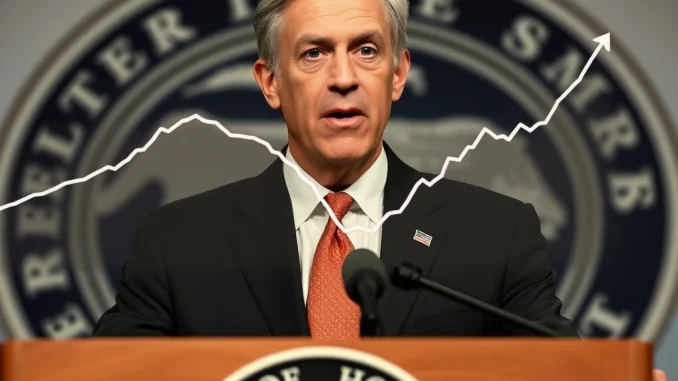
Federal Reserve Chair Jerome Powell recently delivered a notable statement. He indicated that the United States’ job growth rate is effectively near zero. This assessment comes after adjusting for certain statistical discrepancies. Specifically, Powell referenced duplicate statistics identified within the Bureau of Labor Statistics (BLS) data.
His remarks underscore a potentially concerning trend in the labor market. While headline numbers sometimes suggest robust activity, a deeper dive reveals complexities. This re-evaluation of employment figures could influence future monetary policy decisions. Market participants are now analyzing these statements carefully.
Understanding the BLS Data Discrepancy
The Bureau of Labor Statistics (BLS) is the principal federal agency for measuring labor market activity. It collects and disseminates vital economic data. However, data collection and analysis are complex processes. Occasionally, issues like duplicate statistics can arise. These issues can skew initial reports.
Powell’s comments highlight the importance of accurate data. When duplicates are removed, the picture changes significantly. What once appeared as modest growth now looks stagnant. This adjustment suggests a much softer labor market than previously understood. It is crucial to consider the full context of these revisions.
Key points regarding the BLS data discrepancy:
- Initial reports may include statistical anomalies.
- Duplicate entries can inflate job creation figures.
- Adjustments provide a more accurate labor market view.
- This revised data directly impacts economic assessments.
Implications for the Federal Reserve’s Monetary Policy
The Federal Reserve plays a critical role in managing the U.S. economy. Its dual mandate involves achieving maximum employment and stable prices. Powell’s revelation about near-zero job growth directly impacts the ‘maximum employment’ objective. This new data point could significantly influence the Fed’s strategy moving forward.
Historically, strong job growth allows the Fed more room to combat inflation through interest rate hikes. Conversely, a weakening labor market often prompts a more dovish stance. Policymakers might reconsider aggressive tightening measures. They could even contemplate easing policies if economic conditions worsen. Therefore, these revised employment figures are a major factor in monetary policy discussions.
The Broader Economic Outlook
A slowdown in job creation can signal a broader economic deceleration. Businesses may be hiring less due to reduced demand or uncertain future prospects. This trend could lead to lower consumer spending. Consumer spending is a primary driver of economic activity. Furthermore, weaker employment can impact wage growth. Lower wages, in turn, affect household budgets.
Analysts are now reassessing their economic forecasts. Many had anticipated a ‘soft landing’ for the economy. This scenario involved bringing inflation down without triggering a recession. However, near-zero job growth complicates this optimistic outlook. It raises concerns about a potential economic downturn. All sectors, including crypto, feel the ripple effects of these macroeconomic shifts.
Connecting Job Growth to Cryptocurrency Markets
Cryptocurrency markets, while distinct, do not operate in a vacuum. They are increasingly correlated with traditional financial markets. Macroeconomic data, such as job growth figures, directly influences investor sentiment. When the overall economic outlook appears weak, investors often become more risk-averse. This shift can lead to outflows from riskier assets, including digital currencies.
Conversely, if the Fed responds to weak employment with more accommodative policies, it could indirectly benefit crypto. Lower interest rates typically make speculative assets more attractive. However, sustained economic weakness could also depress overall investment. Thus, the relationship is nuanced. Monitoring these economic indicators remains crucial for crypto participants.
Potential Market Reactions and Future Scenarios
The immediate market reaction to Powell’s statement was one of increased caution. Equity markets often respond negatively to signs of economic weakness. Crypto markets frequently follow suit. However, some analysts argue that a dovish Fed could eventually support crypto prices. This support would come from increased liquidity in the financial system.
Looking ahead, several scenarios could unfold:
- Scenario 1: Fed Easing. The Federal Reserve might pause or even cut interest rates. This action would aim to stimulate job creation. Such a move could eventually boost risk assets.
- Scenario 2: Economic Slowdown. Persistent weak job growth could lead to a recession. In this case, most asset classes, including crypto, would likely face headwinds.
- Scenario 3: Data Re-evaluation. Further analysis of BLS data might reveal different insights. Such a re-evaluation could alter the current perception of the labor market.
Each scenario carries different implications for investors. Staying informed about Fed communications and economic data is therefore essential.
The Importance of Accurate Data in Economic Policy
Powell’s comments highlight a fundamental principle: economic policy relies on accurate data. The integrity of statistics from agencies like the BLS is paramount. Misleading data can lead to misguided policy decisions. These decisions can have far-reaching consequences for businesses and individuals.
The process of identifying and correcting statistical errors is vital. It ensures that policymakers have the clearest possible picture of the economy. This transparency helps foster trust in government institutions. Moreover, it allows for more effective responses to economic challenges. Ultimately, a clearer understanding of job growth figures benefits everyone.
Conclusion: Navigating Uncertainty with Jerome Powell’s Insights
Jerome Powell’s recent comments about near-zero job growth are a significant development. They compel a re-evaluation of the current economic landscape. The adjustment for duplicate BLS data offers a more sober assessment of the labor market. This insight will undoubtedly shape future decisions by the Federal Reserve. Consequently, it impacts the broader economic outlook. Investors, including those in the crypto space, must remain vigilant. Understanding these macroeconomic shifts is key to navigating an uncertain financial future.
Frequently Asked Questions (FAQs)
Q1: What exactly did Jerome Powell say about job growth?
A1: Federal Reserve Chair Jerome Powell stated that the job growth rate is nearly zero. This assessment excludes duplicate statistics found within the Bureau of Labor Statistics (BLS) data. His remarks suggest a much weaker labor market than previously indicated by headline figures.
Q2: Why is the BLS data being adjusted?
A2: The Bureau of Labor Statistics (BLS) data is being adjusted to correct for statistical discrepancies. These include duplicate entries that may have inflated previous job creation reports. The aim is to provide a more accurate and reliable picture of the actual employment situation.
Q3: How does near-zero job growth impact the Federal Reserve’s policy?
A3: Near-zero job growth complicates the Federal Reserve’s dual mandate of maximum employment and price stability. It may lead the Fed to adopt a more dovish monetary policy stance. This could involve pausing interest rate hikes or even considering cuts to stimulate the economy, rather than aggressive tightening.
Q4: What are the broader economic implications of this revelation?
A4: This revelation suggests a potential slowdown in the economy. Weak job growth can lead to reduced consumer spending, lower wage growth, and overall economic deceleration. It raises concerns about a possible economic downturn or recession, affecting various sectors and asset classes.
Q5: How might this affect cryptocurrency markets?
A5: Cryptocurrency markets are increasingly correlated with traditional financial markets. A weaker economic outlook often increases investor risk aversion, potentially leading to outflows from crypto. However, if the Fed responds with easing policies, the resulting increase in liquidity could eventually support speculative assets like cryptocurrencies, though the short-term impact may be negative.