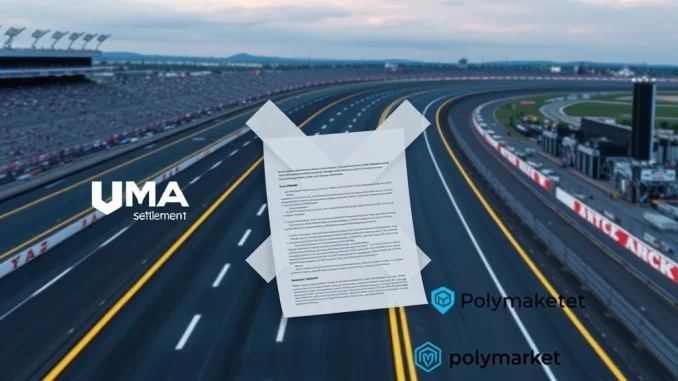
Imagine placing a seemingly straightforward bet, only for it to spiral into a financial nightmare six times its original value. That’s precisely what happened on Polymarket, the popular prediction market platform, where a $10,000 NASCAR bet astonishingly escalated into a $60,000 dispute. This high-stakes drama, fueled by the UMA oracle system’s rejection of an early settlement, shines a harsh light on the complexities and inherent risks within decentralized finance, particularly for those deeply invested in the world of cryptocurrency and blockchain technology.
The Shocking Polymarket NASCAR Bet Dispute
The core of this gripping tale revolves around a NASCAR Cup Series race and a $10,000 wager placed on Polymarket. When Denny Hamlin was declared the winner after NASCAR’s post-race inspection, a seasoned trader, known as “GeopoliticsWizard,” moved swiftly. Just one minute after the race conclusion, they submitted 40 settlement proposals to UMA, each backed by a required 750 USDC bond. The intent was clear: to finalize the market quickly and claim the winnings.
However, the rapid action soon hit a snag. A mere 90 minutes later, other users challenged all 40 proposals. Their argument? The “GeopoliticsWizard” had acted prematurely, failing to await NASCAR’s “official confirmation.” Each challenge, mirroring the proposal, demanded a 750 USDC bond, quickly ballooning the total staked funds to a staggering $60,000. This swift escalation transformed a routine market settlement into a costly battleground, highlighting the volatile nature of even seemingly simple prediction markets.
Understanding the UMA Oracle Dispute Mechanism
At the heart of this controversy lies UMA’s optimistic-oracle mechanism, a system designed for speed and decentralization. Its process is deceptively simple, yet it holds the potential for significant financial implications:
- Propose: A data proposer submits a value (e.g., race winner) and stakes a bond.
- Dispute: Anyone can challenge the proposal by also staking a bond, arguing the data is incorrect or premature.
- Vote: If disputed, UMA token holders vote on the correct outcome. The majority group wins the combined bonds, while the minority forfeits theirs.
In the NASCAR case, despite UMA’s own documentation advising reliance on “authoritative public sources” (and NASCAR’s leaderboards showing no asterisks), the on-chain vote ruled the proposals “Too Early.” This decision, made after NASCAR officially confirmed Hamlin’s victory, cost the proposer approximately $30,000 in net value. What was once a profitable position for “GeopoliticsWizard” instantly turned into a significant loss, underscoring how procedural nuances can outweigh factual accuracy in decentralized governance. This UMA oracle dispute is a stark reminder of the financial risks when clarity meets decentralized interpretation.
The Broader Implications for Decentralized Oracle Systems
This incident is not an isolated one for UMA. The system has faced scrutiny before, notably concerning a $200 million Polymarket contract about Ukrainian President Zelensky’s attire and a separate MLB market error attributed to a technical glitch. These events collectively paint a picture of the inherent challenges within decentralized oracle systems.
The optimistic-oracle model, while prioritizing rapid resolution, exposes participants to costly disputes, especially when outcomes are ambiguous or timing-sensitive. Defining “authoritative” sources becomes a battleground. While UMA reportedly offers refunds for technical errors, human-driven disputes, like the NASCAR timing or Zelensky’s clothing, highlight vulnerabilities in the system’s ability to consistently interpret real-world events in a way that satisfies all parties. This raises critical questions about the reliability and fairness of decentralized oracle systems in high-value scenarios.
Navigating Risks in the Prediction Market Landscape
Analysts, including X user Domer who highlighted the NASCAR incident, point to systemic risks within UMA’s governance model. Domer argues that the voting base has significantly contracted, now comprising a small circle of “trusted” regulars. These insiders, it’s claimed, often have financial incentives that align more with disputers than with neutral accuracy.
When Polymarket remains neutral in such disputes, UMA’s reliance on these “insiders” can create an environment where external pressures, even from “centralized actors,” might influence votes. In the NASCAR dispute, the opposing group allegedly “spam” Discord channels, potentially swaying the vote to deem the proposal premature. Such dynamics, Domer suggests, can turn individual traders into “collateral damage,” caught between opaque incentives and potentially centralized voting patterns within what is supposed to be a decentralized prediction market. Understanding these intricate risks is crucial for anyone participating in the evolving prediction market landscape.
What This Means for Blockchain Dispute Resolution
The Polymarket NASCAR dispute serves as a potent case study for the broader challenges facing blockchain dispute resolution. While decentralization aims to remove single points of failure and increase transparency, this incident reveals how consensus mechanisms can still be manipulated or influenced, leading to outcomes that feel unfair to participants.
Key Takeaways for Blockchain Dispute Resolution:
- Clarity of Rules: The need for crystal-clear definitions of “official” or “authoritative” sources is paramount, especially in time-sensitive markets.
- Governance Vulnerabilities: Even decentralized governance models can be susceptible to concentrated power or external pressures if voter participation is low or incentives are misaligned.
- Cost vs. Notional Value: The cost of dispute resolution can dramatically exceed the market’s notional value, making smaller markets disproportionately risky for proposers.
- User Protection: Mechanisms for user recourse, beyond just technical errors, need to be robustly defined and transparent.
This incident is a wake-up call for the entire blockchain ecosystem, urging developers and users alike to critically examine the resilience and fairness of decentralized oracle systems and their role in facilitating reliable, trustless interactions.
The Polymarket NASCAR bet, a seemingly minor $10,000 wager, ballooned into a $60,000 financial entanglement due to the UMA oracle’s controversial settlement rejection. This dramatic event underscores the critical challenges facing decentralized oracle systems: balancing speed with accuracy, navigating ambiguous “authoritative” sources, and safeguarding against potential governance centralization. As prediction markets and blockchain applications continue to grow, incidents like this highlight the urgent need for more robust, transparent, and truly decentralized dispute resolution mechanisms to protect users and foster genuine trust in the future of DeFi.
Frequently Asked Questions (FAQs)
Q1: What was the core issue in the Polymarket NASCAR bet dispute?
A1: The dispute arose when a trader submitted early settlement proposals for a NASCAR race on Polymarket, which were then challenged by other users for being “Too Early,” despite the winner being publicly known. The UMA oracle system sided with the challengers, leading to significant financial losses for the proposer.
Q2: How does the UMA optimistic-oracle system work?
A2: UMA’s system involves a three-step “propose–dispute–vote” cycle. A proposer suggests an outcome; if unchallenged, it’s final. If challenged, UMA token holders vote on the correct outcome, with the majority winning staked bonds.
Q3: Why did the dispute cost $60,000 when the original bet was $10,000?
A3: The dispute escalated due to the bond requirements. Both the initial proposer and the challengers had to post 750 USDC bonds for each of the 40 driver contracts involved in the market, totaling $60,000 in staked funds during the dispute phase.
Q4: What are the main criticisms leveled against UMA’s governance?
A4: Critics argue that UMA’s voting base has become concentrated among a small group of “trusted” regulars whose incentives may align with disputers. There are also concerns that external pressures or “spamming” of communication channels can influence voting outcomes, compromising the decentralized nature.
Q5: What lessons can be learned from this incident for decentralized finance (DeFi)?
A5: This incident highlights the critical need for clearer definitions of “authoritative sources,” more robust and transparent dispute resolution mechanisms, and stronger safeguards against potential centralization within decentralized governance models to protect users and ensure fairness.
Q6: Has UMA faced similar controversies before?
A6: Yes, UMA has been involved in previous controversies, including a $200 million Polymarket contract related to Ukrainian President Zelensky’s attire and an MLB market error attributed to a technical glitch, raising ongoing questions about its reliability.