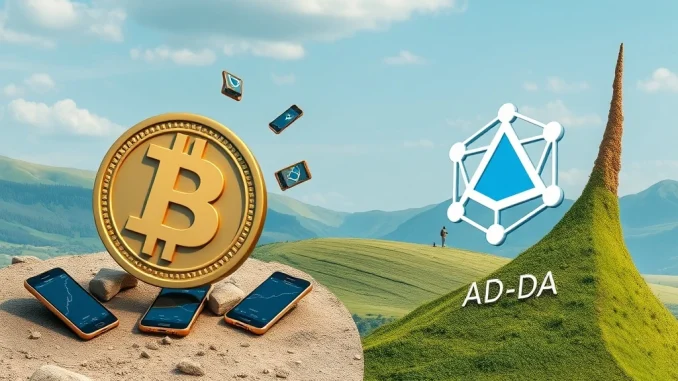
The cryptocurrency landscape is a dynamic arena, constantly shifting with innovations, market sentiment, and technological advancements. As we navigate 2025, a fascinating divergence has emerged, highlighting the contrasting fortunes of two prominent digital assets: Pi Coin and Cardano (ADA). While one faces a significant downturn rooted in speculative models, the other is poised for remarkable growth, fueled by strong fundamentals and burgeoning institutional backing crypto. This article delves into the core reasons behind their divergent paths, offering insights for anyone keen on understanding current blockchain market trends and making informed decisions for their crypto investment 2025 strategy.
The Curious Case of Pi Coin: Speculation Versus Utility in 2025
Pi Coin, once hailed for its accessible mobile-mining model, has experienced a dramatic fall from grace. Its price plummeted from a peak of $2.98 to a mere $0.44, representing a staggering decline exceeding 85%. This sharp drop has ignited widespread debate about its long-term viability and the sustainability of projects built primarily on speculative hype rather than concrete utility.
The initial appeal of Pi Coin was undeniable: it offered millions the chance to ‘mine’ cryptocurrency directly from their smartphones, promising a decentralized future. However, critics argue that this speculative allure quickly outpaced the development of any tangible use cases. Despite recent listings on exchanges, the price slump persists, raising critical questions for its future. Analysts suggest that Pi could stabilize within a cautious range of $0.30–$0.44 this year. However, a significant rebound or sustained growth appears unlikely unless the development team delivers compelling, real-world applications and a robust ecosystem.
While some forecasts optimistically anticipate a rebound to $0.5110 by July 2025, such projections are heavily contingent on unproven upgrades to its mainnet. The coin’s reliance on speculative narratives—including audacious 2026 projections of $200–$3000 per 1000 coins—remains highly speculative, dependent entirely on the elusive combination of utility-driven adoption and broader exchange listings.
Cardano ADA: A Foundation Built on Research and Institutional Backing Crypto
In stark contrast to Pi Coin’s struggles, Cardano ADA presents a narrative of measured progress and resilience. Currently boasting a substantial $29 billion market cap and a robust $1 billion in daily trading volume, Cardano’s strength lies in its commitment to peer-reviewed research and a meticulously planned development roadmap. This research-driven approach, coupled with ongoing scalability upgrades like Hydra, has steadily attracted significant institutional backing crypto.
Despite trading at $0.82, below its impressive $3.09 all-time high, analysts project a potential 170% price increase for Cardano ADA if it successfully breaches a key 230-day resistance level, potentially reaching $1.00. More optimistic forecasts envision ADA climbing to $1.50–$2.20 by late 2025, with some even anticipating a return to its all-time high or beyond. This widespread optimism is intrinsically linked to Cardano’s unique layered architecture and its adaptability within evolving regulatory frameworks, distinguishing it sharply from Pi Coin’s grassroots, often unregulated, model.
Key Differences in Development and Market Approach:
- Development Philosophy: Cardano follows a rigorous, academic, peer-reviewed approach, ensuring robust and secure upgrades. Pi Coin relies on a more community-driven, iterative development, often perceived as less structured.
- Scalability Solutions: Cardano has implemented and continues to develop advanced scalability solutions like Hydra. Pi Coin’s scalability remains largely theoretical, awaiting a fully functional mainnet.
- Ecosystem Maturity: Cardano has a growing DeFi infrastructure and expanding smart contract capabilities, fostering developer adoption. Pi Coin’s ecosystem is still nascent, with limited tangible applications.
Ecosystem Evolution: Where Do They Stand in Crypto Investment 2025?
The stark difference in ecosystem development further underscores the divide between these two projects. Cardano ADA has diligently strengthened its Decentralized Finance (DeFi) infrastructure and significantly expanded its smart contract capabilities, fostering a vibrant environment for developer adoption. Institutional investors, drawn to its scalable framework, academic collaborations, and commitment to regulatory compliance, increasingly view Cardano as a more secure and promising bet compared to Pi Coin’s unproven tokenomics.
Meanwhile, Pi Coin’s impressive grassroots growth, fueled by its mobile mining, has yet to translate into tangible, widely adopted applications. The crucial question remains: will its vast user base transition from mere ‘miners’ to active participants in a functional, utility-driven ecosystem? The answer will heavily influence its standing in the broader blockchain market trends and its viability as a serious contender for crypto investment 2025.
Navigating the Future: Key Differences and Actionable Insights
For investors prioritizing stability, established infrastructure, and long-term potential, Cardano’s institutional credibility and ongoing infrastructure upgrades position it as a significantly more robust candidate. Its methodical approach to development and strong emphasis on security resonate well with risk-averse investors and institutions looking for reliable entry points into the digital asset space.
Conversely, Pi Coin remains a high-risk proposition. Its future hinges entirely on its ability to demonstrate lasting utility, move beyond its speculative phase, and prove the value of its vast user base through concrete applications and widespread adoption. Without these fundamental shifts, its path to recovery and sustained growth will be challenging.
While both assets, like the broader crypto market, face macroeconomic headwinds, Cardano’s inherent regulatory adaptability and its maturing ecosystem give it a clearer edge in a highly competitive market. Understanding these structural differences is paramount for any investor looking to navigate the complex world of blockchain market trends and make strategic decisions for their crypto investment 2025 portfolio.
In conclusion, the tales of Pi Coin and Cardano in 2025 serve as a powerful reminder of the fundamental principles that govern long-term success in the crypto sphere: utility, robust development, and institutional trust. While Pi Coin struggles to convert speculative enthusiasm into tangible value, Cardano continues its steady ascent, building a foundation that attracts serious investment and promises sustained growth.
Frequently Asked Questions (FAQs)
Q1: Why has Pi Coin’s price dropped so significantly?
Pi Coin’s price drop is primarily attributed to its speculative model, where its initial appeal was mobile mining without a fully developed ecosystem or clear utility. The price was largely driven by hype rather than fundamental value, and its listing on exchanges without concrete use cases led to a sharp decline as speculative interest waned.
Q2: What gives Cardano (ADA) its investment potential for 2025?
Cardano’s potential stems from its research-driven development, robust layered architecture, ongoing scalability upgrades like Hydra, and strong institutional backing. Its commitment to peer-reviewed research and regulatory adaptability makes it attractive to serious investors seeking stability and long-term growth in the crypto market.
Q3: Is Pi Coin a viable long-term investment?
Currently, Pi Coin is considered a high-risk investment due to its speculative nature and lack of proven utility. Its long-term viability depends entirely on the development team delivering concrete use cases, a functional mainnet, and tangible applications that convert its large user base into an active, value-generating ecosystem.
Q4: How does institutional backing benefit Cardano?
Institutional backing provides Cardano with increased liquidity, credibility, and capital for further development. Large institutions typically invest in projects with strong fundamentals, clear roadmaps, and regulatory compliance, which validates Cardano’s approach and attracts more mainstream adoption, contributing to its price stability and growth.
Q5: What are the main differences between Pi Coin and Cardano’s approach to blockchain?
Pi Coin emphasizes broad accessibility through mobile mining and grassroots growth, with its utility still largely conceptual. Cardano, conversely, focuses on a rigorous, academic, peer-reviewed development process, building a secure, scalable, and decentralized platform with a strong emphasis on smart contracts and DeFi applications, attracting professional developers and institutional interest.