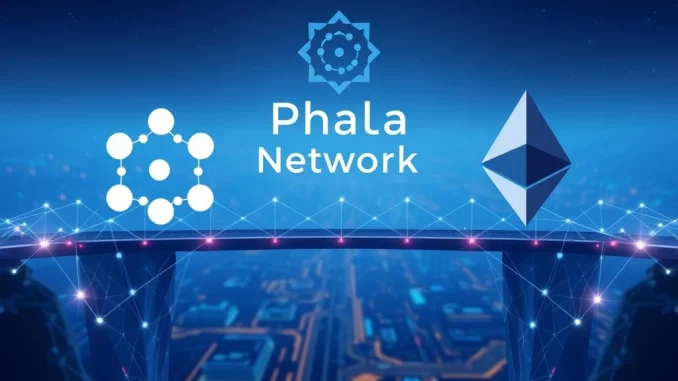
The cryptocurrency world constantly evolves. Consequently, projects often make significant strategic decisions. A notable development has emerged from the Phala Network community. This pivotal move involves migrating from its foundational Polkadot (DOT) parachain to an Ethereum Layer 2 (L2) solution. This decision, approved through a governance proposal, marks a crucial turning point for the Phala Network and its native PHA token. The migration process will reportedly commence before November 20, initiating a new chapter for the project.
Phala Network’s Strategic Decision: A Deep Dive
Phala Network, originally known for its privacy-preserving cloud computing on Polkadot, has always aimed for robust decentralization. The recent community vote represents a bold step. This decision shifts its operational base to a different blockchain ecosystem. Specifically, the move targets an Ethereum Layer 2. Such a blockchain migration is not trivial. It involves complex technical and strategic considerations. The community’s approval underscores a collective vision for enhanced scalability and broader ecosystem integration.
Phala Network’s core mission revolves around providing decentralized computation. It offers privacy-preserving smart contracts. Its original architecture leveraged Polkadot’s parachain model. This model provided shared security and interoperability. However, the blockchain landscape changes rapidly. New solutions emerge. Therefore, projects must adapt to remain competitive and relevant. The shift to an Ethereum L2 reflects this adaptive strategy. It aims to harness the strengths of Ethereum’s expansive ecosystem while addressing performance bottlenecks.
Understanding the Ethereum L2 Advantage
Ethereum Layer 2 solutions have gained immense traction. They offer significant improvements over the mainnet. These include lower transaction fees and faster processing times. Furthermore, they inherit Ethereum’s robust security. Projects like Phala Network can benefit immensely from these advancements. By moving to an Ethereum L2, Phala seeks to:
- Reduce Transaction Costs: L2s significantly cut gas fees, making network interactions more affordable.
- Enhance Scalability: They process a higher volume of transactions per second. This improves user experience.
- Access Broader Liquidity: Ethereum boasts the largest DeFi ecosystem. Integration with L2s opens doors to vast liquidity.
- Leverage Developer Tools: Ethereum’s mature developer community and tools are unparalleled.
Consequently, this migration could unlock new growth opportunities for Phala Network. It could also attract more developers and users. The decision aligns with a broader industry trend. Many projects seek more efficient and scalable environments. They want to maintain decentralization. This move positions Phala Network strategically within the evolving Web3 landscape.
The Mechanics of Polkadot Migration for Phala Network
The Polkadot migration from a parachain to an Ethereum L2 is a multi-faceted process. As a Polkadot parachain, Phala Network relied on the relay chain for its security. It also used Polkadot’s cross-chain communication capabilities. Moving away from this model requires careful planning. It involves re-architecting certain aspects of the network. The exact L2 solution Phala Network will utilize has not been explicitly detailed in initial reports. However, several prominent options exist, such as Arbitrum, Optimism, zkSync, or Polygon. Each offers unique advantages.
The transition will likely involve several technical phases. First, the community approved the governance proposal. Next, developers will execute the technical implementation. This will include bridging existing assets and smart contracts. Moreover, it will establish new operational procedures on the chosen L2. The announced deadline, before November 20, suggests a rapid and focused execution timeline. This aggressive schedule highlights the urgency and strategic importance of this blockchain migration for Phala Network.
This shift also raises questions about Polkadot’s ecosystem. While Polkadot offers strong interoperability and shared security, some projects might seek the immediate benefits of Ethereum’s vast user base and DeFi liquidity. Phala Network’s decision reflects a calculated trade-off. It prioritizes access to a larger, more active dApp ecosystem. Therefore, this move will be closely watched by other projects within the Polkadot and Ethereum communities.
Implications for PHA Token Holders and Ecosystem
For existing PHA token holders, the migration is a significant event. It will likely involve a token swap or bridging mechanism. This ensures that PHA tokens continue to function seamlessly on the new L2 environment. Holders should stay informed about official announcements from the Phala Network team. They must follow instructions carefully to ensure a smooth transition of their assets. The migration aims to enhance the utility and accessibility of the PHA token. This is achieved by placing it within a more liquid and active ecosystem.
Furthermore, the move to an Ethereum L2 could positively impact PHA tokenomics. Increased transaction efficiency and lower fees may encourage greater network usage. This could, in turn, drive demand for the PHA token. The integration with Ethereum’s extensive decentralized finance (DeFi) protocols could also open new avenues for staking, lending, and other financial activities involving PHA. Ultimately, the success of this migration will depend on its execution. It also depends on the subsequent adoption within the Ethereum ecosystem.
The community’s decision to embrace this change demonstrates forward-thinking leadership. It prioritizes the long-term viability and growth of the Phala Network. As the migration progresses, transparent communication will be crucial. This ensures all stakeholders understand the process and its implications. Ultimately, this move seeks to bolster the PHA token’s position in the broader crypto market.
A Broader Look at Blockchain Migration Trends
Phala Network’s decision is not an isolated incident. Instead, it reflects a growing trend within the blockchain space. Projects frequently evaluate their foundational blockchain. They consider factors like scalability, cost, developer support, and ecosystem reach. Historically, many projects started on one chain before migrating to another. This is often driven by technological advancements or strategic realignments. The concept of blockchain migration highlights the dynamic nature of this industry. Projects must remain agile.
For instance, some projects initially built on Ethereum have migrated to other L1s or L2s for better performance. Conversely, projects from smaller ecosystems sometimes move to Ethereum L2s. They seek greater exposure and liquidity. These migrations underscore a competitive environment. Blockchains constantly innovate to attract and retain projects. Phala Network’s move emphasizes the gravitational pull of Ethereum’s network effects. It shows the efficiency gains offered by its Layer 2 solutions. This trend suggests that blockchain ecosystems will continue to evolve. They will adapt to meet the changing needs of decentralized applications.
Community-Driven Evolution: The Power of Decentralized Governance
The approval of this migration through a community governance proposal is highly significant. It showcases the power of decentralized autonomous organizations (DAOs). These structures empower token holders. They make crucial decisions about a project’s future. The Phala Network community actively participated in this strategic discussion. They weighed the pros and cons of remaining on Polkadot versus embracing an Ethereum L2. This democratic process ensures that the project’s direction aligns with its stakeholders’ interests.
Decentralized governance fosters resilience and adaptability. It allows projects to respond effectively to market changes and technological innovations. This community-led decision strengthens Phala Network’s commitment to decentralization. It sets a precedent for how major strategic shifts can be managed in a transparent and inclusive manner. Ultimately, the community’s vote was decisive. It charted a new course for the Phala Network.
Future Prospects for Phala Network on Ethereum L2
The migration to an Ethereum L2 opens up a world of new possibilities for Phala Network. It positions the project within a vibrant and highly active ecosystem. Phala can now more easily integrate with countless decentralized applications (dApps). It can also tap into Ethereum’s massive user base. This strategic shift could significantly boost Phala Network’s adoption. It could also enhance its utility in the broader Web3 space. The focus on privacy-preserving computation remains central. However, its delivery mechanism becomes more efficient and accessible.
New partnerships and collaborations may emerge. These could leverage Phala’s unique privacy features within the Ethereum ecosystem. The move also signals Phala’s commitment to long-term growth and innovation. It demonstrates a willingness to adapt to optimize its technological foundation. As the migration completes, the crypto community will closely observe Phala Network’s progress. Its success could serve as a model for other projects considering similar strategic shifts. Ultimately, this move represents a calculated effort to secure a more robust and scalable future for the Phala Network.
In conclusion, Phala Network’s decision to migrate from Polkadot to an Ethereum L2 marks a significant moment. It reflects the dynamic nature of the blockchain industry. This community-approved move prioritizes scalability, efficiency, and ecosystem integration. It promises a new era of growth and innovation for the PHA token and its privacy-focused computing services. The crypto world awaits the successful completion of this ambitious blockchain migration.
Frequently Asked Questions (FAQs)
What is Phala Network, and why is it migrating?
Phala Network (PHA) is a privacy-preserving cloud computing platform. It initially operated as a parachain on Polkadot. It is migrating to an Ethereum Layer 2 solution. This move aims to enhance scalability, reduce transaction costs, and access Ethereum’s larger DeFi ecosystem and developer community.
What is an Ethereum Layer 2 (L2) solution?
Ethereum Layer 2 solutions are protocols built on top of the main Ethereum blockchain. They process transactions off-chain, then batch them and submit them to the mainnet. This significantly increases transaction speed and reduces gas fees while inheriting Ethereum’s security.
How will the Polkadot migration affect PHA token holders?
PHA token holders will likely need to participate in a token swap or bridging process. This ensures their tokens function on the new Ethereum L2 environment. Phala Network will provide detailed instructions for this transition. Holders should monitor official announcements closely.
When is the Phala Network migration scheduled to begin?
The migration process for Phala Network is scheduled to commence before November 20. This indicates a focused and relatively swift transition timeline.
Why did Phala Network choose to leave Polkadot for Ethereum L2?
The community-approved decision was driven by the desire for improved scalability, lower transaction fees, and greater access to Ethereum’s vast liquidity and developer ecosystem. While Polkadot offers strong security and interoperability, Ethereum L2s provide immediate benefits for dApp growth and user experience.
What are the long-term benefits of this blockchain migration for Phala Network?
The migration is expected to boost Phala Network’s adoption and utility. It will enable easier integration with numerous dApps, attract more users and developers, and potentially enhance the value and liquidity of the PHA token within the larger Ethereum ecosystem.