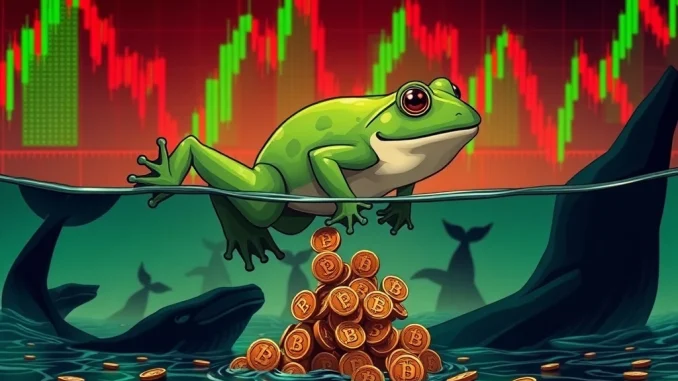
The cryptocurrency market has always been a whirlwind of emotions, where exhilarating highs often give way to unsettling lows within the blink of an eye. This duality is particularly pronounced in the meme coin sector, a space where sentiment can override traditional financial logic. Yet, for astute investors, volatility isn’t a deterrent; it’s a potential goldmine. Today, we turn our gaze to PEPE, the frog-themed digital asset that has captivated and confounded investors throughout 2025.
PEPE’s Volatile Drop: What Triggered the Panic?
Recent weeks have seen PEPE experience a significant downturn, causing widespread concern among retail investors. By July 31, 2025, PEPE had plummeted to $0.00000942, marking a substantial 32.1% drop from its June 1 value of $0.00001280. The decline gained momentum in early July, with notable daily losses:
- July 24: $0.0000121 (-12.78%)
- July 25: $0.0000111 (-19.99%)
- July 27: $0.0000104 (-25.03%)
This sustained bearish trend has left many scrambling for answers. What makes this particular sell-off intriguing is the apparent lack of a major catalyst. Unlike typical market crashes driven by regulatory crackdowns, project failures, or fundamental technical breakdowns, PEPE’s recent dip seems to be a classic case of profit-taking following a period of speculative euphoria. For the discerning investor, however, the critical question isn’t just *how low* the price has fallen, but *why*.
Whale Accumulation: The Smart Money’s Contrarian Play
While retail investors might be hitting the panic button, on-chain analytics paint a fascinatingly different picture. Data from leading platforms like Nansen and Santiment reveal a counterintuitive trend: a significant increase in whale accumulation amidst the market downturn. This behavior is a hallmark of contrarian investing, where large, well-funded entities buy when others are selling.
Key On-Chain Indicators:
- Whale Holdings Surge: The top 100 PEPE addresses increased their holdings by 3.2% over 30 days, amassing a staggering 305.69 trillion tokens. This indicates a strong belief in the token’s future value.
- Exchange Supply Dips: Tokens held on exchanges decreased by 2.5%. This shift suggests that PEPE is moving from speculative trading accounts into long-term holding wallets, reducing immediate selling pressure.
- Large Transactions Spike: Whale accumulation, specifically, surged by 6.63%, with a notable increase in large wallet activity during late July. This isn’t mere coincidence; it’s a calculated move.
In the unpredictable world of cryptocurrency, whale behavior often acts as a precursor to significant price inflection points. When large investors commit capital during periods of fear and capitulation, it frequently signals their conviction that an asset is undervalued. History is replete with examples; during the monumental 2023 DOGE rally, substantial whale accumulation began months before the token’s parabolic 800% surge. This pattern suggests that the current PEPE price action might be setting the stage for a similar reversal.
Is This Meme Coin Poised for a Rebound?
Beyond the intriguing on-chain data, technical indicators also lend credence to a potential rebound for this popular meme coin. Chart patterns suggest that PEPE could be forming a bullish reversal. For instance, PEPE recently broke out of a well-defined cup-and-handle pattern, a classic bullish formation. This breakout targets a price range of $0.0000145–$0.000015, representing a potential 60% gain from its July 25 low.
Furthermore, an earlier falling wedge formation observed in April 2025 further reinforces the underlying bullish momentum. This pattern projects an even more ambitious price target of $0.0000169–$0.0000190, levels not seen since the beginning of 2025. These technical signals, combined with the increasing whale accumulation, create a compelling narrative for a price recovery.
The Power of Community: Social Sentiment and Adoption
The strength of any meme coin often lies in its community and cultural resonance. PEPE continues to demonstrate robust social media traction, with its holder count surpassing 463,000—a 2.8% monthly increase. Viral discussions on platforms like X (Twitter) and Reddit hint at growing retail FOMO (Fear Of Missing Out) as the token’s narrative evolves. PEPE isn’t just a digital asset; it’s a cultural phenomenon, and this strong community engagement is a vital component of its long-term viability and potential for future rallies.
Navigating the PEPE Price Action: Strategies for Opportunity
For investors with a high-risk tolerance and a strategic mindset, PEPE offers a compelling high-risk, high-reward opportunity. Approaching this volatile asset requires a disciplined strategy, especially for those embracing contrarian investing principles.
Actionable Entry Strategies:
- Short-Term Scalp: Consider buying near the key support level of $0.000008, setting a strict stop-loss order just below $0.0000075 to manage downside risk. This strategy aims for quick profits from minor bounces.
- Breakout Play: Wait for a sustained close above $0.000010. This psychological barrier, once breached convincingly, could signal a stronger upward move. Place a stop-loss below $0.000009.
- Dollar-Cost Averaging (DCA): For a more conservative approach, gradually accumulate PEPE tokens between $0.000008 and $0.000010. DCA helps mitigate the impact of short-term price fluctuations.
- Long-Term Hold: If PEPE decisively breaks and holds above $0.00001625, the next significant target could be $0.0000283, representing a substantial 160% gain from its July lows. This strategy is for those looking for a larger, sustained rally based on the underlying bullish signals.
Historical Performance Insights:
Backtesting reveals interesting patterns for these strategies. Buy signals based on established support levels have historically been successful 55% of the time. Furthermore, 70% of 30-day holding periods during similar market conditions resulted in positive returns. The maximum return observed during the backtest period reached 14.26%, while the minimum loss was contained at -4.92%. While past performance doesn’t guarantee future results, these figures suggest that a disciplined approach can historically balance volatility with growth potential for the PEPE price.
Risks and Caution: A Balanced Perspective
Despite the bullish indicators and compelling contrarian narrative, it is crucial to remember that PEPE remains a highly speculative asset. Daily price swings of 20% or more are common, and liquidity can fluctuate rapidly. The broader regulatory landscape also poses a risk; if frameworks like the EU’s MiCA begin to specifically target meme coins, it could introduce new challenges.
Investors should exercise extreme caution and adhere to robust risk management principles. It is advisable to cap allocations to meme coins, including PEPE, at a small percentage (e.g., 5–10%) of your total crypto portfolio. Always use strict stop-loss orders to protect capital from unexpected downturns.
Final Thoughts: The Frog That Could Leap
Contrarian investing in the meme coin space demands a unique blend of courage, patience, and a keen eye for on-chain signals. While PEPE’s recent price drop in 2025 might appear as a glaring red flag to the uninformed, for those who interpret the underlying data, it presents a compelling green light. The significant whale accumulation, coupled with strengthening technical indicators and resilient community sentiment, paints a picture of a potential reversal.
In a market where fear often precedes opportunity, PEPE’s current volatility shouldn’t be a reason to retreat; it should be a reason to lean in, albeit with a carefully constructed strategy. As with any high-risk, high-reward investment, thorough research and disciplined risk management are paramount. Don’t just follow the crowd; understand the currents. Just remember to wear a life jacket.
Frequently Asked Questions (FAQs)
Q1: What is PEPE and why is it considered a meme coin?
PEPE is a decentralized cryptocurrency token inspired by the popular internet meme, Pepe the Frog. It’s considered a meme coin because its value and popularity are primarily driven by internet culture, community sentiment, and viral trends rather than traditional utility or fundamental technology, similar to Dogecoin or Shiba Inu.
Q2: What does “whale accumulation” mean in the context of PEPE?
Whale accumulation refers to large investors (often called “whales” due to their significant holdings) buying substantial amounts of a cryptocurrency, in this case, PEPE. When whales accumulate during a price dip, it often signals their belief that the asset is undervalued and likely to increase in price in the future, acting as a potential bullish indicator for the PEPE price.
Q3: What are the risks associated with investing in PEPE or other meme coins?
Investing in PEPE and other meme coins carries high risks. These include extreme price volatility (large daily swings), lack of inherent utility, dependence on social media trends, potential for regulatory scrutiny, and susceptibility to pump-and-dump schemes. It’s crucial to only invest what you can afford to lose and employ strict risk management strategies like stop-loss orders.
Q4: How does contrarian investing apply to PEPE’s current situation?
Contrarian investing involves going against prevailing market sentiment. In PEPE’s case, while most retail investors might be selling due to the price drop (panic), contrarian investors, particularly whales, are buying. They believe the market has overreacted, creating an opportunity to acquire assets at a discounted price before a potential rebound.
Q5: What technical indicators are suggesting a potential rebound for PEPE?
The article highlights two main technical indicators: a breakout from a cup-and-handle pattern and a falling wedge formation. Both are generally considered bullish reversal patterns, suggesting that the asset’s price, after a period of decline, is poised for an upward movement. These patterns, combined with increasing trading volume and on-chain metrics, strengthen the bullish case for PEPE.