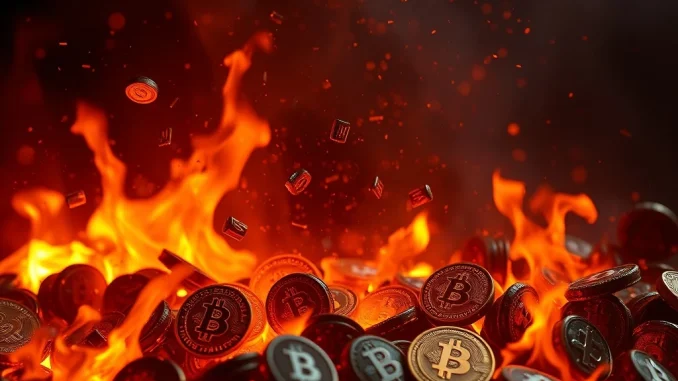
A significant event recently captured the attention of the cryptocurrency community. Whale Alert, a prominent blockchain transaction tracker, reported a massive **OKB burn** of 20 million tokens. This substantial reduction occurred from an unknown wallet, immediately sparking discussions about its implications for the OKB ecosystem and the broader market. Such a large-scale token destruction event naturally raises questions about its purpose and potential effects on token value and scarcity.
Understanding the Massive OKB Burn Event
Whale Alert’s recent report highlighted the permanent removal of 20 million OKB tokens. This transaction, executed from an undisclosed wallet address, represents a considerable portion of OKB’s total supply. For context, token burns involve sending cryptocurrencies to an unspendable address, effectively removing them from circulation forever. This process reduces the overall supply, aiming to increase the scarcity and potentially the value of the remaining tokens.
The precise reasons behind this particular **OKB burn** remain unconfirmed by official sources at the time of reporting. However, such large-scale burns often align with a project’s long-term tokenomics strategy. They can also be part of a scheduled buyback and burn program, designed to benefit token holders by reducing supply. This specific event marks one of the largest single OKB burns observed recently, drawing considerable market attention.
Delving into OKB Tokenomics and Utility
OKB serves as the native utility token of the **OKX exchange**, one of the world’s leading cryptocurrency trading platforms. Its utility extends across various functions within the OKX ecosystem. Holders of OKB tokens enjoy several benefits. These include reduced trading fees on the OKX platform, access to exclusive features, and participation in the OKX Jumpstart program, which offers early access to new crypto projects. Therefore, OKB is more than just a tradable asset; it is an integral part of the OKX operational framework.
The design of **OKB tokenomics** incorporates a deflationary mechanism. This strategy aims to gradually decrease the total supply of tokens over time. OKX typically implements a regular buyback and burn program for OKB. The exchange uses a portion of its trading fees to repurchase OKB tokens from the market. These purchased tokens are then sent to a burn address, permanently removing them from circulation. This systematic approach aims to enhance the long-term value proposition for OKB holders by ensuring a continually decreasing supply.
The Mechanics of a Crypto Token Burn
A **crypto token burn** is a fundamental concept in blockchain technology. It involves the intentional and permanent removal of a certain number of cryptocurrency tokens from circulation. Developers or project teams execute this process by sending tokens to a specific wallet address that no one can access. This address is often referred to as a ‘burner address’ or ‘null address’. Once tokens are sent to this address, they are irretrievable. This action ensures their permanent removal from the circulating supply.
The primary purpose of a token burn is to manage the token’s supply and demand dynamics. By reducing the total number of tokens available, a burn can increase the scarcity of the remaining tokens. This increased scarcity can, in turn, potentially lead to an appreciation in the token’s value, assuming demand remains constant or increases. Many projects utilize token burns as a deflationary measure, counteracting inflationary pressures and rewarding long-term holders. For instance, the recent 20 million OKB burn aligns with this strategy, contributing to the token’s scarcity.
OKX Exchange’s Role and Ecosystem Impact
The **OKX exchange** plays a crucial role in the lifecycle and value of OKB tokens. As the issuer of OKB, OKX manages the token’s supply and implements its tokenomics strategy. The exchange’s commitment to a regular buyback and burn program for OKB demonstrates its dedication to the token’s long-term sustainability. This program typically occurs on a quarterly basis. It removes a portion of OKB from circulation, directly benefiting the token’s value proposition.
This recent large-scale burn, while not explicitly announced as part of the regular schedule, significantly impacts the OKX ecosystem. A reduced supply of OKB tokens can lead to several outcomes. It could enhance the token’s attractiveness for investors seeking assets with deflationary characteristics. Furthermore, it reinforces the value of holding OKB for its utility within the OKX platform. The exchange’s strategic management of OKB tokens underscores its influence on the token’s market dynamics and overall health.
What This Deflationary Crypto Event Means for Investors
The recent 20 million **OKB burn** is a significant event for investors. It represents a substantial reduction in the circulating supply of OKB tokens. In traditional economics, a decrease in supply, coupled with stable or increasing demand, often leads to higher prices. For cryptocurrencies, this principle largely holds true. Therefore, this burn could contribute to an upward price momentum for OKB in the long run.
Investors often view such **deflationary crypto** events positively. They signal a commitment from the project team to enhance token value through scarcity. A reduced supply can also make the token more appealing for long-term holding strategies. This is because future demand will compete for a smaller pool of available tokens. While immediate price reactions can vary due to broader market conditions, the fundamental impact of a large burn is typically seen as bullish. It strengthens the token’s position as a deflationary asset within the competitive crypto landscape.
In conclusion, the massive 20 million OKB burn reported by Whale Alert is a pivotal moment for the OKB ecosystem. It reinforces the token’s deflationary nature and the strategic management by the OKX exchange. This event underscores the importance of tokenomics in the cryptocurrency space. It highlights how supply reduction can influence a token’s scarcity and potential value. As the market digests this news, stakeholders will closely watch OKB’s performance, anticipating the long-term effects of this significant supply shock.
Frequently Asked Questions (FAQs)
What is a token burn in cryptocurrency?
A token burn is the process of permanently removing cryptocurrency tokens from circulation. This is done by sending them to an unspendable wallet address, often called a ‘burner address’. Once tokens are sent to this address, they cannot be retrieved or spent, effectively reducing the total supply.
Why did 20 million OKB tokens get burned?
The exact reason for this specific 20 million OKB burn from an unknown wallet has not been officially confirmed. However, token burns are typically part of a project’s tokenomics strategy. They aim to reduce supply, increase scarcity, and potentially enhance the value of the remaining tokens. OKX also has a regular buyback and burn program for OKB.
How does a token burn affect the price of OKB?
A token burn reduces the total circulating supply of OKB. If demand for OKB remains constant or increases, the reduced supply can lead to increased scarcity. This increased scarcity often puts upward pressure on the token’s price, as fewer tokens are available for purchase.
What is OKB’s role within the OKX ecosystem?
OKB is the native utility token of the OKX exchange. It provides holders with various benefits, including reduced trading fees, access to exclusive features, and participation in the OKX Jumpstart program. It is an integral part of the OKX platform’s functionality and incentive structure.
Is OKB considered a deflationary crypto asset?
Yes, OKB is considered a deflationary crypto asset. This is due to OKX’s regular buyback and burn program, which systematically removes a portion of OKB tokens from circulation. The recent 20 million OKB burn further emphasizes its deflationary nature.