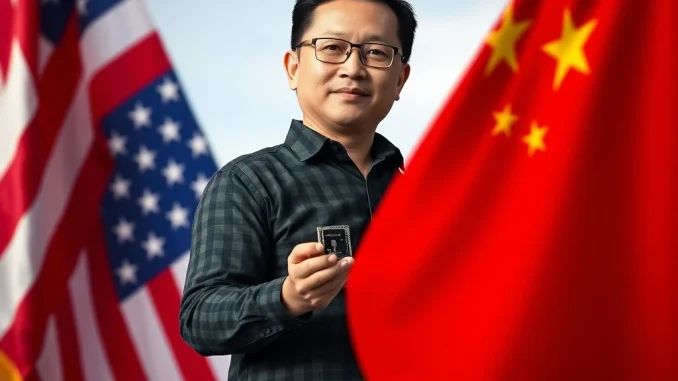
Nvidia, a titan in the semiconductor industry, powers everything from cutting-edge AI to advanced gaming. Consequently, when its **Nvidia CEO**, Jensen Huang, speaks, the tech world listens. Recently, Huang made a notable statement, expressing confidence that President Donald Trump will secure a favorable **US-China trade deal**. This sentiment offers a glimmer of hope amidst ongoing geopolitical complexities. However, Huang then added a surprising caveat: he expects the company’s **China sales** to remain at zero moving forward. This paradox has sparked significant discussion across the technology and financial sectors.
Nvidia CEO Jensen Huang’s Strategic Outlook
Jensen Huang, the visionary leader of Nvidia, recently shared his perspective on the intricate relationship between the United States and China. He conveyed a strong belief in the eventual success of a **US-China trade deal**. This confidence stems from a long-term view of global economic relations. However, Huang’s outlook also included a pragmatic assessment of Nvidia’s immediate future in the Chinese market. He anticipates that the company’s direct sales in China will effectively be non-existent for the foreseeable future.
This dual message highlights the delicate balance major tech companies must maintain. They navigate complex geopolitical landscapes. Huang’s statement suggests a strategic acceptance of current market realities. It also points to a focus on long-term opportunities. Understanding this nuanced position is crucial for stakeholders.
Understanding the US-China Trade Deal Dynamics
The **US-China trade deal** negotiations have profoundly impacted global industries. These discussions involve tariffs, intellectual property rights, and technological supremacy. The semiconductor sector, where Nvidia holds a dominant position, stands at the epicenter of these tensions. Both nations view advanced chip technology as critical for national security and economic growth. Therefore, any trade agreement carries immense weight.
Key areas of friction include:
- Export controls on advanced microchips.
- Restrictions on technology transfers.
- Concerns over data security and intellectual property.
These factors directly influence companies like Nvidia. They shape market access and supply chain strategies. A comprehensive deal could stabilize these conditions. Yet, the path remains uncertain.
Navigating China Sales Challenges for Nvidia
The expectation of zero **China sales** going forward represents a significant shift for Nvidia. China has historically been a crucial market for its gaming GPUs and, more recently, its powerful AI accelerators. This anticipated decline is largely attributed to escalating **tech trade tensions** and stringent export controls imposed by the U.S. government. These regulations aim to limit China’s access to advanced computing capabilities. Nvidia has worked to comply with these rules. It has developed specific chips, such as the H800 and L20, designed to meet export control thresholds. Despite these efforts, the market environment remains challenging. Chinese companies often prefer domestic alternatives or face restrictions on purchasing foreign technology.
This situation compels Nvidia to adapt its global strategy. It must seek growth in other regions. It also means focusing on diverse applications for its technology.
Broader Implications for the Tech Trade Landscape
Nvidia’s experience serves as a microcosm for the broader **tech trade tensions** affecting the global industry. Many technology companies face similar dilemmas. They must balance market opportunities with geopolitical risks. The ongoing trade disputes foster an environment of uncertainty. This uncertainty can lead to fragmented markets. It can also encourage localized supply chains. Companies are increasingly diversifying their manufacturing bases. They are also re-evaluating their market strategies. This strategic shift aims to mitigate risks associated with concentrated production or market reliance.
The long-term effects of these shifts include:
- Increased investment in domestic semiconductor production.
- Greater emphasis on geopolitical risk assessment in business planning.
- Potential for a bifurcated global technology ecosystem.
Ultimately, the industry is adjusting to a new normal. Geopolitics plays an ever-larger role in business decisions.
The Future of Nvidia and Geopolitical Strategy
Despite the challenges in China, **Nvidia CEO** Jensen Huang’s overall confidence remains notable. This confidence likely stems from Nvidia’s strong position in other burgeoning markets. The company continues to innovate in AI, data centers, professional visualization, and autonomous vehicles. These sectors offer substantial growth potential outside of the restricted Chinese market. Nvidia’s long-term strategy involves continuous technological leadership. It also includes strategic partnerships and market diversification. The company aims to reduce its reliance on any single market. This approach is vital in a volatile global economy.
Future developments in the **US-China trade deal** will undoubtedly shape the landscape. However, Nvidia appears prepared to navigate these complexities. It maintains its focus on innovation and global expansion.
In conclusion, Jensen Huang’s statement offers a nuanced view of the current global economic climate. His confidence in a future **US-China trade deal** reflects a hopeful long-term outlook. However, the immediate expectation of zero **China sales** underscores the significant impact of ongoing **tech trade tensions**. Nvidia, under Huang’s leadership, is strategically adapting. It focuses on diversification and innovation to maintain its leading position in the global technology arena. The tech world will watch closely as these dynamics continue to unfold, shaping the future of international trade and technological advancement.
Frequently Asked Questions (FAQs)
1. What did Nvidia CEO Jensen Huang say about the US-China trade deal?
Jensen Huang expressed confidence that President Donald Trump will secure a favorable trade agreement with China. However, he also stated his expectation that Nvidia’s sales in China would remain at zero going forward.
2. Why does Nvidia expect zero sales in China despite confidence in a trade deal?
This paradox arises from ongoing US export controls and **tech trade tensions**. Even with a broader trade deal, specific restrictions on advanced chips for AI and other strategic technologies are likely to persist, severely limiting Nvidia’s ability to sell its high-end products in the Chinese market.
3. How do US-China trade tensions affect Nvidia’s business?
Trade tensions directly impact Nvidia through export restrictions on its advanced chips. This forces the company to develop modified, less powerful versions for the Chinese market or to effectively exit certain segments, affecting its potential revenue and market share in China.
4. What is Nvidia’s strategy to cope with these challenges?
Nvidia’s strategy includes diversifying its markets and applications beyond China. It focuses on growth in areas like data centers, automotive, and professional visualization in other regions. The company also continues to innovate to maintain its technological leadership globally.
5. What are the broader implications for the tech industry?
Nvidia’s situation highlights wider challenges for the global tech industry, including market fragmentation, the need for diversified supply chains, and increased geopolitical risk assessment in business planning. Many companies are adjusting their strategies to navigate similar trade barriers and uncertainties.
6. Is Nvidia completely exiting the Chinese market?
While **Jensen Huang** anticipates zero direct sales of certain products due to restrictions, Nvidia is not necessarily exiting the entire Chinese market. It may continue to sell compliant products or engage in other business activities not affected by export controls. The focus is on adapting to specific regulatory environments.