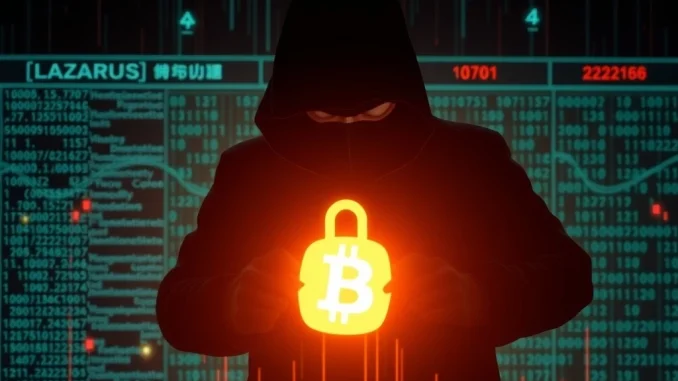
The cryptocurrency world recently faced another stark reminder of persistent cyber threats. Reports confirm that **North Korean hackers** are responsible for a significant $19.5 million **crypto theft** from the UK-based Lykke exchange. This audacious attack underscores the critical need for enhanced **cryptocurrency security** measures across the digital asset landscape. It highlights the evolving tactics of state-sponsored cybercriminals targeting vulnerable platforms.
Unmasking the Perpetrators: The Notorious Lazarus Group
In June 2024, Lykke exchange became the latest victim of a sophisticated cyberattack. The UK’s Office of Financial Sanctions Implementation (OFSI) linked the incident directly to the **Lazarus Group**, a notorious cybercrime syndicate. This group operates under the direct control of North Korea’s primary intelligence agency, the Reconnaissance General Bureau.
The **Lazarus Group** has a long history of targeting financial institutions and cryptocurrency platforms globally. They aim to circumvent international sanctions against North Korea. Their methods often involve elaborate phishing schemes, supply chain attacks, and exploiting software vulnerabilities. This group remains one of the most prolific and dangerous actors in the cybercrime arena.
Previous high-profile attacks attributed to the **Lazarus Group** include the 2017 WannaCry ransomware attack and the 2016 Bangladesh Bank heist. Furthermore, they are widely believed to be behind the 2022 Ronin Bridge hack, which saw over $600 million stolen. These incidents demonstrate their persistent efforts to illicitly acquire funds for the North Korean regime.
The Anatomy of a Crypto Theft: Tracing Stolen Funds
The $19.5 million stolen from Lykke exchange primarily consisted of Bitcoin (BTC) and Ethereum (ETH). Investigators quickly began tracing these digital assets. The laundering process revealed a complex web of transactions designed to obscure the funds’ origins. This strategy is typical for sophisticated **crypto theft** operations.
Investigators observed the stolen funds moving through various channels. These included:
- Thorchain: A decentralized cross-chain liquidity protocol, often favored for its ability to facilitate swaps between different cryptocurrencies without traditional intermediaries.
- No-KYC Exchanges: Platforms that do not require Know Your Customer (KYC) verification. These exchanges allow for greater anonymity, making it harder to track the ultimate beneficiaries.
- OTC Desks: Over-the-counter desks in specific regions like China, Cambodia, and Russia. These desks enable large-volume transactions outside of public exchanges, offering another layer of obfuscation.
The use of these diverse methods highlights the criminals’ intent to make the stolen assets virtually untraceable. This sophisticated laundering technique makes recovery incredibly challenging for law enforcement and affected exchanges.
Devastating Consequences for Lykke Exchange
The **Lykke exchange** suffered immensely from this significant cyberattack. The Daily Hodl reported that Lykke was liquidated in March following the June 2024 attack. This suggests the theft played a substantial role in the exchange’s financial distress. Such a large-scale breach often erodes user trust and operational stability, leading to severe financial repercussions.
The liquidation of **Lykke exchange** serves as a grim warning to other platforms. Even established exchanges face constant threats from highly organized cybercriminals. The incident underscores the fragility of digital asset platforms without robust **cryptocurrency security** protocols. It also highlights the need for adequate insurance and recovery plans.
Users of the **Lykke exchange** likely faced significant losses and disruption. Such events not only impact the exchange itself but also shake the confidence of the broader crypto community. Trust remains a cornerstone of the decentralized finance (DeFi) ecosystem, and breaches like this severely undermine it.
Strengthening Cryptocurrency Security Against North Korean Hackers
The persistent threat posed by **North Korean hackers** necessitates continuous improvement in **cryptocurrency security** measures. Exchanges must implement multi-layered defenses to protect user funds and operational integrity. This involves both technological advancements and human vigilance.
Key strategies for enhancing **cryptocurrency security** include:
- Robust Encryption: Implementing strong encryption protocols for all data, both in transit and at rest.
- Multi-Factor Authentication (MFA): Enforcing MFA for all user accounts and administrative access.
- Regular Security Audits: Conducting frequent third-party security audits and penetration testing to identify and patch vulnerabilities.
- Cold Storage: Storing a significant portion of assets in cold wallets (offline storage) to minimize exposure to online threats.
- Employee Training: Educating staff about phishing attempts, social engineering, and other common attack vectors.
- Incident Response Plans: Developing comprehensive plans for detecting, responding to, and recovering from cyberattacks.
For individual users, practicing good cyber hygiene is equally vital. Always use strong, unique passwords, enable MFA, and be wary of suspicious links or unsolicited communications. Verify the authenticity of any requests for personal information or funds. Vigilance remains a powerful defense against cyber threats.
Global Response and Regulatory Action
The UK’s OFSI’s swift attribution of the Lykke attack to the **Lazarus Group** demonstrates a growing global effort. International bodies and national governments are increasingly working to combat state-sponsored cybercrime. This cooperation is crucial for disrupting the financial networks that fuel these illicit activities.
Sanctions play a vital role in this response. Governments impose sanctions on individuals and entities linked to cyberattacks. This aims to cut off their access to the global financial system. However, the decentralized nature of cryptocurrencies presents unique challenges. Tracing and seizing stolen digital assets requires specialized expertise and cross-border collaboration.
Law enforcement agencies worldwide continue to enhance their capabilities in blockchain forensics. They collaborate with private sector security firms to identify and track illicit cryptocurrency flows. Despite these efforts, the anonymity offered by certain crypto services and the global reach of cybercriminals make this an ongoing battle.
The Lykke exchange **crypto theft** by **North Korean hackers** serves as a stark reminder of the persistent and evolving threats in the digital asset space. The **Lazarus Group** continues to pose a significant risk, compelling exchanges and users to prioritize **cryptocurrency security**. As the industry matures, the collective commitment to robust defenses, regulatory oversight, and international cooperation will be paramount. Only through concerted effort can the crypto ecosystem truly protect itself from such devastating attacks.
Frequently Asked Questions (FAQs)
Q1: Who is the Lazarus Group?
The Lazarus Group is a notorious cybercrime organization. It is linked to the North Korean government. They specialize in cyber espionage, sabotage, and financial theft, primarily targeting cryptocurrency exchanges and financial institutions to fund the regime’s illicit activities.
Q2: How much cryptocurrency was stolen from Lykke exchange?
North Korean hackers, specifically the Lazarus Group, stole approximately $19.5 million in cryptocurrency from the Lykke exchange. This theft occurred in June 2024.
Q3: How do hackers typically launder stolen cryptocurrency?
Hackers use various methods to launder stolen cryptocurrency. These often include decentralized exchanges (DEXs) like Thorchain, no-KYC exchanges, and over-the-counter (OTC) desks. They also use mixers or tumblers to obscure transaction trails. This makes the funds harder to trace.
Q4: What happened to Lykke exchange after the attack?
Reports indicate that Lykke exchange faced liquidation proceedings in March, following the significant cyberattack in June 2024. The large-scale theft likely contributed to its financial distress and eventual closure.
Q5: What measures can cryptocurrency exchanges take to improve security?
Exchanges can enhance security by implementing robust encryption, multi-factor authentication (MFA), regular security audits, and cold storage for most assets. They should also train employees on cybersecurity best practices and develop comprehensive incident response plans. These steps are crucial for robust **cryptocurrency security**.
Q6: Why do North Korean hackers target cryptocurrency?
North Korean hackers target cryptocurrency to bypass international sanctions. These sanctions severely limit the regime’s access to traditional financial systems. Crypto thefts provide a vital source of untraceable funds. These funds are then used to finance weapons programs and other state operations.