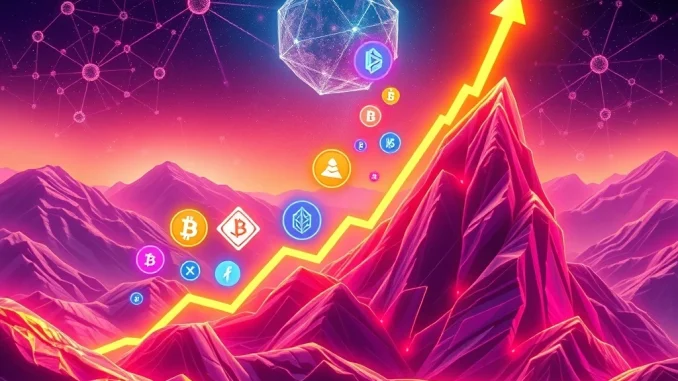
The cryptocurrency market is buzzing with renewed excitement, and this time, the spotlight isn’t solely on the established giants. A significant shift in investor sentiment is propelling a new wave of innovation, focusing on Mid-Cap Altcoins that are demonstrating tangible progress and groundbreaking utility. As the decentralized finance (DeFi) ecosystem continues its explosive expansion, these agile mid-tier projects are proving to be fertile ground for substantial returns. Among the most compelling narratives emerging this summer, BlockDAG stands out, not just for its ambitious vision but for an astonishing potential ROI that has investors scrambling to get in.
Why Are Mid-Cap Altcoins Capturing Investor Attention?
For too long, the crypto conversation has been dominated by Bitcoin and Ethereum. While their foundational roles are undeniable, the real dynamism and explosive growth potential often lie within the mid-cap segment. These are projects that have moved beyond mere concepts, showcasing functional products, growing user bases, and clear roadmaps for innovation. Their relatively smaller market capitalizations, compared to top-tier assets, mean that even moderate inflows of capital can lead to significant price movements, offering disproportionately higher returns for early and discerning investors.
Several factors contribute to this renewed focus on mid-cap projects:
- Innovation and Niche Solutions: Many mid-caps are addressing specific pain points or exploring novel applications within the blockchain space, from enhanced scalability to specialized DeFi protocols and AI integrations.
- Strong Community and Development: Projects like BlockDAG are fostering vibrant communities of developers and users, leading to rapid ecosystem expansion and continuous improvement.
- Undervalued Potential: Compared to their large-cap counterparts, many mid-caps may still be undervalued relative to their long-term potential, making them attractive for growth-oriented portfolios.
- DeFi Integration: A significant driver for many surging mid-caps is their deep integration and contribution to the burgeoning DeFi landscape, offering real-world utility and financial services.
Unpacking the BlockDAG ROI Potential: A Deep Dive into its Ecosystem
While many altcoins vie for attention, BlockDAG has emerged as a true sensation, captivating the market with its impressive technological advancements and a presale performance that’s turning heads. The project’s unique directed acyclic graph (DAG) architecture promises unparalleled scalability and efficiency, making it a powerful contender in the blockchain space.
BlockDAG’s ecosystem is rapidly expanding, boasting over 4,500 builders actively developing more than 300 projects. These initiatives span critical sectors like DeFi, artificial intelligence (AI), and various utility-driven applications, showcasing the versatility and robustness of the BlockDAG network. The project’s presale success speaks volumes, having raised a staggering $351 million through the sale of 24.3 billion tokens. Early investors have already reaped substantial rewards, with reports of a remarkable 2,660% return from Batch 1 to the current Batch 29 price of $0.0276.
But the excitement doesn’t stop there. BlockDAG has announced a limited-time offer, allowing new buyers to acquire BDAG tokens at an attractive price of $0.0016 until August 11. With a projected listing price of $0.05, this presents an astounding potential return on investment of 3,025%. This aggressive pricing strategy, combined with its rapid development and community growth, firmly positions BlockDAG as a standout name in the current altcoin season, making its potential BlockDAG ROI a topic of fervent discussion among investors.
How DeFi Growth is Fueling the Altcoin Resurgence
Decentralized Finance (DeFi) has transformed the financial landscape, offering a myriad of services like lending, borrowing, trading, and asset management without traditional intermediaries. This sector’s explosive growth has created immense demand for underlying blockchain infrastructure and native tokens that power these applications. DeFi Growth is not just a trend; it’s a fundamental shift, and mid-cap altcoins are uniquely positioned to capitalize on it.
Many of the surging altcoins are either core components of DeFi protocols or are enhancing the infrastructure that supports DeFi. Their utility is directly tied to the expansion and adoption of decentralized financial services. As more users and institutions enter the DeFi space, the demand for efficient, secure, and scalable blockchain networks increases, directly benefiting projects that can meet these needs. This symbiotic relationship between DeFi expansion and altcoin utility is a key driver behind the current market momentum.
Navigating the Surge: SUI Crypto and Its DeFi Dominance
Among the top performers, SUI Crypto is making significant strides, particularly within the DeFi and stablecoin sectors. Its innovative Move programming language and object-centric data model are designed for high throughput and low latency, making it ideal for scalable decentralized applications. SUI’s total value locked (TVL) has soared to an impressive $2.25 billion, signaling robust adoption and liquidity within its ecosystem. Furthermore, its stablecoin supply has seen a phenomenal 100-fold increase year-over-year, indicating growing trust and utility as a settlement layer.
Institutional interest in SUI is also on the rise, highlighted by a recent ETF filing by 21Shares, a major crypto ETP provider. This institutional validation could pave the way for broader mainstream adoption. From a technical perspective, SUI recently broke out of a bullish flag pattern on its weekly chart, a strong indicator of continued upward momentum. This breakout suggests a price target of $5.39, representing a substantial 45% increase from its current level of $3.85. With an impressive 368% annual return, SUI remains a critical altcoin for investors to monitor closely for sustained DeFi Growth.
Stellar Prospects: The Role of XLM Stellar in Cross-Border Payments
Stellar Lumens (XLM Stellar) continues to solidify its position as a leading blockchain for cross-border payments and asset issuance. Its ongoing compliance efforts, particularly with ISO 20022, are proving to be a significant tailwind, attracting both traditional financial institutions and new users. The network’s focus on regulatory clarity positions it favorably in an increasingly regulated crypto landscape.
Recent data underscores Stellar’s growing utility: its USDC volume surged by 189%, and USDC supply on the network increased by 22% in a single month. This indicates heightened activity and adoption for stablecoin transactions on the Stellar blockchain. Technically, XLM is forming a classic cup-and-handle pattern on its weekly chart, a bullish continuation signal. A successful breakout from its current $0.46 level could propel XLM to a target of $1.18. This potential surge follows a remarkable 100% price increase in July, driven by its strategic focus on efficient, low-cost cross-border payments and growing institutional partnerships.
CRO’s Strategic Play: Enhancing Scalability and Stablecoin Adoption
Cronos (CRO), the native token of the Cronos Chain, is gaining considerable traction, especially with its strategic focus on a US-compliant stablecoin launch in Q3. This move is anticipated to significantly boost its institutional adoption, particularly in regulated financial environments. Complementing this, the recent Cronos V2 upgrade has dramatically enhanced network scalability by a factor of 10, making it more robust and efficient for a wider range of decentralized applications.
From a market perspective, CRO is currently trading within an ascending channel, a pattern indicative of a strong uptrend. Fibonacci extension levels suggest a potential 124% rise, pushing CRO from its current $0.12 to a target of $0.27. This technical strength, combined with its strategic developments in stablecoins and scalability, positions CRO as a compelling mid-cap altcoin to watch, poised for further growth fueled by increased utility and institutional interest within the broader DeFi Growth narrative.
The Broader Altcoin Resurgence: What It Means for Investors
The resurgence of Mid-Cap Altcoins reflects a profound shift in investor sentiment. Gone are the days when speculative hype alone could sustain a project. Today, investors are prioritizing projects with clear use cases, measurable progress, strong development teams, and vibrant communities. The emphasis is on utility, scalability, and regulatory compliance, making projects like BlockDAG, SUI, XLM, and CRO particularly attractive.
For investors, this period presents both opportunities and challenges. While the potential for high returns is evident, due diligence remains paramount. It’s crucial to look beyond short-term price movements and evaluate a project’s fundamental strengths, its contribution to the broader blockchain ecosystem, and its ability to adapt to evolving market conditions. The current cycle highlights the importance of diversification, with mid-cap altcoins offering a compelling avenue for growth alongside more established assets.
In conclusion, the current crypto landscape is vibrant and dynamic, with Mid-Cap Altcoins leading the charge. While SUI, XLM, and CRO are capitalizing on critical developments in DeFi, stablecoins, and regulatory compliance, BlockDAG’s combination of rapid ecosystem growth, strategic limited-time pricing, and unparalleled BlockDAG ROI potential truly sets it apart. As the market continues to evolve, these innovative projects are poised to redefine the future of decentralized finance and beyond.
Frequently Asked Questions (FAQs)
Q1: What defines a “mid-cap altcoin” and why are they gaining traction?
A mid-cap altcoin typically refers to a cryptocurrency project with a market capitalization ranging from a few hundred million to several billion dollars. They are gaining traction because they offer a sweet spot between the stability of large-cap assets and the high volatility (and often higher risk) of micro-cap projects. Mid-caps have usually demonstrated some level of product-market fit, have active development, and possess significant growth potential as their ecosystems mature and adoption increases.
Q2: What makes BlockDAG’s 3,025% ROI potential so significant?
BlockDAG’s 3,025% ROI potential is significant because it represents a substantial return on investment in a relatively short period, especially for new buyers entering before August 11. This potential is based on the difference between its current presale price of $0.0016 and a projected listing price of $0.05. Such high potential returns are rare and often indicative of strong underlying technology, a rapidly expanding ecosystem with diverse applications (DeFi, AI, utility), and aggressive market positioning during its early stages.
Q3: How is DeFi growth influencing the performance of altcoins like SUI and CRO?
DeFi growth is a primary catalyst for altcoin performance because it creates demand for the underlying blockchain infrastructure and native tokens. For SUI, its high throughput and scalability make it ideal for DeFi applications, leading to soaring TVL and stablecoin adoption. For CRO, its Cronos V2 upgrade and upcoming US-compliant stablecoin directly enhance its utility within the DeFi ecosystem, positioning it for increased institutional adoption and network activity. Both projects directly benefit from the expanding utility and user base within decentralized finance.
Q4: What role does ISO 20022 compliance play for XLM Stellar?
ISO 20022 is a global standard for electronic data interchange between financial institutions. For XLM Stellar, compliance with this standard is crucial because it facilitates seamless integration with traditional financial systems. This makes Stellar’s network more attractive for banks and payment providers looking to leverage blockchain for cross-border transactions, significantly boosting its utility and adoption in the regulated financial sector.
Q5: What should investors consider when looking at mid-cap altcoins?
When evaluating mid-cap altcoins, investors should consider several factors: the project’s core technology and innovation, the strength and activity of its development team and community, its real-world utility and clear use cases (especially within growing sectors like DeFi), its market performance and technical indicators, and its regulatory compliance efforts. Diversification and understanding the inherent risks of crypto volatility are also key considerations.