In the unpredictable world of financial markets, where traditional valuations often take a backseat to collective enthusiasm, a familiar phenomenon is once again capturing headlines: the memestock frenzy. This time, the spotlight isn’t just on GameStop or AMC, but on an unexpected duo – Krispy Kreme (NASDAQ: DNUT) and GoPro (NASDAQ: GPRO). For those accustomed to the wild swings of cryptocurrency markets, the recent surges in these seemingly conventional stocks offer a fascinating parallel, driven by high short interest and the coordinated power of retail traders. What’s truly happening behind these dramatic price movements?
The Sweet Surge of Krispy Kreme Stock: More Than Just Doughnuts?
Krispy Kreme, a beloved name synonymous with sugary treats, has found itself unexpectedly caught in the memestock spotlight. Its stock, trading under the ticker DNUT, recently experienced a remarkable 39.5% weekly gain, pushing its price to $4.38. This surge is particularly notable given that DNUT had previously plummeted 72% from its July 2021 peak of $20.05. So, what’s fueling this unexpected rally for Krispy Kreme stock?
- High Short Interest: A significant factor is the substantial short interest, with 24.16 million shares shorted, representing 28.09% of its float. This high level of bearish bets makes the stock ripe for a short squeeze if buying pressure intensifies.
- Underlying Challenges: Despite the recent surge, Krispy Kreme faces considerable structural risks. The commoditization of its core doughnut product, coupled with high logistics costs, continues to weigh on its profitability. Q1 2025 earnings painted a concerning picture, revealing a 401.4% year-over-year net loss of $33.4 million and an operating loss of $20.3 million. The company’s cash balance of $18.7 million against $54.6 million in current liabilities further exacerbates liquidity concerns.
- Analyst Sentiment: Analysts surveyed by WSJ largely recommend holding the stock, with an average price target of $4.10, slightly below the current levels. This reflects a cautious optimism, perhaps tied to anticipated cost-cutting measures and product diversification efforts.
GoPro Shares Capture Attention: An Action-Packed Comeback?
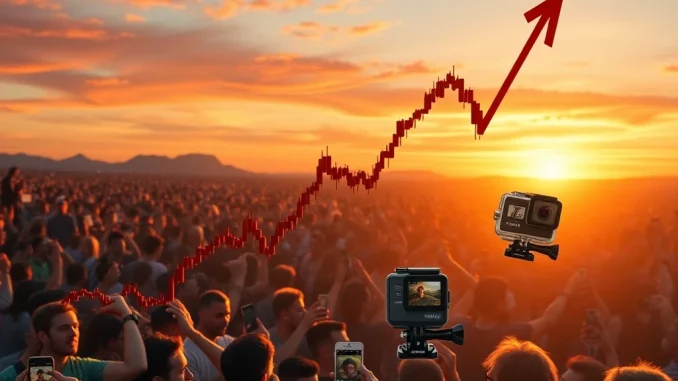
Joining Krispy Kreme in the memestock resurgence is GoPro, the action camera pioneer. GoPro shares (GPRO) witnessed an even more dramatic ascent, climbing an astounding 91% to $1.52, significantly outpacing its 52-week average. This rally is occurring despite persistent challenges in the highly competitive action camera market.
- Speculative Bets vs. Fundamentals: GoPro’s short interest stands at 9.69% (12.17 million shares), which, while lower than Krispy Kreme’s, is still enough to attract speculative attention. However, the company’s Q1 2025 sales dropped by 13.6%, resulting in a $46.7 million net loss.
- Market Headwinds: GoPro continues to battle intense smartphone competition, stagnant consumer demand, and the complexities of relocating supply chains to Vietnam and Thailand.
- Potential Catalysts: Recent legal victories against rival Insta360 over intellectual property claims have provided some stability. Furthermore, past consultations with JP Morgan have fueled speculation about a potential acquisition, adding another layer of volatility and appeal for speculative traders. Despite a $69.6 million cash position, its $316.9 million in liabilities underscore significant liquidity risks.
Understanding the Memestock Frenzy: What Fuels These Surges?
The recent rallies in DNUT and GPRO are not isolated incidents but rather a continuation of the memestock frenzy that first gripped markets in 2021. This phenomenon is characterized by several key elements:
At its core, a memestock frenzy is often a battle between institutional short-sellers and a decentralized army of retail investors. When a stock has high short interest, meaning a large percentage of its shares are borrowed and sold by investors betting on a price decline, it becomes vulnerable to a ‘short squeeze.’ If the stock price starts to rise, short sellers may be forced to buy back shares to cover their positions, further driving up the price and creating a feedback loop.
Here’s a quick comparison of the two:
| Metric | Krispy Kreme (DNUT) | GoPro (GPRO) |
|---|---|---|
| Weekly Gain | 39.5% | 91% |
| Short Interest (% of float) | 28.09% | 9.69% |
| Q1 2025 Net Loss | $33.4 million | $46.7 million |
| Current Price (approx.) | $4.38 | $1.52 |
The Power of Short Interest: A Double-Edged Sword
As highlighted, a crucial component of the memestock phenomenon is high short interest. When institutional investors or hedge funds believe a company’s stock is overvalued or its business model is failing, they borrow shares and sell them, hoping to buy them back later at a lower price and profit from the difference. This practice, while legitimate, creates a pool of potential buyers if the stock unexpectedly rises.
The higher the percentage of a company’s shares that are shorted, the more volatile it can become. A significant influx of buying, often from retail traders, can trigger a ‘short squeeze.’ This forces short sellers to cover their positions by buying shares back, which in turn drives the price even higher, creating a snowball effect. Both Krispy Kreme and GoPro exhibited notable short interest, making them prime candidates for such a scenario.
Are Retail Traders the New Market Movers?
The rise of commission-free trading platforms and online communities has empowered a new generation of investors. Retail traders, coordinating on platforms like Reddit’s WallStreetBets, have demonstrated their collective power to influence stock prices, particularly those with high short interest and low market caps. This decentralized force can challenge the dominance of institutional investors, creating a dynamic and often unpredictable market environment.
Unlike the traditional investment thesis driven by fundamentals, retail traders in the memestock space are often motivated by a mix of factors:
- Anti-establishment sentiment: A desire to challenge large hedge funds.
- Quick profit potential: The allure of outsized returns in a short period.
- Community and entertainment: The social aspect of participating in a collective movement.
This speculative appeal of DNUT and GPRO mirrors past memestock dynamics, driven by their low market caps, short squeezes, and the coordination of retail traders. However, a key distinction from GameStop’s resurgence (which was later bolstered by a Bitcoin treasury strategy) is that these companies currently lack clear, fundamental catalysts for sustained recovery. While Krispy Kreme’s low debt-to-equity ratio (0.83) offers some operational flexibility, both stocks remain highly vulnerable to disappointing earnings reports and broader macroeconomic headwinds.
Navigating the Volatility: Risks and Rewards for Investors
While the prospect of quick profits is enticing, investing in memestocks like DNUT and GPRO comes with significant risks. These are not typically long-term fundamental plays but rather short-term speculative vehicles. Investors considering these highly leveraged and capital-intensive models must weigh the potential rewards against the inherent dangers:
- Extreme Volatility: Prices can swing wildly, leading to rapid gains or substantial losses.
- Weak Fundamentals: Many memestocks have underlying operational or structural challenges that may not support sustained growth.
- Liquidity Risks: Thin liquidity can exacerbate price movements, making it difficult to enter or exit positions.
- Short-Lived Gains: Without fundamental improvements or sustained catalysts, any gains may be short-lived, as the initial speculative fervor fades.
For GoPro, the path to sustained profitability depends heavily on its ability to navigate supply chain costs, innovate effectively, and regain pricing power in a fragmented and competitive market. For Krispy Kreme, the challenge lies in diversifying its product line and optimizing its logistics to improve margins.
The Road Ahead: What to Watch For
As institutional short positions remain elevated, the upcoming earnings reports for both Krispy Kreme and GoPro will be critical. These reports could either ignite further speculative buying or trigger a sharp sell-off if results disappoint. The ongoing tug-of-war between retail traders and institutional short-sellers will likely continue to define the immediate future of these stocks.
While the excitement of the memestock frenzy is undeniable, investors are reminded that past performance is not indicative of future results. Thorough research, risk assessment, and a clear understanding of the underlying fundamentals are paramount before diving into such volatile waters. The story of Krispy Kreme and GoPro is a potent reminder of the market’s evolving dynamics, where community sentiment can, at times, override traditional valuation metrics, creating both unprecedented opportunities and significant pitfalls.
Frequently Asked Questions (FAQs)
Q1: What is a memestock frenzy?
A memestock frenzy refers to a rapid and significant surge in a company’s stock price, often driven by social media sentiment and coordinated buying by retail investors, rather than traditional financial fundamentals. These stocks typically have high short interest, making them susceptible to short squeezes.
Q2: Why are Krispy Kreme (DNUT) and GoPro (GPRO) considered memestocks now?
Both DNUT and GPRO have attracted attention due to their relatively low share prices (under $5), thin liquidity, and notable short interest. These characteristics make them appealing targets for retail traders seeking outsized returns and potential short squeezes, mirroring the dynamics seen with previous memestocks like GameStop.
Q3: What role does short interest play in a memestock’s surge?
High short interest means a large number of investors are betting against the stock. If the stock price begins to rise, these short sellers may be forced to buy back shares to limit their losses (covering their positions), which in turn creates additional buying pressure and can rapidly drive the stock price even higher, known as a short squeeze.
Q4: Are memestocks a good long-term investment?
Generally, memestocks are considered high-risk, speculative investments rather than good long-term plays. Their price movements are often driven by sentiment and short-term trading dynamics, not sustainable business fundamentals. While they can offer quick profits, they also carry a high risk of significant losses.
Q5: What are the main risks associated with investing in memestocks like DNUT and GPRO?
Key risks include extreme price volatility, weak underlying company fundamentals, liquidity risks (difficulty buying or selling without impacting the price), and the possibility that any gains will be short-lived once speculative interest fades. Investors can lose a substantial portion or all of their investment quickly.