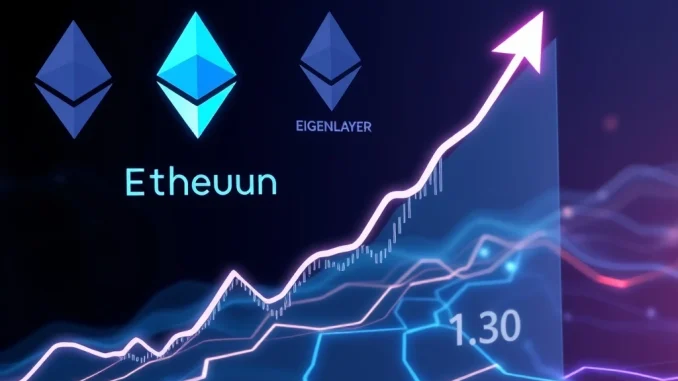
Are you tracking the latest in Ethereum’s scaling solutions? If so, then the buzz around Mantle (MNT) crypto is something you can’t afford to miss. This Ethereum Layer 2 solution is generating significant excitement among crypto analysts, with a bullish technical pattern pointing towards a potential price surge that could see MNT reach $1.30. Currently trading around $0.7543, Mantle’s trajectory is fueled not just by chart dynamics but also by strategic collaborations that could redefine its future.
Unpacking Mantle’s Bullish Technicals: A Deep Dive into Crypto Technical Analysis
At the heart of Mantle’s optimistic outlook is a fascinating chart formation known as a ‘right-angled descending broadening wedge.’ This pattern, often highlighted by renowned analysts like @ali_charts on X, is historically associated with significant upward reversals. For those familiar with classic texts like ‘Technical Analysis of Stock Trends’ by Edwards and Magee, such patterns have often preceded substantial gains, making this a key indicator for the Mantle price prediction.
Key Characteristics of the ‘Right-Angled Descending Broadening Wedge’:
- Formation: The pattern forms with a horizontal support line and a downward-sloping resistance line, creating a broadening shape as price volatility increases.
- Bullish Signal: Despite the descending nature, a breakout above the resistance line, especially when accompanied by strong volume, signals a potential reversal and upward momentum.
- Historical Context: While not foolproof, this pattern has a track record of preceding significant price movements, attracting the attention of seasoned traders looking for reversal opportunities.
However, it’s crucial to approach technical analysis with caution. A 2018 study in the Journal of Finance noted that broadening wedges succeed approximately 60% of the time. This means validation through strong volume and a definitive breakout above resistance levels is essential to confirm the pattern’s reliability. Traders are often advised to implement stop-loss orders below recent lows to mitigate risks associated with false signals.
The Strategic Edge: How EigenLayer Partnership Boosts Ethereum Layer 2
Beyond the charts, Mantle’s fundamental strengths provide a robust foundation for its potential growth. As one of Ethereum’s largest Layer 2 networks leveraging zero-knowledge proofs, Mantle is already a significant player in enhancing Ethereum’s scalability. The recent groundbreaking partnership with EigenLayer takes this a step further, integrating restaking technology – a first for L2 solutions. This collaboration, detailed on mantle.xyz, is designed to:
| Benefit Area | Impact of EigenLayer Partnership |
|---|---|
| Data Availability | Enhanced security and reliability for transaction data. |
| Scalability | Improved capacity to handle more transactions efficiently. |
| Security | Leveraging Ethereum’s economic security through restaking. |
| Ecosystem Growth | Attracting more dApps and users to Mantle’s network. |
This strategic move positions Mantle (MNT) crypto to significantly benefit from Ethereum’s expanding transaction volume, which has seen a 15% year-over-year increase according to L2Beat data. By integrating EigenLayer’s restaking capabilities, Mantle not only bolsters its technical infrastructure but also aligns itself with a cutting-edge trend in decentralized finance, potentially attracting more capital and development to its ecosystem.
Fueling Growth: The $200 Million EcoFund and MNT Crypto Demand
Further reinforcing the bullish narrative for MNT crypto is the substantial $200 million EcoFund. Supported by top-tier venture capital firms such as Polychain and Dragonfly, this fund underscores Mantle’s commitment to fostering a vibrant and innovative ecosystem. Such dedicated funding is crucial for:
- Developer Incentives: Attracting talented developers to build dApps and protocols on Mantle.
- Project Incubation: Supporting promising new projects from their nascent stages.
- Community Growth: Funding initiatives that expand Mantle’s user base and community engagement.
These ecosystem growth initiatives are designed to drive token demand by increasing utility and adoption within the Mantle network. A thriving ecosystem naturally translates into higher demand for the native token, providing a strong fundamental underpin for the projected Mantle price prediction.
Navigating the Path to $1.30: What Traders Need to Know
While the confluence of bullish technical patterns, strategic partnerships, and robust ecosystem funding paints a promising picture for Mantle, it’s essential for traders to remain vigilant. The path to $1.30 is not without its hurdles. Key factors influencing this rally include:
- Technical Validation: A confirmed breakout above resistance levels with significant volume is paramount. Without this, the wedge pattern’s 60% historical success rate leaves room for uncertainty.
- Macroeconomic Conditions: The broader cryptocurrency market sentiment plays a crucial role. While the overall market cap saw a slight growth of 0.16% recently, bearish pressures can quickly shift momentum.
- Execution of Mantle’s Infrastructure: The successful implementation and adoption of the EigenLayer integration and other technical advancements will be critical.
Traders are advised to monitor volume dynamics closely and keep an eye on broader market trends. These elements can either amplify the projected rally or pose significant headwinds. Responsible trading, including the use of stop-loss orders, remains crucial in this volatile market.
Conclusion: Mantle’s Moment in the Spotlight
Mantle (MNT) stands at a pivotal juncture, with a compelling blend of technical indicators and fundamental catalysts suggesting a significant upward movement. The ‘right-angled descending broadening wedge’ pattern, coupled with the pioneering EigenLayer partnership and the substantial EcoFund, paints an optimistic future for this key Ethereum Layer 2 solution. While the potential for a 72% surge to $1.30 is exciting, a balanced approach acknowledging market dynamics and the need for technical confirmation is vital. For those looking to stay ahead in the crypto space, Mantle’s journey is certainly one to watch closely.
Frequently Asked Questions (FAQs)
What is Mantle (MNT) Crypto?
Mantle (MNT) is an Ethereum Layer 2 (L2) scaling solution that utilizes zero-knowledge proofs to enhance the scalability, efficiency, and cost-effectiveness of transactions on the Ethereum blockchain. It aims to provide a high-performance environment for decentralized applications (dApps).
What is the ‘right-angled descending broadening wedge’ pattern?
It’s a bullish technical chart pattern characterized by a horizontal support line and a downward-sloping resistance line that widens over time. A breakout above the resistance line, ideally with strong volume, typically signals a potential upward price reversal, as observed in crypto technical analysis.
How does the EigenLayer partnership benefit Mantle?
The partnership integrates EigenLayer’s restaking technology into Mantle, making Mantle the first L2 to do so. This enhances data availability, scalability, and security by leveraging Ethereum’s economic security, potentially driving more adoption and demand for MNT crypto.
What is the significance of Mantle’s $200 million EcoFund?
The EcoFund, backed by major VC firms, is designed to foster ecosystem growth by incentivizing developers, incubating new projects, and expanding Mantle’s community. This sustained investment aims to increase the utility and adoption of the MNT token, supporting the Mantle price prediction.
Is the projected 72% surge for MNT guaranteed?
No, while technical patterns and fundamental developments suggest a strong potential, no price movement in the crypto market is guaranteed. The ‘right-angled descending broadening wedge’ has a historical success rate of about 60%, and the outcome also depends heavily on broader market conditions and confirmed technical breakouts with strong volume.