Are you tracking the latest movements in the crypto market? If so, you won’t want to miss the incredible momentum building around Mantle (MNT). This innovative token has just achieved a significant milestone, breaking through a crucial resistance level and signaling a potential for substantial gains. Get ready to dive deep into the technical analysis that suggests MNT price could be on the verge of an epic climb.
Has Mantle (MNT) Price Just Signaled a Monumental Breakout?
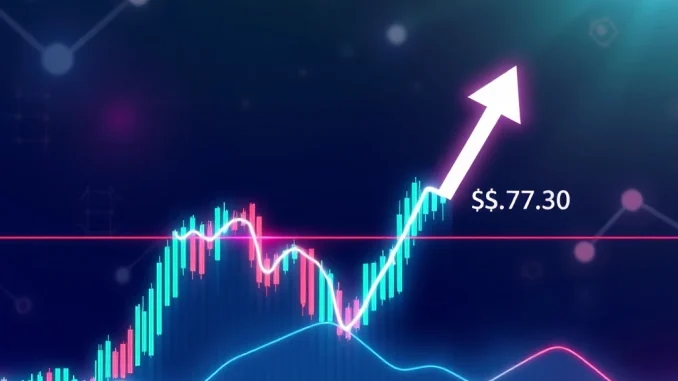
The crypto world is buzzing with excitement as Mantle (MNT) demonstrates impressive strength, surging past the critical $0.77 resistance level. This isn’t just a minor fluctuation; it’s a significant crypto breakout that technical analysts have been closely watching. For months, MNT had been consolidating within a complex descending broadening wedge pattern, a formation often indicative of strong future movements. The recent surge, marked by steep upward candlesticks in mid-July, has positioned the MNT price firmly above this key barrier, suggesting that bulls are now in control. This breakout isn’t merely speculative; it’s validated by increased trading volume, which lends credibility to the structural interpretation of the daily timeframe.
What Does the Descending Broadening Wedge Mean for MNT Price?
Understanding the technical patterns behind Mantle (MNT)‘s recent surge is crucial for any serious investor. The descending broadening wedge, a pattern characterized by diverging trendlines, signals a period of consolidation followed by a strong continuation move. In MNT’s case, this pattern formed over a four-month base, starting in April. As the pattern tightened, the stage was set for the explosive mid-July breakout. Historically, such right-angled structures have preceded significant price appreciation. We’ve already seen evidence of this, with MNT price jumping from a base near $0.55 to the $0.75 range in a relatively short period. The sustained buyer interest, reflected in consistent body growth of candlesticks and low shadowed candles, underscores the robust momentum driving this crypto breakout.
What Are the Key Mantle Resistance Levels and Fibonacci Targets?
With the Mantle resistance at $0.77 now decisively breached, attention shifts to potential higher targets. Technical analysis, specifically Fibonacci extensions, provides clear checkpoints for traders. These tools project potential targets at $0.99, $1.11, and the highly anticipated price target $1.30. These levels are not arbitrary; they are derived from precise mathematical relationships within the price movement, serving as key milestones for continued upward pressure. While the path to $1.30 might encounter intermediate tests, particularly around prior resistance levels near $0.86 (established in April and June), a clean break above $0.90 could significantly accelerate the move. Traders will be closely monitoring confluence zones between $0.99 and $1.11 for confirmation of sustained momentum, especially given the recent impressive surge in MNT price from $0.55 to intraday highs above $0.76.
How Can Mantle (MNT) Token Maintain Its Bullish Momentum?
While the outlook for Mantle (MNT) is undeniably bullish, short-term support levels remain critical for the continuation of this trend. The 0.618 Fibonacci level at $0.72 and the 0.5 level at $0.68 represent key consolidation zones. These levels act as a safety net; a failure to hold them could trigger a retracement, potentially challenging the validity of the recent crypto breakout. Conversely, sustained volume spikes and candlestick closes above $0.77 would strongly reinforce the case for further gains. Analysts emphasize that reaching the ambitious price target $1.30 will require a ‘second leg’ of price action, meaning continued strong buying pressure and clear breaks of subsequent resistance levels to confirm the breakout’s strength and sustainability for the MNT token.
What’s Next for Mantle (MNT) on Its Path to $1.30?
The structural integrity of the descending broadening wedge pattern, coupled with the recent Mantle resistance breach, provides a clear trajectory for the token. The upper horizontal resistance has been decisively broken, creating a powerful confluence of technical factors that could propel Mantle (MNT) higher. However, the ultimate sustainability of this move will hinge on sustained price action above $0.90 and, subsequently, $1.10. A firm hold above these levels could position MNT for a measured move towards its ambitious price target $1.30, a figure that aligns perfectly with both the wedge’s projected width and the Fibonacci extensions. For active traders, the immediate focus should remain on volume dynamics and candlestick behavior. Steep, high-volume candles closing above key resistance levels are often indicators of institutional participation, which is vital for validating long-term momentum. While the technical indicators are overwhelmingly positive, it’s always prudent to consider broader market conditions and macroeconomic factors, as these can influence even the strongest individual asset movements. The journey to the price target $1.30 for MNT price is set to be an exciting one, but vigilance and confirmation remain key.
In summary, Mantle (MNT) has executed a textbook crypto breakout, overcoming the significant $0.77 resistance. The confluence of a confirmed descending broadening wedge pattern, robust volume, and clear Fibonacci targets paints a compelling bullish picture for the MNT price. While potential intermediate hurdles exist, the technical setup strongly supports a move towards the ambitious price target $1.30. As the market watches for a ‘second leg’ of price action and sustained momentum, Mantle stands out as a token with significant upside potential, offering an exciting opportunity for traders and investors alike. Keep a close eye on those key support and resistance levels as MNT charts its course.
Frequently Asked Questions (FAQs)
1. What is the significance of Mantle (MNT) breaking $0.77 resistance?
Breaking the $0.77 resistance is highly significant because it was a critical technical barrier that Mantle (MNT) had been consolidating below for months. This decisive breach signals strong buying interest and confirms a bullish shift in its price trend, opening the door for further upward movement.
2. What is a descending broadening wedge pattern and why is it important for MNT?
A descending broadening wedge is a bullish reversal pattern characterized by two diverging trendlines. It indicates a period of price consolidation with increasing volatility, often preceding a strong upward breakout. For MNT, this pattern’s formation over four months suggests a robust base for its recent surge and validates the potential for continued gains.
3. What are the projected price targets for Mantle (MNT) after this breakout?
Based on Fibonacci extensions and the width of the descending broadening wedge pattern, analysts project potential price targets for Mantle (MNT) at $0.99, $1.11, and most notably, a long-term target of $1.30. These levels represent key milestones for the bullish trend.
4. What are the key support levels Mantle (MNT) needs to hold?
To sustain its bullish momentum, Mantle (MNT) needs to hold key short-term support levels. These include the 0.618 Fibonacci level at $0.72 and the 0.5 Fibonacci level at $0.68. A failure to maintain these levels could indicate a temporary retracement.
5. How important is trading volume in validating MNT’s breakout?
Trading volume is crucial for validating any price breakout. For MNT, the surge past $0.77 was accompanied by increased volume, which confirms that the move is backed by significant buying interest rather than just market noise. High volume suggests strong conviction behind the price action.
6. What does the ‘second leg of price action’ mean for Mantle’s target?
The ‘second leg of price action’ refers to a sustained continuation of the upward trend after the initial breakout. For Mantle (MNT) to reach its ambitious $1.30 price target, it will need to demonstrate continued strong buying pressure and successfully break through subsequent resistance levels (like $0.90 and $1.10) to confirm the strength and sustainability of the initial breakout.