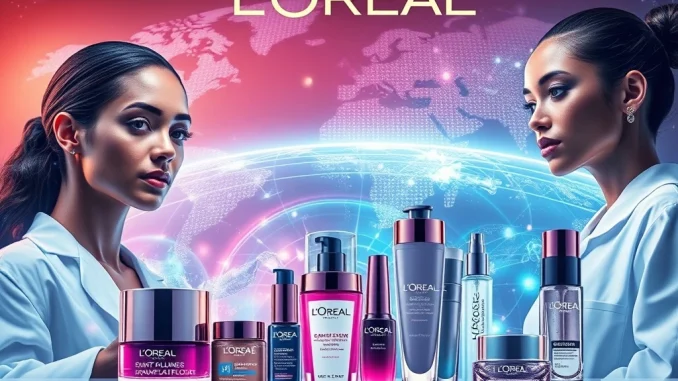
In an era defined by rapid technological shifts and fierce competition, industries across the board are looking for models of sustained success. While the cryptocurrency world grapples with its own unique challenges and opportunities, the principles of strategic foresight and adaptive innovation are universally valuable. L’Oréal, a global beauty titan, offers a compelling masterclass in achieving phenomenal growth, doubling its turnover since 2014 by mastering these very principles.
L’Oréal’s Phenomenal Growth Trajectory
How does a 116-year-old company not just survive but thrive and accelerate in a dynamic $450 billion industry? L’Oréal’s journey since 2014 is a testament to calculated strategy, achieving an impressive 12.3% like-for-like sales growth in key regions like Africa and Asia (excluding China, Japan, and Korea) in 2024 alone. This significant L’Oréal growth trajectory has seen the French cosmetics giant nearly double its 2014 turnover of $47 billion, consistently outperforming formidable rivals like Estée Lauder.
The Power of an Unwavering Innovation Strategy
At the heart of L’Oréal’s enduring success is an relentless commitment to innovation. The company’s deputy CEO, Barbara Lavernos, highlights innovation as the core of their approach. In 2024, L’Oréal invested a staggering €1.3 billion in research and innovation. This figure alone exceeds the combined budgets of its three largest competitors, underscoring a deep-seated belief in hard science and cutting-edge technology. This robust innovation strategy isn’t just about spending; it’s about pioneering advancements that redefine beauty. For instance, their researchers developed 3,636 new formulas in 2024, a testament to their prolific R&D engine.
Fueling Expansion Through Strategic Acquisitions
L’Oréal hasn’t just grown organically; its portfolio expansion through strategic acquisitions has been a game-changer. Since 2014, the company has skillfully integrated brands like NYX, CeraVe, and Dr. G, allowing them to tap into emerging trends such as Korean beauty without diluting the acquired brands’ unique identities. These partnerships are symbiotic: smaller brands gain access to L’Oréal’s vast global supply chain and marketing expertise, enabling them to scale rapidly. The majority acquisition of Medik8 in 2024, for example, signals collaborative R&D opportunities. Furthermore, licensing deals with luxury brands like Prada and Armani amplify L’Oréal’s reach, cementing its Luxe division’s global prestige beauty leadership.
Sustaining Beauty Market Dominance Through Diversification
Navigating a competitive landscape requires more than just good products; it demands strategic resilience. L’Oréal’s diversified portfolio is a key factor in its continued beauty market dominance. By spanning mass-market, prestige, and dermatological skincare categories, the company mitigates risks from market-specific downturns. For instance, if mass-market sales dip, prestige customers often trade down, providing a built-in stability mechanism. This multi-pronged approach, coupled with geographic diversification, ensures sustained growth even when certain regions, like China, experience slower growth for global brands.
Leveraging AI-Driven Technologies for Future Beauty
The future of beauty is increasingly digital and data-driven, and L’Oréal is at the forefront of this transformation through its adoption of AI-driven technologies. Consider BETiq, an AI system designed to optimize marketing spend, improving ROI by 10–15%. Beyond marketing, L’Oréal uses massive 14.5-terabyte datasets to create digital twins for complex hair types, such as curly and Afro-textured hair. This advanced modeling significantly accelerates product development, allowing for more precise and effective formulations. This fusion of science and artificial intelligence isn’t just about efficiency; it’s about creating hyper-personalized and ethically tested products, as exemplified by their use of reconstructed human skin for testing.
Challenges and the Path Forward
Despite its formidable success, L’Oréal isn’t immune to challenges. The U.S. mass-market makeup segment and evolving consumer demographics, particularly Gen Z and social media users, present ongoing shifts. However, L’Oréal’s ‘beauty stimulus’ plan for 2024, focusing on intensified product launches tailored for these demographics, demonstrates its proactive approach. Deputy CEO Barbara Lavernos encapsulates the company’s spirit, describing it as a ‘confrontational spirit’ where internal competition fuels continuous innovation. This agile mindset, combined with a long-term vision enabled by its family and Nestlé majority ownership, allows for sustained investment in R&D and M&A, ensuring consistency in strategy.
A Legacy of Vision and Adaptation
L’Oréal’s journey is a powerful narrative of how a legacy brand can not only adapt but lead in a rapidly evolving industry. By prioritizing scientific innovation, executing shrewd acquisitions, and leveraging advanced technologies like AI, the company has not merely kept pace but has set the pace. Its commitment to understanding and meeting diverse consumer demands, while maintaining brand integrity and a long-term strategic outlook, solidifies its position as a true leader in the global beauty landscape. This continuous pursuit of excellence ensures L’Oréal remains at the pinnacle of beauty innovation for years to come.
Frequently Asked Questions (FAQs)
Q1: How has L’Oréal achieved such significant growth in recent years?
A1: L’Oréal’s growth stems from a combination of strategic factors, including aggressive investment in research and innovation (over €1.3 billion in 2024), strategic acquisitions of emerging brands like CeraVe and Dr. G, and a diversified product portfolio spanning mass-market to prestige categories.
Q2: What role does innovation play in L’Oréal’s strategy?
A2: Innovation is central to L’Oréal’s strategy. They prioritize hard science and AI-driven technologies, leading to thousands of new formulas annually. Examples include AI systems for marketing optimization (BETiq) and digital twins for accelerating product development, ensuring they stay ahead of consumer demands.
Q3: How do L’Oréal’s acquisitions contribute to its market dominance?
A3: Acquisitions allow L’Oréal to quickly enter new market segments and trends (e.g., Korean beauty). They integrate acquired brands while preserving their distinct identities, leveraging L’Oréal’s global supply chain and marketing expertise to help these smaller brands scale significantly.
Q4: How does L’Oréal mitigate risks in a diverse global beauty market?
A4: L’Oréal mitigates risks through a highly diversified portfolio across mass-market, prestige, and dermatological skincare. This ensures stability, as different segments perform differently in various economic conditions. Geographic diversification also balances growth, reducing reliance on any single market.
Q5: What are some examples of AI-driven technologies L’Oréal uses?
A5: L’Oréal utilizes AI for various purposes, including BETiq for optimizing marketing spend and improving ROI, and using 14.5-terabyte datasets to create digital twins for hair types (like curly and Afro-textured hair) to accelerate and refine product development.
Q6: What is the significance of L’Oréal’s ownership structure?
A6: Majority ownership by the Bettencourt Meyers family and Nestlé provides L’Oréal with a long-term vision, enabling sustained investment in R&D and M&A without undue pressure for short-term gains. This “best of both worlds” approach combines agility with market discipline.