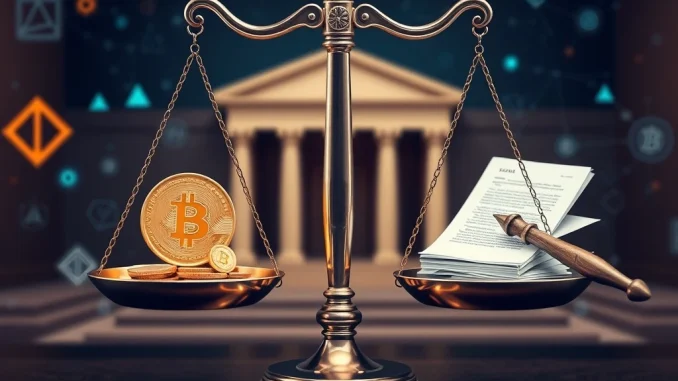
Imagine a digital token launched purely for laughs, a satirical jab at the serious world of finance, suddenly finding itself at the epicenter of a colossal $280 million legal showdown. This isn’t a plot from a new crypto thriller; it’s the very real, unfolding drama surrounding the **Libra memecoin** project. With a pivotal August 19 hearing fast approaching, the crypto world is watching closely to see how this unprecedented case will redefine the boundaries of digital speculation, legal accountability, and the very nature of decentralized assets.
The Unfolding **Libra Memecoin** Saga: From Satire to Serious Scrutiny
The LIBRA cryptocurrency project, initially conceived as a tongue-in-cheek satirical token, has spiraled into a monumental $280 million legal dispute. At the heart of this controversy is its founder, Hayden Davis, who has made a startling admission in a U.S. court filing: the initiative was never intended as a legitimate financial investment. Davis openly described LIBRA as a ‘memecoin’ – a category of cryptocurrency primarily driven by internet culture, humor, and speculative trading, often lacking any fundamental utility or intrinsic value.
The case, now under the vigilant eye of Judge Jennifer L. Rochon in the Southern District of New York, involves a substantial sum of frozen cryptocurrency assets. These assets are directly linked to LIBRA’s meteoric, yet fleeting, rise and subsequent crash in value earlier this year. The rapid boom-and-bust cycle of such tokens is a common, albeit dangerous, characteristic of the memecoin market, but LIBRA’s story takes a unique turn with allegations of fraud and significant misuse of funds now dominating the narrative.
The saga truly kicked off when Davis aggressively promoted the LIBRA token across various social media platforms. As is often the case with memecoins, this social media buzz fueled an intense surge in its value, only for it to plummet just as quickly, often within mere hours. This volatility, while inherent to memecoins, has drawn the ire of investors who now seek legal recourse, transforming a playful experiment into a high-stakes legal battle.
Was It Ever a Real Investment? Hayden Davis’s Startling Admission
One of the most compelling aspects of this case is Hayden Davis’s defense strategy. As reported by Argentine media outlet Clarín, Davis’s legal team has argued vehemently that the LIBRA token was never presented as an organized investment vehicle. Their core assertion is that the project lacked fundamental elements typically associated with legitimate financial endeavors, such as:
- A formal business plan
- A clear distribution strategy
- A defined expenditure framework
Instead, the defense has classified LIBRA, and similar memecoins, as “unsecured affinity and collectible goods.” This classification suggests that these tokens are akin to digital collectibles or social experiments, holding no intrinsic value and carrying no expectation of financial return. It’s a bold legal stance that directly challenges the very premise of the plaintiff’s claims, asserting that investors should have understood the speculative, non-investment nature of the asset from the outset.
This defense stands in stark contrast to the claims brought forth by plaintiff Omar Hurlock. Hurlock is actively seeking to initiate a class-action lawsuit against Davis, co-creator Benjamin Chow, and other associated parties. His legal team contends that despite any satirical branding, the promotion and subsequent financial activity surrounding LIBRA created an environment where investors were led to believe they were making a legitimate financial investment, rather than simply acquiring a humorous digital collectible.
Tracing the Funds: Suspicious Transactions and the **Crypto Fraud** Allegations
The legal proceedings have unearthed a trail of suspicious financial activity directly linked to Davis’s accounts, intensifying the accusations of **crypto fraud**. These transactions paint a picture of rapid asset movement coinciding with significant public events, raising red flags for regulators and investors alike. Key financial movements under scrutiny include:
- January 30th Transfer: Wallets reportedly linked to Davis transferred a substantial $500,000 in USDC (a stablecoin pegged to the U.S. dollar) to Kraken, a prominent cryptocurrency exchange. This transfer suspiciously coincided with a high-profile meeting between Davis and Argentine President Javier Milei. The timing suggests a potential attempt to liquidate or move funds during a period of heightened public attention.
- Post-Encounter Movement: Shortly after an image of Davis’s encounter with President Milei surfaced online, another wallet associated with Davis executed a transfer of over half a million dollars via Bitget, another popular crypto exchange. This subsequent large transaction further fueled suspicions about the strategic movement of funds.
Adding to the complexity, these transactions are not isolated. They are reportedly connected to other controversial tokens, including MELANIA (named after former U.S. First Lady Melania Trump). The involvement of multiple tokens and significant sums across different exchanges has deepened concerns about potential patterns of misuse of investor funds and sophisticated financial maneuvers designed to obscure their origin or purpose. Investigators are meticulously examining these transfers to determine if they constitute illegal activity or a deliberate attempt to defraud investors.
Navigating the Legal Labyrinth: Setbacks and Challenges for Plaintiffs
Omar Hurlock’s legal team has faced considerable headwinds in their efforts to advance the class-action lawsuit. Judge Rochon recently dealt a significant blow to their strategy by dismissing Hurlock’s request to depose the defendants. The judge’s reasoning was clear: Hurlock had not adequately demonstrated personal financial harm directly attributable to the LIBRA project. This ruling is a critical setback, as a class-action lawsuit typically requires a lead plaintiff who can prove direct, tangible injuries to represent the broader group of affected individuals.
This decision complicates the path forward for the potential class action, forcing Hurlock’s legal team to re-evaluate their strategy for proving widespread damages. Meanwhile, Davis’s defense has not shied away from aggressive counter-accusations. They have publicly labeled Hurlock’s attorney, Max Burwick, a “crypto ambulance chaser” – a derogatory term used to describe lawyers who actively seek out social media investors involved in failed crypto projects, often with the intent of initiating lucrative litigation opportunities. This accusation aims to undermine the plaintiff’s credibility and portray the lawsuit as opportunistic rather than genuinely driven by investor harm.
The Broader Implications: **Memecoin Regulation** and Market Volatility
Beyond the immediate financial and legal ramifications for Hayden Davis and Omar Hurlock, the LIBRA case carries profound implications for the nascent field of **memecoin regulation**. The defense’s attempt to challenge the jurisdiction of the case, seeking to relocate it to Argentina or Texas, highlights the complex, often ambiguous, legal landscape governing decentralized digital assets. This strategic move is likely driven by the hope of finding a more favorable legal environment or a jurisdiction with less stringent interpretations of crypto law.
The connection to Argentina’s political landscape, specifically the meeting with President Javier Milei, adds another layer of intrigue. Milei, known for his pro-crypto stance, could potentially influence the perception or legal treatment of such assets within Argentina, making it a potentially more amenable venue for the defense. This jurisdictional tug-of-war underscores the global nature of cryptocurrency and the challenges regulators face in establishing consistent legal frameworks across different nations.
The outcome of this trial could set a critical precedent for how memecoins are viewed and regulated worldwide. Currently, these highly speculative assets operate in a largely unregulated grey area. A ruling in favor of the plaintiffs could pave the way for stricter investor protection laws, potentially classifying memecoins as securities or regulated financial products, thereby subjecting them to more rigorous oversight. Conversely, a ruling favoring the defense could reinforce the idea that investors in memecoins assume full risk, treating them as mere collectibles outside traditional financial regulation.
The $280 million in frozen funds remains a central piece of the puzzle. Regulators and investors are eagerly awaiting clarity on their origin, how they were deployed, and whether they were indeed mismanaged or illegally obtained. The investigation into these funds will be crucial in determining the final judgment and potential restitution for affected parties.
The August 19 Hearing: A Critical Juncture for the Future of Crypto
The upcoming August 19 hearing is poised to be a pivotal moment in this unfolding drama. The court will delve deep into how the funds were acquired, deployed, and potentially mismanaged. This session is expected to scrutinize the financial flows, the intent behind the LIBRA project, and the validity of both the plaintiff’s fraud allegations and the defense’s “satirical token” argument.
The outcome of this hearing, and ultimately the trial, holds immense significance for the broader cryptocurrency ecosystem. It could:
- Establish a Legal Precedent: Provide a clearer legal definition and regulatory framework for memecoins, influencing future enforcement actions.
- Impact Investor Confidence: Either bolster or erode trust in the memecoin market, depending on whether investor protection is prioritized.
- Shape Regulatory Approaches: Encourage governments and financial bodies to develop more robust guidelines for novel digital assets.
- Influence Founder Accountability: Send a strong message to project founders regarding their legal responsibilities, even for seemingly satirical ventures.
For now, the future of the LIBRA project, its founder Hayden Davis, and co-creator Benjamin Chow remains shrouded in uncertainty. This case is a stark reminder of the volatile intersection of digital finance, legal accountability, and the often-unpredictable nature of internet-driven speculative assets. It underscores the critical need for both investors to exercise extreme caution and for regulators to adapt quickly to the rapidly evolving landscape of decentralized finance.
Frequently Asked Questions (FAQs)
Q1: What is a memecoin, and how does LIBRA fit into this category?
A memecoin is a cryptocurrency inspired by internet memes, pop culture, or humorous concepts. Unlike traditional cryptocurrencies that aim to solve real-world problems, memecoins often derive their value from community hype, social media trends, and speculative trading. LIBRA was launched as a satirical token, intended as a humorous experiment rather than a serious financial investment, fitting the definition of a memecoin due to its lack of intrinsic utility and reliance on viral promotion.
Q2: What are the main allegations against Hayden Davis and the LIBRA project?
The primary allegations against Hayden Davis and the LIBRA project revolve around fraud and misuse of investor funds. Plaintiffs claim that despite being labeled satirical, the project’s promotion led investors to believe it was a legitimate financial opportunity. Suspicious financial transactions, including large transfers to exchanges coinciding with public appearances, have fueled concerns about the proper handling of the $280 million in frozen assets.
Q3: Why is the August 19 hearing so important?
The August 19 hearing is a critical juncture because the court will examine how the frozen funds were acquired, deployed, and potentially mismanaged. The outcome could set a significant legal precedent for how memecoins are classified and regulated in the future, impacting investor protection and founder accountability across the entire cryptocurrency sector.
Q4: What does the defense mean by classifying LIBRA as “unsecured affinity and collectible goods”?
By classifying LIBRA as “unsecured affinity and collectible goods,” Hayden Davis’s defense team argues that the token was never meant to be an investment in a traditional sense. Instead, they contend it was more akin to a digital collectible or a social experiment, lacking a formal business plan or expectation of financial return. This defense aims to absolve the founders of liability by asserting that investors should have understood the speculative, non-investment nature of the token.
Q5: How does this case relate to **memecoin regulation**?
This case is highly relevant to **memecoin regulation** because it directly challenges the current legal ambiguity surrounding these assets. A ruling could determine whether memecoins are treated as securities, requiring stricter oversight, or remain largely unregulated. The outcome will influence how governments and financial bodies approach the rapidly growing and often volatile memecoin market, potentially leading to new guidelines for investor protection and market transparency.
Q6: What are the risks associated with investing in memecoins?
Investing in memecoins carries extremely high risks due to their inherent volatility, lack of intrinsic value, and reliance on speculative hype. They are highly susceptible to rapid price fluctuations, often driven by social media trends rather than fundamental analysis. Investors face significant risks of total capital loss, as these projects often lack formal business plans, regulatory oversight, and may be prone to ‘pump-and-dump’ schemes or outright fraud.