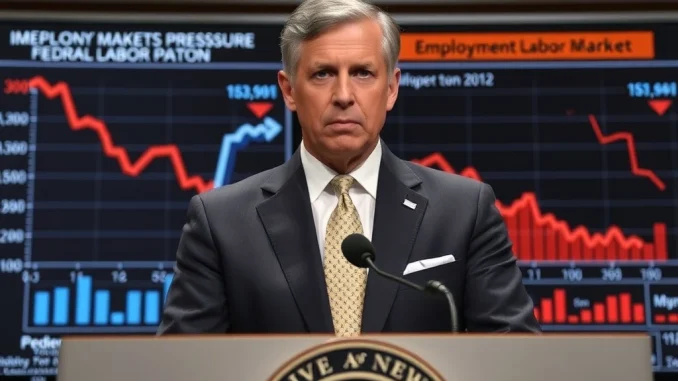
Investors in the cryptocurrency space closely watch macroeconomic signals. Therefore, a recent statement from a top financial official demands attention. Federal Reserve Vice Chair Philip Jefferson delivered a **crucial warning** regarding the nation’s employment landscape. He indicated that the labor market is slowing down, a development with significant implications for the broader economy and potentially for digital asset valuations.
Labor Market Slowing Down: What the Fed Says
Federal Reserve Vice Chair Philip Jefferson recently provided a sober assessment. He stated that various data points suggest the labor market is slowing down. This slowdown could lead to increased pressure on employment. Furthermore, it might result in larger job losses. A rise in the unemployment rate is also a distinct possibility.
Jefferson did not specify the exact data he reviewed. However, such assessments typically consider several key indicators. These include job openings, hiring rates, wage growth, and initial jobless claims. Indeed, a consistent trend across these metrics points to a cooling job market. This cooling follows a period of robust growth. Consequently, the Fed monitors these changes closely. They understand the profound impact on household finances and overall economic stability.
Understanding the Federal Reserve Outlook
The Federal Reserve maintains a dual mandate. It aims for maximum employment and price stability. Therefore, comments from officials like Jefferson are highly significant. His remarks offer a direct insight into the central bank’s current thinking. They also hint at future policy directions. A softening labor market could influence the Fed’s approach to interest rates. Historically, the Fed might ease monetary policy if economic conditions weaken substantially. This would support job growth.
The Fed’s primary tool for managing the economy is the federal funds rate. Raising rates slows economic activity. Conversely, lowering rates stimulates it. Jefferson’s statement reflects the Fed’s careful balancing act. They aim to cool inflation without causing a severe economic downturn. This delicate situation defines the current Federal Reserve outlook.
Impact on the US Economic Forecast
A significant slowdown in the labor market directly affects the US economic forecast. Consumer spending drives a large portion of economic activity. When job growth falters, consumer confidence often declines. People may reduce discretionary spending. This, in turn, can slow down businesses. Consequently, companies might cut investments or lay off more workers.
This creates a cycle of reduced economic activity. Furthermore, a weaker labor market could signal broader economic fragility. It raises concerns about a potential recession. Economists closely watch these indicators. They help predict future growth trends. Therefore, Jefferson’s remarks underscore the challenges facing the economy. They highlight the need for careful navigation by policymakers.
Potential Rise in Unemployment Rate Predictions
Vice Chair Jefferson specifically mentioned a potential rise in the unemployment rate. This is a critical indicator of economic health. The unemployment rate measures the percentage of the labor force that is jobless and actively seeking employment. A sustained increase signals economic distress. It impacts individual livelihoods and national productivity.
Current unemployment rate predictions vary. However, a significant slowdown in hiring could quickly push these numbers higher. For instance, if businesses respond to lower demand by freezing hiring or implementing layoffs, unemployment rises. This situation creates financial strain for many families. It also affects their ability to save and invest. Monitoring this metric remains paramount for the Fed and financial markets.
Navigating the Economic Slowdown Impact for Investors
An **economic slowdown impact** reverberates across all financial markets. Traditional assets like stocks and bonds react to changes in economic data. Furthermore, the cryptocurrency market, while often seen as distinct, is not immune. Bitcoin and other digital assets have shown increasing correlation with traditional markets. This is especially true during periods of economic uncertainty.
During a slowdown, investors often seek safer assets. They might move away from riskier investments. Cryptocurrencies are generally considered higher-risk assets. Therefore, a weakening labor market and a bleak economic outlook could trigger volatility in crypto prices. Savvy investors will closely monitor Fed communications. They will also assess global economic trends. Diversification and risk management become even more crucial during such times.
What This Means for Cryptocurrency Markets
Cryptocurrency markets are highly sensitive to liquidity. They also react to investor sentiment. A slowing labor market suggests tighter financial conditions. It indicates less disposable income for retail investors. This could reduce new capital flowing into crypto. Furthermore, a cautious macroeconomic environment often leads institutional investors to de-risk their portfolios.
Conversely, some might argue that a deteriorating economic outlook could push investors towards assets perceived as hedges against inflation or traditional financial system instability. However, the current environment suggests a flight to quality. This often benefits established assets over nascent ones. Therefore, understanding the broader **economic slowdown impact** is vital for crypto participants.
In conclusion, Federal Reserve Vice Chair Philip Jefferson’s statements offer a clear signal. The **labor market is slowing down**. This development carries significant weight for the entire **US economy**. It influences the **Federal Reserve outlook** and shapes **unemployment rate predictions**. Consequently, investors across all asset classes, including cryptocurrencies, must remain vigilant. They should prepare for potential shifts in market dynamics. Staying informed about these macroeconomic trends is essential for making sound investment decisions.
Frequently Asked Questions (FAQs)
Q1: What exactly did Fed Vice Chair Philip Jefferson say about the labor market?
A1: Fed Vice Chair Philip Jefferson indicated that a broad range of data suggests the **labor market is slowing down**. He warned of potential pressures, including larger job losses or an increase in the unemployment rate.
Q2: How does a slowing labor market affect the US economy?
A2: A slowing labor market can reduce consumer spending and confidence. This can lead to slower economic growth, lower business investment, and potentially contribute to an **economic slowdown impact** on the overall **US economy**.
Q3: What is the Federal Reserve’s role in monitoring the labor market?
A3: The Federal Reserve has a dual mandate to achieve maximum employment and price stability. Therefore, they closely monitor labor market data to inform their monetary policy decisions, such as adjusting interest rates, which directly influences the **Federal Reserve outlook**.
Q4: How might a slowing labor market impact cryptocurrency markets?
A4: A slowing labor market often signals tighter economic conditions and reduced investor risk appetite. This can lead to decreased liquidity and potential volatility in cryptocurrency markets, as investors may move towards less risky assets during an **economic slowdown impact**.
Q5: What are some key indicators of a slowing labor market?
A5: Key indicators include a decrease in job openings, a slowdown in hiring rates, moderating wage growth, and an increase in initial jobless claims. These factors collectively contribute to the assessment of a **labor market slowing down**.