Are international sanctions truly airtight? A recent report by blockchain intelligence firm TRM Labs suggests otherwise, revealing an alarming trend: Kyrgyzstan crypto platforms are allegedly being exploited by Russian entities to circumvent global restrictions. This isn’t just about financial transactions; it points to a significant loophole in the global effort to curb illicit finance, with potential ramifications for geopolitical stability.
Unmasking the Illicit Network: The TRM Labs Report
A comprehensive analysis by UK-based blockchain intelligence firm TRM Labs, released in July 2025, has brought to light compelling evidence. The core finding? Russian entities are actively leveraging Kyrgyzstan’s burgeoning cryptocurrency industry to evade international sanctions imposed after Russia’s invasion of Ukraine in February 2022. The report paints a picture of Central Asian crypto platforms serving as conduits for illicit financial activity.
- Significant Link to Shuttered Exchanges: A substantial portion of the suspicious transactions is reportedly linked to Garantex, a Russian exchange that has since been shut down. This suggests a continuation of previous illicit financial networks.
- Post-Invasion Growth: Before the 2022 invasion, Kyrgyzstan’s crypto sector was virtually non-existent. Its rapid expansion post-invasion, now predominantly serving Russian-linked interests, raises significant red flags.
- Irregularities Identified: TRM Labs highlighted numerous irregularities, including the proliferation of shell companies sharing identical addresses, contact details, and even founders. This pattern is indicative of a concerted effort to obscure ownership and operations.
How Russian Sanctions Evasion Funnels Through Central Asia
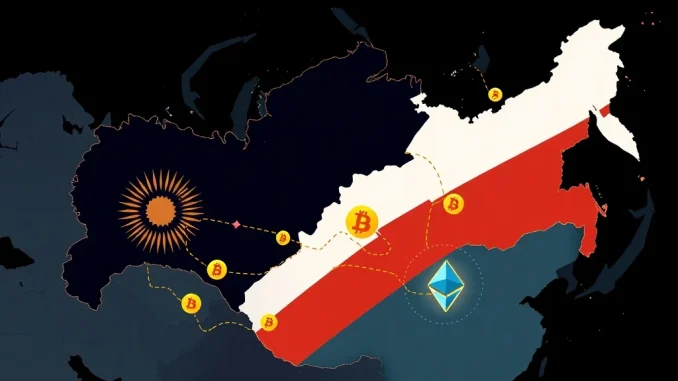
The report details the mechanisms through which this alleged Russian sanctions evasion is occurring. Platforms like Grinex and Meer are at the heart of these operations, facilitating ruble-to-crypto conversions. A key element in this process is the use of Russian-backed stablecoins, such as A7A5, which previously routed Garantex funds directly into Kyrgyzstan’s crypto ecosystem.
The implications extend beyond mere financial transfers. TRM Labs identified connections between Kyrgyz exchanges and entities like the Rusich Group, a paramilitary organization, registered with Envoys Vision Digital Exchange (EVDE). These platforms are reportedly interacting with cross-border logistics firms and Chinese financial institutions. This intricate web of connections facilitates Russia’s procurement of ‘dual-use goods’—items with both civilian and military applications—such as semiconductors and drones, critical for its ongoing conflict efforts.
The role of Central Asian crypto hubs, particularly Kyrgyzstan, in this scheme appears to be growing. Trade data supports this, showing a 64% increase in Chinese exports of dual-use goods to Kyrgyzstan and Kazakhstan between 2022 and 2023, reaching $1.3 billion. Furthermore, bilateral trade between Kyrgyzstan and Russia hit $3.5 billion in 2023, and Russian imports via Central Asian nations surged to $20 billion in the first half of 2023. These figures underscore Kyrgyzstan’s expanding role in Russia’s sanctioned economic strategies, significantly aided by its underregulated crypto sector.
The Alarming Growth of Kyrgyzstan Crypto
Kyrgyzstan’s swift embrace of cryptocurrency infrastructure, propelled by a pro-crypto law enacted in January 2022, has paradoxically amplified these risks. This law classified cryptocurrencies as property and established a registration regime for Virtual Asset Service Providers (VASPs). The growth figures are staggering:
- In the first seven months of 2024 alone, VASPs in Kyrgyzstan recorded an astonishing $4.2 billion in transactions.
- This contrasts sharply with just $59 million recorded throughout the entirety of 2022.
Despite this exponential growth, TRM Labs emphasizes a crucial point: local demand for crypto in Kyrgyzstan remains minimal. This suggests that the sector’s rapid expansion is not driven by domestic interest but rather serves as an extension of Russian crypto activity. The country’s Ministry of Finance is even developing a USD-pegged stablecoin, USDKG, further indicating its integration into broader global crypto networks, which could inadvertently create more pathways for illicit flows if not properly regulated.
Vulnerabilities and the Threat of Illicit Crypto Finance
Critics point to Kyrgyzstan’s inherent governance vulnerabilities as a primary catalyst for this exploitation. Transparency International’s 2024 Corruption Perceptions Index ranked Kyrgyzstan 25 out of 100, highlighting “serious concerns” about judicial independence and transparency. Altynai Myrzabekova of Transparency International noted that the nation’s weak checks and balances, coupled with expanding executive power, create fertile ground for illicit crypto finance flows.
While Transparency International did not independently verify the specific use of Kyrgyz crypto exchanges by Russian actors, their assessment aligns with the broader risks posed by state capture and opaque resource control in the region. The lack of robust regulatory oversight and enforcement mechanisms leaves the door open for malicious actors to exploit the crypto sector for their own gains, undermining global financial integrity and sanctions regimes.
Conclusion: A Call for Urgent Action
The TRM Labs report serves as a stark warning. Without stronger safeguards and a genuine commitment to transparency, Kyrgyzstan’s crypto industry could remain a persistent vector for illicit finance. The report unequivocally calls for enhanced transparency measures and robust political will to enforce anti-money laundering (AML) frameworks. The current governance weaknesses leave the country “highly exposed to exploitation by corrupt actors and sanctioned entities,” posing a significant challenge to international efforts to maintain financial security and stability.
Frequently Asked Questions (FAQs)
1. What is the main finding of the TRM Labs report regarding Kyrgyzstan?
The TRM Labs report identifies that Russian entities are extensively using Kyrgyzstan’s cryptocurrency sector to evade international sanctions imposed after the 2022 invasion of Ukraine, leveraging its rapid growth and regulatory vulnerabilities.
2. How are Russian entities allegedly using Kyrgyzstan’s crypto sector for sanctions evasion?
They are reportedly using Kyrgyz crypto platforms like Grinex and Meer to convert rubles to crypto, often utilizing Russian-backed stablecoins like A7A5. These activities are linked to shell companies and facilitate the procurement of dual-use goods, such as semiconductors and drones, for Russia.
3. What are ‘dual-use goods’ and why are they relevant to this report?
Dual-use goods are items that can be used for both civilian and military purposes. They are relevant because the report suggests that illicit financial flows through Kyrgyzstan’s crypto sector are helping Russia acquire these goods, which are critical for its military efforts, circumventing sanctions designed to restrict such procurements.
4. Why has Kyrgyzstan’s crypto sector grown so rapidly, according to the report?
Kyrgyzstan enacted a pro-crypto law in January 2022, classifying cryptocurrencies as property and establishing a VASP registration regime. This legal framework, combined with minimal local demand, suggests the growth is primarily driven by external, Russian-linked interests seeking avenues for illicit finance.
5. What are the broader risks associated with Kyrgyzstan’s crypto activity?
The risks include the undermining of international sanctions, facilitating financial crime and money laundering, and contributing to geopolitical instability by enabling sanctioned entities. Kyrgyzstan’s governance vulnerabilities and weak anti-money laundering frameworks exacerbate these risks.
6. What recommendations does TRM Labs offer to address these issues?
TRM Labs recommends enhanced transparency measures and a stronger political will within Kyrgyzstan to enforce robust anti-money laundering (AML) frameworks. This is crucial to prevent the country’s crypto industry from remaining a persistent vector for illicit financial activities.