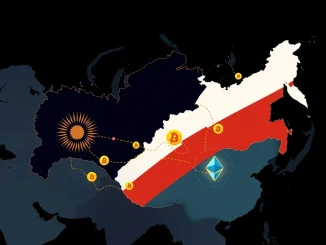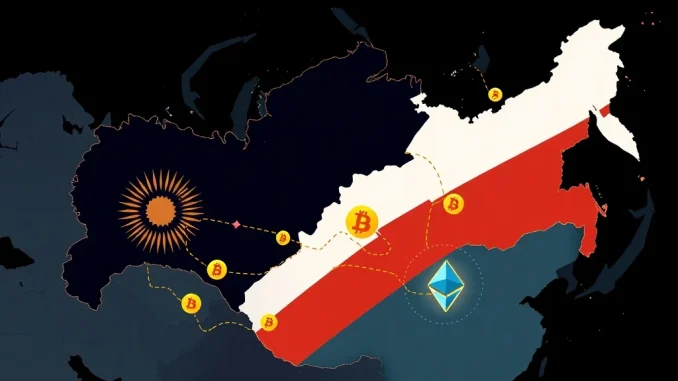
In the intricate world of global finance, new challenges constantly emerge, testing the resolve of international sanctions. A recent, alarming report by British blockchain intelligence firm TRM Labs has cast a spotlight on Kyrgyzstan crypto infrastructure, revealing its pivotal role in enabling Russian entities to bypass international sanctions. This isn’t just about financial transactions; it’s a complex web of digital deception that threatens global financial stability and highlights the ever-evolving tactics of illicit networks.
Unmasking the Sanctions Bypass: How Russian Entities Exploit Kyrgyzstan Crypto
The TRM Labs analysis paints a clear picture: Russian entities are leveraging Kyrgyzstan’s burgeoning cryptocurrency ecosystem to circumvent international restrictions. The report specifically highlights how Kyrgyz-based platforms—including Grinex, Meer, and EVDE—are intricately linked to Russian exchanges like Garantex, which has already faced bans from Western regulators. These platforms facilitate critical ruble-to-crypto conversions, often utilizing stablecoins such as A7A5, enabling sanctioned individuals and groups to sidestep traditional financial barriers.
- Interconnected Operations: TRM Labs identified suspicious operational overlaps among Kyrgyz exchanges, noting shared addresses, founders, and contact details. This suggests a coordinated effort rather than isolated incidents.
- Timely Transitions: For instance, Grinex began allowing A7A5 withdrawals just days after Garantex’s shutdown in March 2025, a timing that strongly suggests pre-planned, coordinated activity designed to maintain continuity of illicit financial flows.
- Shell Firms and Obfuscation: Experts suspect some of these platforms operate as shell firms, specifically designed to obscure transaction trails and make tracing funds significantly more challenging for authorities attempting to enforce Russian sanctions.
A Permissive Framework: How Kyrgyzstan’s 2022 Crypto Law Fuels Crypto Evasion
A key enabler of this illicit activity is Kyrgyzstan’s regulatory framework. A 2022 law formally recognized virtual assets and, crucially, allowed foreign Virtual Asset Service Providers (VASPs) to register without requiring in-person visits. This policy has created a magnet for Russian entities eager to establish untraceable crypto services, exploiting the ease of registration and the perceived lack of stringent oversight.
The economic impact of this permissive environment is stark:
- By 2024, bilateral trade between Russia and Kyrgyzstan surged to an astonishing $3.5 billion.
- Russian investments in Kyrgyzstan grew by a significant 23% year-on-year.
This economic growth, while seemingly positive, raises serious questions when viewed through the lens of heightened crypto evasion activities and the potential for financial circumvention.
Beyond Currency: The Flow of Dual-Use Goods and Russian Sanctions
The implications extend far beyond mere financial transactions. The TRM Labs report also sheds light on Kyrgyzstan’s role in channeling dual-use goods to Russia—items that have both civilian and military applications. Data indicates a significant increase in Chinese exports of critical technologies like drones, semiconductors, and anti-UAV (unmanned aerial vehicle) equipment to Kyrgyzstan and Kazakhstan.
- Between 2022 and 2023, these exports increased by a staggering 64%, reaching $1.3 billion.
- These goods are often shipped via Kyrgyzstan to mask their ultimate end use in Russia, effectively bypassing export controls and exacerbating the challenge of enforcing Russian sanctions related to military capabilities.
This connection reveals a sophisticated network designed not only to move money but also to facilitate the acquisition of strategic materials.
The Alarming Surge in Stablecoin Transactions and VASP Volumes
The expansion of Kyrgyzstan’s crypto ecosystem has been rapid and directly correlated with the onset of the Russian-Ukrainian war. The statistics are compelling:
- VASP transaction volumes skyrocketed from $59 million in 2022 to an astounding $4.2 billion in the first seven months of 2024.
- This explosive growth directly aligns with the heightened demand for alternative financial channels by sanctioned Russian actors.
The pervasive use of stablecoins like A7A5 further complicates tracking efforts. These digital assets act as intermediaries in ruble conversions, creating additional layers of anonymity and making it exceedingly difficult for authorities to trace the flow of funds back to their origins or intended recipients. The sheer volume of these stablecoin transactions underscores the scale of the challenge.
What Does the TRM Labs Report Mean for Global Financial Stability?
The situation highlighted by the TRM Labs report raises profound concerns about the overall effectiveness of international sanctions and the remarkable adaptability of illicit financial networks. Kyrgyzstan’s strategic location, coupled with its highly permissive regulatory environment, has inadvertently made it a crucial hub for cross-border evasion tactics.
TRM Labs issues a stern warning: without swift and decisive action, similar tactics and evasion strategies could easily spread to other regional jurisdictions, creating a ripple effect that further undermines global financial integrity and security. The ability of sanctioned entities to innovate and exploit regulatory gaps poses a continuous threat to the international financial system.
Countering the Threat: Steps Towards Strengthening Global Financial Integrity
In response to these revelations, Western governments are intensifying their calls for increased collaboration with Kyrgyz authorities. The goal is clear: to identify and close the loopholes that enable such widespread evasion.
Key actions deemed essential to disrupt these networks and safeguard global financial stability include:
- Strengthening Transparency: Implementing more robust transparency measures in regional exchanges to make transaction trails more visible.
- Enhancing Regulatory Alignment: Fostering greater international regulatory alignment to prevent bad actors from simply moving their operations to less regulated jurisdictions.
- Information Sharing: Improving the sharing of intelligence and data between nations to proactively identify and mitigate threats.
These measures are crucial steps in a continuous battle against financial crime and the erosion of sanctions effectiveness.
Conclusion
The TRM Labs report serves as a critical wake-up call, highlighting how Kyrgyzstan’s crypto landscape has become an unwitting facilitator for Russian sanctions evasion. The intricate dance between permissive laws, rising crypto volumes, and the flow of dual-use goods paints a concerning picture for global security and financial stability. As illicit networks grow more sophisticated, the onus is on international cooperation and robust regulatory frameworks to stem the tide. Only through concerted efforts can we hope to disrupt these evolving threats and uphold the integrity of the global financial system.
Frequently Asked Questions (FAQs)
1. What is the main finding of the TRM Labs report regarding Kyrgyzstan?
The TRM Labs report primarily finds that Kyrgyzstan’s cryptocurrency infrastructure, particularly due to its permissive 2022 crypto law, is being actively used by Russian entities to evade international sanctions, often through the use of stablecoins and linked crypto exchanges.
2. How does Kyrgyzstan’s 2022 crypto law enable sanctions evasion?
The 2022 law recognized virtual assets and allowed foreign Virtual Asset Service Providers (VASPs) to register without requiring in-person visits. This ease of registration and lack of stringent oversight has attracted Russian entities seeking to establish untraceable crypto services to bypass financial restrictions.
3. Which specific crypto platforms are implicated in this activity?
The report implicates Kyrgyz-based platforms such as Grinex, Meer, and EVDE, which are linked to Russian exchanges like Garantex. These platforms show suspicious operational overlaps, suggesting coordinated activity for evasion.
4. Are stablecoins primarily used for this evasion, and why?
Yes, stablecoins like A7A5 are frequently used as intermediaries in ruble-to-crypto conversions. They are favored because they can complicate tracking efforts, adding layers of anonymity to transactions and making it harder for authorities to trace illicit financial flows.
5. What are dual-use goods, and how are they related to this evasion?
Dual-use goods are items with both civilian and military applications (e.g., drones, semiconductors). The report indicates that Kyrgyzstan serves as a transit point for increased Chinese exports of these goods to Russia, helping to mask their end use and bypass export controls related to Russian sanctions.
6. What actions are Western governments urging to counter this threat?
Western governments are urging increased collaboration with Kyrgyz authorities, strengthening transparency in regional crypto exchanges, and enhancing international regulatory alignment. The goal is to close loopholes, disrupt illicit networks, and safeguard global financial stability.