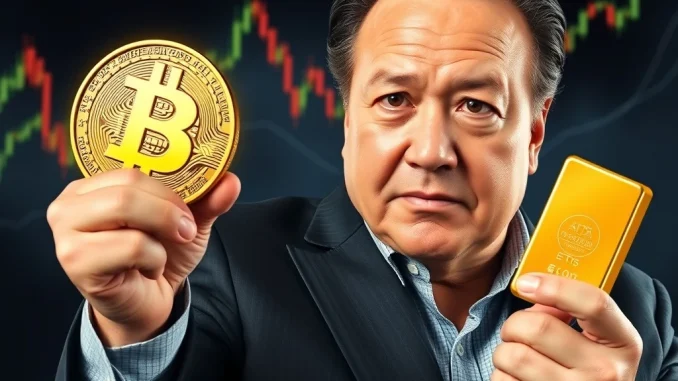
In the ever-shifting sands of the global economy, prominent financial author Robert Kiyosaki, best known for ‘Rich Dad Poor Dad,’ has once again ignited a fiery debate. His recent pronouncements have sent ripples through the investment community, particularly concerning the merits of Bitcoin and gold versus their exchange-traded fund (ETF) counterparts. As market volatility continues to be a defining characteristic of our times, Kiyosoki’s bold stance urges investors to rethink their strategies, advocating for direct ownership of tangible assets over what he controversially labels ‘paper versions.’
Robert Kiyosaki’s Stinging Critique of ETFs: Why Direct Ownership Matters
Kiyosaki has not held back in his criticism of ETFs, particularly when it comes to their reliability during times of crisis. His central argument revolves around the fundamental difference between owning an asset directly and owning a fund that merely tracks its price. He starkly illustrates this point by comparing an ETF to ‘having a picture of a gun for self-defense’—a symbolic representation that offers no practical utility when faced with real danger. This analogy underscores his belief that in a true economic downturn, the liquidity and security promised by ETFs may evaporate, leaving investors vulnerable.
For Kiyosaki, the appeal of direct ownership, whether it’s physical gold and silver or self-custodied Bitcoin, lies in the complete control it offers. In an era where trust in centralized financial institutions is often questioned, the ability to bypass intermediaries and hold one’s assets independently becomes a paramount concern for many. He argues that this self-custody approach is a critical component of a defensive strategy against anticipated global instability, contrasting sharply with conventional financial advice that often promotes diversified portfolios, including ETFs.
Key Reasons Behind Kiyosaki’s Anti-ETF Stance:
- Lack of Direct Ownership: ETFs are financial instruments that represent ownership of underlying assets, but do not confer direct possession.
- Counterparty Risk: In a severe market collapse, Kiyosaki fears the potential for ETF providers to face issues, impacting investors.
- Practical Utility in Crisis: He questions the real-world utility of a ‘paper’ asset when physical or digital self-custody offers tangible control.
- Bypassing Intermediaries: Direct ownership removes the need for centralized custodians, aligning with a more sovereign approach to wealth.
The Allure of Gold and Bitcoin Amidst Market Volatility
Kiyosaki’s advocacy for gold, silver, and Bitcoin isn’t just about slamming ETFs; it’s about identifying what he believes are the ultimate safe-haven assets in a world teetering on the brink of economic uncertainty. He views these assets as non-correlated to traditional markets, meaning their value tends to move independently, offering a hedge against inflation and systemic financial risks. This perspective has resonated deeply with a segment of investors, leading to notable inflows into both gold and Bitcoin ETFs, even as Kiyosaki himself criticizes the ETF structure.
His long-term price projections for these assets are nothing short of audacious, forecasting Bitcoin to reach an astonishing $500,000 to $1 million by 2035, gold hitting $25,000 per ounce, and silver climbing to $70 per coin. These figures reflect his profound belief in the intrinsic value and scarcity of these assets, especially in an environment of unprecedented money printing and potential currency debasement. While critics highlight the logistical challenges of physical assets like storage costs and liquidity, Kiyosaki frames any potential price declines in these assets not as losses, but as prime opportunities to accumulate more.
Why Gold and Bitcoin are Kiyosaki’s Chosen Safe Havens:
- Inflation Hedge: Both assets have historically served as stores of value against inflationary pressures.
- Scarcity: Finite supply, especially for Bitcoin, drives long-term value potential.
- Decentralization (Bitcoin): Operates outside traditional financial systems, reducing systemic risk.
- Historical Resilience (Gold): Proven track record as a safe haven during economic turmoil.
Understanding Investor Behavior: From Caution to Capital Inflows
Kiyosaki’s influential voice, amplified through platforms like X (formerly Twitter) and various media outlets, has demonstrably impacted investor behavior. His warnings about impending market ‘bubbles’ collapsing have reinforced a cautious sentiment among many, prompting a re-evaluation of portfolio allocations. This caution, paradoxically, has translated into increased demand for physical assets and, notably, a surge in inflows into gold and Bitcoin ETF products.
The market dynamics post-Kiyosaki’s remarks highlight a growing preference for assets perceived as secure and independent. While he advocates for direct custodianship, the sheer accessibility and convenience of ETFs mean that even those who heed his warnings about market instability might still turn to ETF vehicles as a proxy for exposure to gold and Bitcoin. This surge in demand is further supported by year-to-date trends driven by ongoing geopolitical tensions and macroeconomic uncertainties, making the case for safe-haven assets even stronger.
Navigating the Evolving Landscape: Challenges and Opportunities
While Kiyosaki’s emphasis on tangible assets aligns with historical safe-haven strategies, the inclusion of Bitcoin introduces a layer of volatility typically absent in the gold or silver markets. This juxtaposition underscores the evolving landscape of wealth management, where traditional and emerging assets now coexist in uncertain economic climates. For investors, the challenge lies in balancing the potential for high returns with the inherent risks.
Critics often point to the practicalities: storing physical gold requires secure vaults, and managing Bitcoin self-custody demands technical proficiency and careful security practices. These are the very logistical hurdles that ETFs aim to mitigate, offering a simpler, albeit less direct, pathway to asset exposure. However, Kiyosaki’s argument forces investors to weigh convenience against control, particularly when considering worst-case scenarios.
Actionable Insights for Investors:
- Diversify Wisely: Consider a mix of traditional and alternative assets, including direct holdings of precious metals and Bitcoin.
- Assess Risk Tolerance: Understand the volatility associated with Bitcoin and the storage implications of physical gold.
- Educate Yourself: Learn about self-custody solutions for digital assets and secure storage for physical assets.
- Long-Term Perspective: Kiyosaki’s projections are long-term; short-term market fluctuations should be expected.
In conclusion, Robert Kiyosaki’s impassioned advocacy for physical gold, silver, and Bitcoin, coupled with his strong warnings against ETFs, serves as a powerful reminder for investors to critically assess their holdings. As market volatility persists and economic uncertainties loom, his message resonates with those seeking greater control and security over their wealth. While the debate between direct ownership and ETF convenience continues, Kiyosaki’s influence undeniably contributes to a growing investor sentiment towards tangible, non-correlated assets as crucial components of a resilient financial strategy.
Frequently Asked Questions (FAQs)
1. Why does Robert Kiyosaki prefer direct ownership of Bitcoin and gold over ETFs?
Kiyosaki believes that ETFs are ‘paper versions’ of assets that may not offer real protection or liquidity during severe economic crises. He advocates for direct ownership (self-custody for Bitcoin, physical possession for gold/silver) to ensure complete control and eliminate counterparty risk, comparing ETFs to a picture of a gun for self-defense rather than the real thing.
2. What are Kiyosaki’s long-term price predictions for Bitcoin and gold?
Robert Kiyosaki has made bold long-term forecasts, projecting Bitcoin to reach $500,000 to $1 million by 2035, gold to hit $25,000 per ounce, and silver to climb to $70 per coin. These projections are based on his belief in their intrinsic value as hedges against inflation and economic instability.
3. How has Kiyosaki’s stance impacted investor behavior?
His warnings have contributed to increased investor caution and a notable surge in demand for safe-haven assets. While he criticizes ETFs, his influence has paradoxically led to significant inflows into both gold and Bitcoin ETF products, as investors seek exposure to these assets, even if through indirect means.
4. What are the main challenges of direct ownership of physical gold and Bitcoin?
For physical gold, challenges include secure storage costs, insurance, and liquidity constraints when needing to sell. For Bitcoin, self-custody requires technical proficiency, robust security practices (like managing private keys), and the risk of permanent loss if keys are lost or stolen. ETFs aim to mitigate these logistical challenges.
5. Does Kiyosaki believe market downturns for Bitcoin and gold are bad?
No, he views potential price declines in gold, silver, and Bitcoin as opportunities to increase holdings. He frames such downturns as advantageous moments to accumulate more of these assets, particularly in an environment of systemic financial risks and anticipated market ‘bubbles’ collapsing.