Are you navigating the turbulent waters of today’s financial markets? The world of cryptocurrency and traditional assets is constantly evolving, and understanding how to protect your wealth has never been more crucial. Amidst this uncertainty, renowned author and financial educator Robert Kiyosaki, known for his ‘Rich Dad Poor Dad’ series, has once again offered timely and provocative insights into a robust Bitcoin investment strategy. His recent advice distinguishes between approaches for the average investor and the sophisticated holder, emphasizing physical assets and strategic patience in an era of perceived monetary instability.
Robert Kiyosaki’s Dual-Tiered Investment Approach
In July 2025, Robert Kiyosaki laid out a compelling dual-tiered investment strategy, designed to help individuals secure their financial future. His recommendations highlight a stark difference in how average investors and sophisticated investors should approach assets like Bitcoin, gold, and silver. This isn’t just about what to buy, but how to hold it.
- For the Average Investor: Kiyosaki advocates for accessibility. He suggests that Bitcoin ETFs, along with gold and silver ETFs, serve as excellent entry points for the general public. These instruments simplify exposure to these valuable assets, making them digestible for those less familiar with direct ownership complexities. They offer a convenient way to gain exposure without the hassle of managing private keys or storing physical bullion.
- For the Sophisticated Holder: Here’s where Kiyosaki’s contrarian philosophy truly shines. For those with deeper expertise and understanding, he strongly emphasizes direct ownership of physical gold, silver, and Bitcoin. His reasoning is simple yet profound: these assets offer “real security” when traditional markets destabilize. He famously likened ETF ownership to “having a picture of a gun for personal defense,” underscoring the limitations of paper-based exposure during crises. True control, in his view, comes from direct possession.
This distinction is central to his philosophy, arguing that understanding the difference between paper and physical assets is key to outperforming average investors and truly achieving wealth preservation.
Why Physical Assets Matter: A Deeper Dive into Monetary Instability
Kiyosaki’s investment strategy stems from a deep-seated skepticism of traditional financial systems and a constant focus on proactive wealth preservation. He consistently warns against the dangers of fiat currencies and the inflationary pressures created by central bank policies. His warnings extend to broader macroeconomic risks, drawing parallels to historical precedents:
- The 1987 Market Crash: A stark reminder of how quickly markets can turn and how traditional portfolios can suffer.
- The 2023 Banking Sector Turmoil: Recent events that underscored the fragility of the banking system and the potential for traditional savings methods to fail during periods of monetary debasement.
“Savers are Losers,” he reiterates, a mantra that encapsulates his view on the eroding purchasing power of cash held in savings accounts. He frames the Federal Reserve’s repeated liquidity injections as a direct threat to wealth preservation, arguing that these actions devalue currencies and necessitate a shift towards hard assets. His stance aligns with his long-standing critique of central banks and a firm belief that physical assets are superior shields against inflation and systemic shocks.
Navigating Bitcoin ETFs: Convenience vs. Control
The emergence and growing popularity of Bitcoin ETFs have democratized access to the world’s leading cryptocurrency, bringing it into the portfolios of mainstream investors. These exchange-traded funds offer unparalleled convenience, allowing individuals to gain exposure to Bitcoin’s price movements through traditional brokerage accounts, without the complexities of direct cryptocurrency management. They eliminate the need for crypto wallets, private keys, or understanding blockchain technology in depth, making Bitcoin investing as simple as buying a stock.
However, Kiyosaki’s perspective introduces a crucial caveat: while convenient, these paper representations diverge significantly from his ideal of direct ownership. His analogy of a “picture of a gun” highlights the core difference: an ETF represents a claim on an asset, not direct possession. In times of extreme financial crisis or systemic breakdown, the ability to physically control your assets becomes paramount. This distinction underscores a persistent debate within the crypto and gold communities: can paper representations of cryptocurrencies and commodities truly replicate the security and sovereignty of tangible ownership?
Robert Kiyosaki’s Personal Bitcoin Accumulation Plan
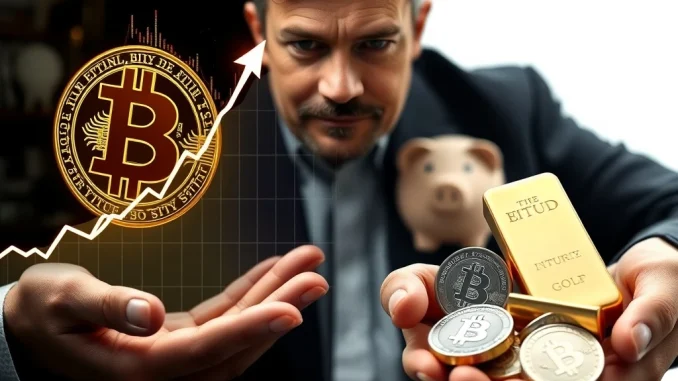
Despite his cautionary tone regarding broader economic risks, Kiyosaki remains bullish on Bitcoin’s long-term potential. He openly shares his personal accumulation strategy, which balances confidence with pragmatic timing. When Bitcoin surpassed $120,000, he expressed his intent to acquire “one more coin,” but crucially, he warned against greed. Referencing his timeless mantra: “Pigs get fat… Hogs get slaughtered,” he stressed the importance of patience, indicating he would pause further accumulation until the economic trajectory becomes clearer.
This approach highlights a key aspect of his Bitcoin investment strategy: it’s not just about buying, but about buying smart. He speculates that Bitcoin could reach anywhere from $200,000 to $1 million, yet his actions reflect a pragmatic view of short-term volatility and the need to capitalize on opportune moments. For newcomers, he advises starting small, suggesting even a “Satoshi” (a tiny fraction of a Bitcoin) as a feasible entry point. This contrasts sharply with the risks of large, ill-timed purchases, which can lead to significant losses if markets correct.
Strategic Patience: Learning from Warren Buffett and Beyond
Kiyosaki often draws parallels between his own patient approach and that of legendary investor Warren Buffett. He notes Buffett’s substantial cash reserve – reportedly $350 billion – speculating that it indicates Buffett is “waiting for the world to crash” to capitalize on undervalued assets. This tactic, he encourages investors to emulate, emphasizes that true wealth is often built not by chasing highs, but by patiently waiting for market dislocations and then acquiring assets at significant discounts.
This contrarian investment mindset, prioritizing strategic patience over speculative frenzy, is a cornerstone of Kiyosaki’s teachings. It encourages investors to develop a long-term perspective, resist the urge to panic buy or sell, and instead, focus on accumulating high-quality assets during periods of market weakness. It’s about understanding market cycles and positioning oneself to profit from inevitable downturns, rather than being swept up in speculative bubbles.
Actionable Insights for Your Wealth Preservation Journey
Kiyosaki’s mixed signals – balancing optimism for Bitcoin’s upside with warnings about market risks – reflect the broader debates within the crypto and gold communities. His advice, while tailored to distinct investor profiles, reinforces a core principle in his financial philosophy: controlling one’s assets is paramount in an era of eroding trust in centralized systems.
For those looking to apply his insights, consider the following:
- Assess Your Investor Profile: Are you an average investor seeking easy exposure, or a sophisticated holder prioritizing direct control?
- Diversify Wisely: Don’t put all your eggs in one basket. Kiyosaki advocates for a mix of Bitcoin, gold, and silver.
- Understand Asset Classes: Differentiate between paper assets (ETFs) and physical assets. Each has its role, but their security profiles differ significantly during crises.
- Practice Patience: Resist FOMO (Fear Of Missing Out) and FUD (Fear, Uncertainty, and Doubt). Develop a long-term strategy and be prepared to wait for optimal entry points.
- Educate Yourself: Continuously learn about monetary policy, economic cycles, and asset classes to make informed decisions.
Conclusion: Securing Your Future in Unpredictable Times
Robert Kiyosaki’s latest guidance offers a compelling roadmap for navigating the complexities of modern finance. By advocating for a clear distinction between Bitcoin ETFs for convenience and physical assets for ultimate security, he underscores the importance of proactive wealth preservation. His warnings about monetary instability and the perils of traditional savings methods serve as a powerful call to action. In an increasingly uncertain world, controlling your assets and understanding the true nature of wealth will be your strongest defense against economic volatility.
Frequently Asked Questions (FAQs)
Q1: What is Robert Kiyosaki’s main advice for average investors regarding Bitcoin?
Robert Kiyosaki advises average investors to use Bitcoin ETFs (Exchange-Traded Funds) to gain exposure to Bitcoin. He highlights their ease of access and simplicity, making them a convenient tool for the general public to participate in the crypto market without needing to manage private keys or physical assets directly.
Q2: Why does Kiyosaki prefer physical assets like gold, silver, and direct Bitcoin ownership for sophisticated investors?
Kiyosaki prefers physical assets and direct Bitcoin ownership for sophisticated investors because he believes these offer “real security” during times of market destabilization and monetary debasement. He likens ETFs to a “picture of a gun,” implying that while they offer exposure, they lack the direct control and security that physical possession provides in a crisis.
Q3: What does Kiyosaki mean by “Savers are Losers”?
Kiyosaki’s mantra “Savers are Losers” reflects his belief that holding cash in traditional savings accounts leads to a loss of wealth due to inflation and the debasement of fiat currencies by central bank policies (like liquidity injections). He argues that physical assets like gold, silver, and Bitcoin are better hedges against inflation and systemic shocks than cash savings.
Q4: What are Robert Kiyosaki’s long-term price predictions for Bitcoin?
Robert Kiyosaki has expressed strong long-term optimism for Bitcoin, speculating that its price could reach anywhere from $200,000 to $1 million. However, he emphasizes patience and strategic timing for accumulation, warning against greed.
Q5: How does Kiyosaki’s investment strategy relate to Warren Buffett’s approach?
Kiyosaki draws a parallel between his patient accumulation strategy and Warren Buffett’s large cash reserves. He suggests that Buffett, like himself, may be waiting for significant market downturns or a “world to crash” to acquire undervalued assets. This highlights a shared philosophy of strategic patience and capitalizing on opportunities during economic distress rather than chasing market highs.