The crypto world is abuzz with a significant development: US lawmakers are now questioning the Securities and Exchange Commission’s (SEC) decision to halt the **Justin Sun lawsuit**. This move has sparked widespread debate, especially concerning potential political influence and national security implications. For those invested in digital assets and regulatory oversight, this inquiry demands close attention.
**Justin Sun Lawsuit**: A Sudden Pause
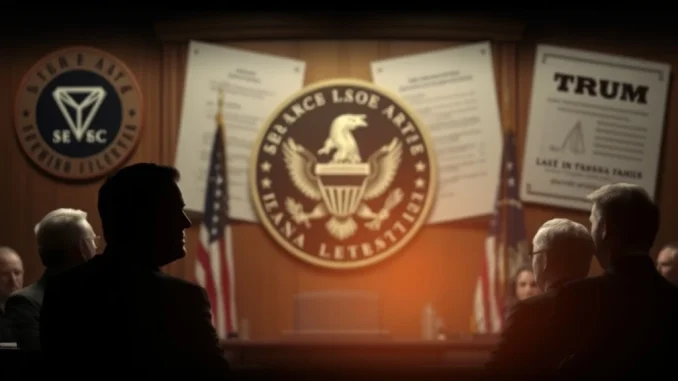
Two prominent U.S. lawmakers recently sent a letter to the SEC. They specifically questioned the commission’s choice to pause a civil lawsuit against Justin Sun, the founder of Tron. This lawsuit involves allegations of selling unregistered securities and market manipulation. The SEC initially filed the charges against Sun and his companies, Tron Foundation Limited, BitTorrent Foundation Ltd., and Rainberry Inc., in March 2023. However, the commission then paused its civil case against Sun in February, shortly after the inauguration of U.S. President Donald Trump.
This timing immediately raised eyebrows. Many observers wondered about the motivations behind such a pivotal regulatory decision. Lawmakers are now demanding transparency and accountability from the financial watchdog. They seek to understand the full scope of the SEC’s reasoning.
Concerns Over **Trump Family Crypto** Connections
In their formal letter, the lawmakers suggested a potential link between the SEC’s decision and a substantial investment made by Justin Sun. Sun reportedly invested in World Liberty Financial (WLFI), a decentralized finance (DeFi) project. Significantly, WLFI has alleged ties to the Trump family. Such connections raise serious ethical questions about the impartiality of regulatory processes.
The suggestion is that Sun’s investment could have influenced the SEC’s actions. This perceived conflict of interest poses a significant challenge to public trust in regulatory bodies. Furthermore, it highlights the increasing intersection of politics and the rapidly evolving cryptocurrency landscape. Investors and the public deserve clarity on these matters.
**SEC Tron** Inquiry: National Security and Nasdaq Listing
Beyond the alleged political ties, the lawmakers also expressed profound national security concerns regarding Tron. They described Tron as a project with significant Chinese roots. These concerns stem from the potential for foreign influence within critical financial infrastructures. The letter specifically highlighted Tron’s reverse merger with SRM Entertainment. This merger aims to facilitate Tron’s listing on the Nasdaq stock exchange.
A Nasdaq listing implies adherence to stringent regulatory and disclosure standards. The lawmakers urged the SEC to investigate whether Tron truly meets these demanding requirements. Therefore, the integrity of U.S. financial markets is at stake. Proper due diligence is absolutely essential before allowing such listings. This scrutiny reflects broader anxieties about global economic competition and data security.
The Broader Implications for Regulatory Oversight
This inquiry from **US lawmakers SEC** demonstrates a growing scrutiny of cryptocurrency regulation. It underscores the challenges faced by agencies in overseeing a complex, global, and often politically charged industry. The SEC’s role is to protect investors and maintain fair, orderly, and efficient markets. Thus, any perception of external influence can severely undermine its credibility.
The incident also brings to light the intricate web of relationships that can exist between prominent figures in the crypto space, political families, and regulatory bodies. Consequently, this creates a precedent for how future allegations of undue influence might be handled. The crypto community keenly watches these developments, understanding their potential impact on future regulatory frameworks.
The Path Ahead for **Tron Nasdaq Listing** and Transparency
The call for an investigation into Tron’s Nasdaq listing process is crucial. It ensures that all companies, regardless of their affiliations, adhere to the same rigorous standards. A reverse merger allows a private company to become publicly traded by merging with an existing public company. This method often bypasses the traditional initial public offering (IPO) process. Therefore, it sometimes raises questions about transparency and investor protection.
Lawmakers want assurances that Tron’s operations and financial disclosures meet all necessary benchmarks for a U.S. public listing. This scrutiny is vital for maintaining the integrity of the Nasdaq exchange itself. The outcome of this investigation could significantly influence how other crypto-related entities approach public listings in the future. Ultimately, transparency and adherence to rules are paramount for investor confidence.
FAQs About the Justin Sun Lawsuit and Related Concerns
1. Who is Justin Sun and what is Tron?
Justin Sun is a prominent figure in the cryptocurrency industry. He founded Tron (TRX), a decentralized blockchain platform. Tron aims to build a free, global digital content entertainment system with distributed storage technology. It supports smart contracts and dApps, similar to Ethereum.
2. Why did US lawmakers question the SEC’s decision regarding the Justin Sun lawsuit?
US lawmakers questioned the SEC’s decision to halt the civil lawsuit against Justin Sun due to the timing of the pause (after President Trump’s inauguration) and Sun’s alleged investment in World Liberty Financial (WLFI), a DeFi project reportedly linked to the Trump family. They suspect potential political influence.
3. What is the alleged connection between Justin Sun and the Trump family?
Lawmakers highlighted Justin Sun’s significant investment in World Liberty Financial (WLFI). WLFI is a DeFi project that has been linked to members of the Trump family, including Donald Trump Jr. This connection forms the basis of the lawmakers’ concerns about potential undue influence on the SEC’s regulatory actions.
4. What are the national security concerns related to Tron?
The lawmakers raised national security concerns over Tron’s alleged Chinese roots. They are concerned about potential foreign influence on a project seeking to list on a major U.S. stock exchange like Nasdaq. They want to ensure that Tron meets stringent U.S. standards for such a listing.
5. What are the potential implications of this inquiry for crypto regulation?
This inquiry could lead to increased scrutiny of crypto projects with political ties or foreign origins. It might also prompt a re-evaluation of how regulatory bodies handle cases involving high-profile individuals and their alleged connections. The outcome could set new precedents for transparency and accountability in the crypto space.
6. What is a reverse merger and why is it significant for Tron?
A reverse merger is a process where a private company becomes publicly traded by acquiring a public shell company. This allows it to bypass the traditional IPO process. For Tron, its reverse merger with SRM Entertainment to list on Nasdaq is significant because it brings the project under U.S. public market regulations, making the lawmakers’ call for scrutiny of its compliance even more critical.