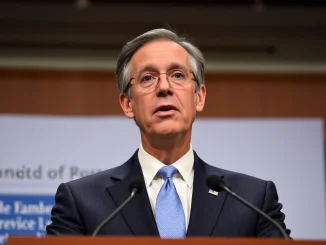
In the dynamic world of finance, where every central bank decision sends ripples across global markets, the steadfast resolve of figures like Jerome Powell often becomes the epicenter of attention. For those tracking cryptocurrencies, understanding the macro-economic landscape shaped by central bank policies is crucial, as these decisions profoundly influence liquidity, investor sentiment, and ultimately, asset valuations. This article delves into the high-stakes conflict between Federal Reserve Chair Jerome Powell and former President Donald Trump, a standoff that tested the very foundations of the Fed’s autonomy and its approach to monetary policy.
The Unwavering Stance of Jerome Powell
Federal Reserve Chair Jerome Powell has found himself at the heart of an unprecedented political storm, publicly and privately reaffirming his commitment to the central bank’s independence despite relentless criticism and threats from former President Donald Trump. Trump, known for his direct and often confrontational style, repeatedly labeled Powell with harsh epithets and publicly demanded significant rate cuts to stimulate the U.S. economy. The president’s campaign even included unsubstantiated claims of Powell’s impending resignation and a symbolic visit to the Fed’s headquarters, where he light-heartedly (or perhaps not so light-heartedly) suggested lowering rates during a tense tour.
Powell, however, has consistently dismissed these overtures, emphasizing that his decisions are not swayed by political influence but are instead meticulously guided by comprehensive economic data. Behind closed doors, Powell has articulated a strong belief that any resignation under political duress would severely undermine the Fed’s institutional independence – a principle he has staunchly defended since his 2017 nomination by Trump himself. Senator Mike Rounds, a Republican, recounted Powell’s firm conviction: “He feels very strongly that his responsibility is to maintain that independence.” Powell has conveyed to allies his intention to serve his full term, which extends until May 2026, and to maintain the central bank’s policy trajectory, irrespective of external pressures. This steadfastness is evident in his consistent adherence to data-driven decision-making, even as the White House scrutinized the Fed’s ongoing $2.5 billion renovation project, hinting at it as a potential ground for termination.
Why Federal Reserve Independence Matters
The conflict between the executive branch and the Federal Reserve underscores deeper tensions regarding executive authority versus the Fed’s statutory mandate to insulate monetary policy from short-term political demands. The concept of Federal Reserve independence is not merely an academic ideal; it is considered a cornerstone of stable economic governance. Here’s why it’s so vital:
- Long-Term Stability: An independent central bank can make difficult, unpopular decisions that are necessary for long-term economic health, such as raising interest rates to combat inflation, even if it temporarily slows growth.
- Credibility: Independence enhances the Fed’s credibility, both domestically and internationally. Markets and investors trust that the Fed’s decisions are based on economic fundamentals, not political cycles.
- Protection from Political Cycles: Without independence, monetary policy could become a tool for political gain, leading to boom-and-bust cycles driven by election timelines rather than economic realities.
- Inflation Control: Historically, central banks that lack independence have often succumbed to political pressure to print money or keep rates artificially low, leading to runaway inflation.
The Clash Over Monetary Policy and Rate Cuts
The core of the dispute revolved around interest rates. Trump and his aides aggressively pushed for immediate rate cuts, arguing they were necessary to offset the inflationary risks posed by proposed tariffs and to further stimulate the economy. The administration framed the Fed’s inaction as “unpatriotic,” accusing Jerome Powell of artificially increasing costs for American households and businesses.
However, Powell and the Fed maintained a cautious approach, insisting on first evaluating how protectionist policies might affect price stability and the broader economic outlook before making any adjustments. The Fed’s dual mandate is to achieve maximum employment and price stability, and rapid, politically motivated rate changes could jeopardize either or both of these goals. The absence of expected rate cuts, despite significant market anticipation, highlighted the Fed’s resolve to prioritize its mandate over political demands. This stance often leads to questions about the Fed’s ability to navigate conflicting signals from policymakers while maintaining its core objectives.
Navigating Trump’s Pressure and Public Scrutiny
The sustained Trump Fed pressure was unprecedented in modern U.S. history. Beyond verbal attacks, White House strategists reportedly explored a $2.5 million plan aimed at weakening Powell’s position, though specifics remained unclear. The conflict underscored a fundamental clash over the role of the Federal Reserve in a democratic system. While Trump’s rhetoric signaled frustration with what he perceived as slow economic adjustments, the Fed’s cautious approach prioritized long-term stability over immediate political gains.
This prolonged standoff risked eroding public trust in both the Federal Reserve and the administration’s economic governance. Public perception of the Fed’s independence is crucial for its effectiveness. If the public believes the central bank is merely a political tool, its policy pronouncements lose their weight, potentially leading to market instability and reduced confidence in the economic system. Powell’s refusal to yield, framed by allies as a defense of the Fed’s apolitical mandate, was seen as an assertion that maintaining his position and staying silent was the best way to protect the institution from external influence. The situation, however, intensified scrutiny of how the Fed balances its dual mandate against the political pressures of a divided administration.
Impact on Economic Governance and Public Trust
The persistent public antagonism between the President and the Fed Chair had tangible implications for economic governance. It created uncertainty in financial markets, as investors watched closely to see if the Fed would bend to political will or maintain its autonomy. This uncertainty can deter investment and slow economic growth. Furthermore, the very public nature of the dispute could sow seeds of doubt among the general public about the integrity and impartiality of key economic institutions. Trust in institutions like the Federal Reserve is vital for the smooth functioning of a modern economy. If that trust erodes, it can complicate the Fed’s ability to implement effective monetary policy, potentially leading to greater volatility and less predictable economic outcomes.
The Future of Central Bank Autonomy
While Trump eventually hinted he might not proceed with firing Powell, the episode left an indelible mark on the discourse surrounding central bank autonomy. It highlighted the fragility of institutional independence when faced with a determined executive. The episode serves as a powerful case study for future administrations and central bank leaders globally, emphasizing the need for clear communication, strong institutional resolve, and a deep understanding of the historical precedents that underpin central bank independence.
For the crypto community, this episode underscores the inherent differences between decentralized digital assets and traditional fiat systems. While cryptocurrencies aim to remove central authorities, the traditional financial system heavily relies on the perceived independence and stability of central banks like the Federal Reserve. The ongoing debate over the Fed’s role and its independence will continue to be a critical factor influencing the broader economic environment in which all assets, including cryptocurrencies, operate.
In conclusion, Jerome Powell’s unwavering defense of the Federal Reserve’s independence against intense Trump Fed pressure was a defining moment for U.S. economic policy. His steadfast commitment to data-driven decision-making over political expediency reinforced the critical importance of an autonomous central bank in maintaining economic stability and public trust. The episode serves as a stark reminder of the delicate balance required to safeguard crucial institutions from short-term political interference, ensuring that decisions regarding monetary policy, including critical rate cuts, are made in the best long-term interest of the nation.
Frequently Asked Questions (FAQs)
Q1: Why is Federal Reserve independence so important?
Federal Reserve independence is crucial because it allows the central bank to make monetary policy decisions based on economic data and long-term stability, free from short-term political pressures. This helps prevent policies that could lead to inflation or instability driven by electoral cycles, thereby maintaining public trust and economic credibility.
Q2: What was the main point of contention between Jerome Powell and Donald Trump?
The primary point of contention was President Trump’s repeated public demands for the Federal Reserve to implement significant interest rate cuts to stimulate the economy. Jerome Powell, however, insisted on maintaining the Fed’s data-driven approach, prioritizing price stability and maximum employment over political expediency.
Q3: What is the Federal Reserve’s dual mandate?
The Federal Reserve operates under a dual mandate: to achieve maximum employment and maintain price stability (low and stable inflation). These two goals often require careful balancing in the implementation of monetary policy.
Q4: Did Jerome Powell ever consider resigning due to the pressure?
While under intense pressure and public scrutiny, Jerome Powell consistently reaffirmed his commitment to serving his full term, which ends in May 2026. He publicly and privately stated that resigning would undermine the Fed’s institutional independence, a principle he strongly defends.
Q5: How does central bank policy, like interest rates, affect the broader economy and potentially cryptocurrencies?
Central bank policies, particularly interest rate decisions, significantly impact the broader economy by influencing borrowing costs, investment, and inflation. Lower rates can stimulate economic activity and make riskier assets, including cryptocurrencies, more attractive. Conversely, higher rates can slow the economy and make safer investments more appealing, potentially drawing capital away from crypto markets.