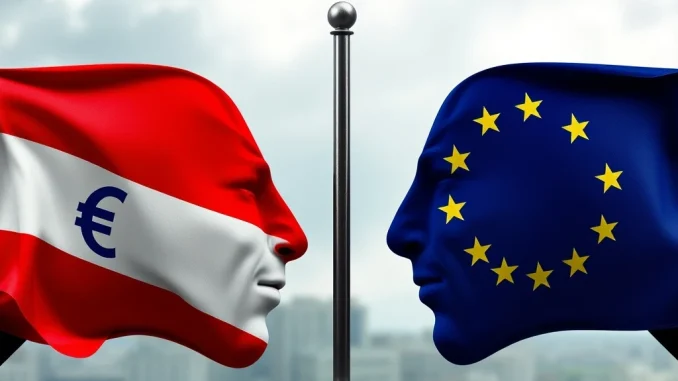
In the intricate world of global finance and geopolitics, even seemingly distant political disputes can send ripples across markets, indirectly influencing everything from traditional stocks to the volatile cryptocurrency space. While the immediate impact on crypto markets remains limited, a significant development in the European Union is demanding attention: Hungary’s Prime Minister Viktor Orbán has taken a firm stance, threatening to block the EU’s monumental €2 trillion seven-year budget unless previously frozen funds allocated to Hungary are released. This move signals a deepening **Hungary EU budget** standoff, raising questions about the bloc’s cohesion and financial stability.
What’s Behind the Hungary EU Budget Standoff?
The latest confrontation stems from a long-standing dispute between Budapest and Brussels. On July 26, 2025, Prime Minister Viktor Orbán declared that Hungary would not approve the new €2 trillion budget without the release of its suspended funds. The EU’s budget, a crucial financial framework for the next seven years, requires unanimous approval from all 27 member states. Orbán’s statement, “The approval of the new seven-year budget requires unanimity and until we get the remaining (frozen) funds, there won’t be a new EU budget either,” underscores the significant leverage Hungary wields in this process.
- The Unanimity Rule: This procedural requirement grants every member state, regardless of size, a veto over the EU’s financial blueprint, giving countries like Hungary considerable bargaining power.
- The Stakes: The €2 trillion budget is not just a number; it’s the lifeline for economic development, defense projects, infrastructure, agricultural subsidies, and green transition programs across the bloc.
- Historical Precedent: Orbán has a history of using budget negotiations to secure favorable terms for Hungary, making this current threat a familiar, yet increasingly impactful, tactic.
The Core of the EU Frozen Funds Dispute
At the heart of this dispute are the **EU frozen funds**, which Brussels has withheld from Hungary. These funds, part of the EU’s recovery and cohesion funds, are tied to strict conditionality rules. These rules are designed to safeguard the EU’s financial integrity and uphold democratic standards, including judicial independence and electoral processes. The EU has repeatedly expressed concerns over what it perceives as democratic backsliding and rule of law issues in Hungary.
The European Commission has paused disbursements, citing issues such as:
- Concerns over the independence of Hungary’s judiciary.
- Transparency in public procurement.
- Measures to combat corruption.
Hungary views these conditions as an overreach by Brussels into its national sovereignty, framing the dispute as a defense of its autonomy. This fundamental disagreement over the balance between supranational oversight and national self-governance continues to fuel the tension.
Viktor Orbán’s Strategic Leverage: A Calculated Risk?
Prime Minister **Viktor Orbán** is no stranger to high-stakes political maneuvering. His current strategy mirrors past tactics where he has successfully used budget negotiations to extract concessions or delay EU decisions. For instance, in 2023, similar disputes led to delays in the ratification of the EU’s current budget. While core agreements were eventually reached, these standoffs consistently disrupt timelines and introduce uncertainty.
However, the current impasse carries heightened stakes. The sheer scale of the €2 trillion budget, especially its role in funding crucial post-pandemic recovery initiatives, means that delays could have widespread ripple effects. Member states reliant on EU grants could face significant setbacks, impacting their ability to implement vital programs and reforms. Orbán’s critics argue that he is exploiting procedural gaps, leveraging Hungary’s minority status to hold the entire bloc hostage, while his supporters see it as a legitimate exercise of national sovereignty.
Implications for EU Financial Governance
This **EU financial governance** crisis highlights the inherent fragility of decision-making within a bloc of 27 diverse nations. The unanimity requirement, while intended to ensure broad consensus, can also be a bottleneck, allowing a single member state to halt collective progress. The standoff raises critical questions about the EU’s ability to balance its commitment to rule of law and democratic standards with the pragmatic need for timely financial planning.
If the dispute prolongs, it could:
- Delay the disbursement of critical funds for recovery and development projects across Europe.
- Create uncertainty for businesses and governments planning based on future EU funding.
- Potentially damage the EU’s international standing and its ability to act decisively on global challenges.
This situation underscores deeper divisions within the EU – between those advocating for stronger centralized oversight to protect shared values and those prioritizing national autonomy and a more limited role for Brussels.
Navigating the EU Budget Standoff: What’s Next?
Analysts generally anticipate that the current **EU budget standoff** will, like past disputes, ultimately be resolved through diplomatic negotiations. The EU has a strong track record of finding compromises, even in the face of significant resistance. However, the absence of a clear resolution timeline introduces considerable uncertainty for EU financial planning and the broader economic outlook.
While direct economic impact on Hungary is expected to be mitigated by its reliance on domestic fiscal policies, the broader implications for EU cohesion are significant. This challenge could escalate as similar disputes arise with other member states, testing the limits of supranational governance and the willingness of member states to cede aspects of their sovereignty for the collective good of the Union.
The ongoing standoff between Hungary and the European Union over the €2 trillion budget and frozen funds is more than just a financial disagreement; it’s a profound test of the EU’s unity, its foundational principles, and its decision-making mechanisms. While the immediate impact on global markets, including cryptocurrencies, remains muted, the resolution of this critical dispute will undoubtedly shape the future trajectory of the European project, influencing economic stability and policy direction for years to come. It serves as a stark reminder of the complex interplay between national interests and collective aspirations within a major economic bloc.
Frequently Asked Questions (FAQs)
Q1: Why is Hungary blocking the EU’s €2 trillion budget?
Hungary’s Prime Minister Viktor Orbán is blocking the EU’s new seven-year budget because he demands the release of previously frozen funds allocated to Hungary. These funds were suspended by the EU due to concerns over Hungary’s adherence to rule of law and democratic standards.
Q2: What are the “frozen funds” and why were they withheld?
The “frozen funds” are disbursements from EU recovery and cohesion funds that the European Commission has withheld from Hungary. They were frozen due to concerns about issues like judicial independence, transparency in public procurement, and anti-corruption measures, based on the EU’s conditionality rules aimed at protecting financial integrity and democratic standards.
Q3: How does the EU budget approval process work, and why does Hungary have leverage?
The approval of the EU’s seven-year budget requires unanimity among all 27 member states. This means that any single member state, including Hungary, can veto the budget, giving them significant leverage in negotiations.
Q4: What are the potential consequences of this budget standoff for the EU?
A prolonged standoff could delay the disbursement of critical funds for economic development, defense, infrastructure, and green transition programs across the bloc. It also raises questions about the EU’s ability to balance conditionality with political pragmatism and highlights deeper divisions within the Union regarding national sovereignty versus centralized oversight.
Q5: Has Hungary used this tactic before?
Yes, Prime Minister Viktor Orbán has a history of using budget negotiations and the unanimity rule to secure favorable terms for Hungary, as seen in similar disputes that delayed the ratification of the EU’s current budget in 2023.
Q6: How might this situation indirectly affect cryptocurrency markets?
While there’s no direct impact currently, significant geopolitical and economic instability within major blocs like the EU can lead to broader market uncertainty. This uncertainty can sometimes prompt investors to seek perceived safe havens or, conversely, increase volatility in risk assets like cryptocurrencies, depending on the overall sentiment and macroeconomic outlook.