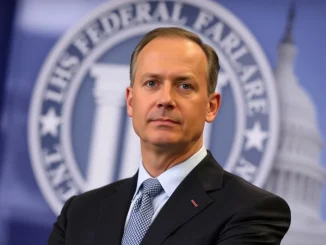
In the dynamic world of finance, every pronouncement from a central banker can send ripples across markets, including the often-volatile cryptocurrency space. When Austan Goolsbee, the influential president of the Chicago Federal Reserve, suggests that interest rates could see a significant decline over the next year, it’s not just Wall Street that pays attention; crypto enthusiasts should also take note. This potential shift in monetary policy could have profound implications for everything from traditional investments to the digital asset landscape, influencing investor sentiment and capital flows. Let’s delve into what Goolsbee’s remarks truly mean for your financial future.
Goolsbee’s Bold Outlook: The Chicago Fed’s Stance on Future Interest Rates
Austan Goolsbee, a prominent voice within the Federal Reserve, recently made headlines with his statement, shared via First Squawk on X, indicating a tangible possibility for interest rates to fall significantly within the coming year. This isn’t just a casual remark; it reflects a growing sentiment among some policymakers that the aggressive rate hikes of the past year or two may have achieved their intended effect in cooling inflation, paving the way for a more accommodative monetary stance.
Goolsbee’s comments are particularly noteworthy because, while he is a voting member of the Federal Open Market Committee (FOMC) this year, his views often provide insight into the broader discussions happening within the Fed. His outlook suggests a potential pivot from the ‘higher for longer’ narrative that has dominated financial markets, offering a glimmer of hope for sectors that thrive on lower borrowing costs.
Understanding the Federal Reserve’s Role in Shaping the Economic Outlook
To fully grasp the weight of Goolsbee’s statement, it’s essential to understand the pivotal role of the Federal Reserve. As the central bank of the United States, the Fed is tasked with a dual mandate: maximizing employment and maintaining price stability (i.e., controlling inflation). Its primary tool for achieving these goals is the federal funds rate, which influences a wide array of other interest rates across the economy.
When the Fed raises rates, it aims to cool down an overheating economy by making borrowing more expensive, thus reducing demand and inflationary pressures. Conversely, lowering rates is intended to stimulate economic activity by making credit cheaper, encouraging spending and investment. Goolsbee’s projection hints at the latter, suggesting that the Fed may soon feel comfortable easing its restrictive policy. This potential shift is a key component of the evolving economic outlook, impacting everything from consumer spending to corporate investment strategies.
Key Functions of the Federal Reserve:
- Monetary Policy: Managing the nation’s money supply and credit conditions to promote maximum employment and stable prices.
- Financial System Stability: Supervising and regulating banks and other financial institutions to ensure the stability of the financial system.
- Financial Services: Providing financial services to the U.S. government, and managing the nation’s payment systems.
Why Significant Rate Cuts Matter: Impact on Markets and Your Wallet
The prospect of significant rate cuts has far-reaching implications across various facets of the economy and financial markets. For investors, businesses, and everyday consumers, understanding these impacts is crucial for making informed decisions.
Impact on Traditional Financial Markets:
- Stocks: Lower interest rates generally make borrowing cheaper for companies, which can boost profits and make stocks more attractive compared to bonds. Growth stocks, in particular, often benefit as their future earnings are discounted at a lower rate.
- Bonds: Existing bonds with higher yields become more valuable when new bonds are issued at lower rates. However, new bond yields will be less attractive.
- Real Estate: Mortgage rates tend to follow the federal funds rate. Lower rates can stimulate the housing market by making homeownership more affordable, increasing demand and potentially prices.
Impact on the Cryptocurrency Market:
While not directly tied to the federal funds rate, the crypto market is significantly influenced by broader macroeconomic conditions. When traditional financial assets become more attractive due to lower interest rates, it can lead to a ‘risk-on’ environment, where investors are more willing to allocate capital to higher-risk, higher-reward assets like cryptocurrencies. Conversely, lower rates can also weaken the dollar, making dollar-denominated assets like Bitcoin more appealing to international investors. The interplay between traditional finance and digital assets means that a significant shift in the economic outlook could provide tailwinds for the crypto market, attracting fresh capital and boosting sentiment.
Impact on Consumers:
- Borrowing Costs: Everything from credit card interest to auto loans and personal loans could become cheaper, easing the financial burden on households.
- Savings: Interest rates on savings accounts and certificates of deposit (CDs) may decline, potentially encouraging consumers to seek higher returns elsewhere or spend more.
Navigating the Future: Preparing for Potential Interest Rate Shifts
If Goolsbee’s prediction of significant rate cuts comes to fruition, how should individuals and businesses prepare? The key lies in understanding the potential scenarios and adjusting strategies accordingly. The path to lower rates isn’t guaranteed; it hinges on various economic indicators, particularly inflation data and labor market strength.
The Fed closely monitors:
- Inflation: The primary driver. If inflation continues to cool towards the Fed’s 2% target, it provides room for rate cuts.
- Employment: A strong labor market might give the Fed less urgency to cut rates, while signs of weakening could accelerate the need for stimulus.
- Global Economic Conditions: International factors can also influence the Fed’s decisions, as the U.S. economy is not an isolated system.
For investors, this could mean re-evaluating portfolios, potentially increasing exposure to growth-oriented assets or sectors that historically perform well in a lower-rate environment. For businesses, it might open doors for expansion through cheaper financing. For individuals, it could be an opportune time to refinance debt or consider larger purchases.
Beyond the Headlines: The Broader Implications of Monetary Policy
The discussion around interest rates extends far beyond immediate market reactions. It touches upon the broader landscape of monetary policy and its profound influence on economic stability and growth. A strategic shift by the Federal Reserve, as hinted by Goolsbee, reflects the Fed’s assessment of the current economic climate and its forward-looking strategy to ensure a soft landing rather than a recession.
This careful balancing act by the Federal Reserve aims to avoid both persistent high inflation and a severe economic downturn. The potential for significant rate cuts signals confidence among some policymakers that the economy is resilient enough to withstand a period of lower rates without reigniting inflationary pressures. This optimistic outlook could foster greater business confidence and consumer spending, setting the stage for sustained economic expansion.
In conclusion, Austan Goolsbee’s remarks offer a compelling glimpse into the potential trajectory of U.S. monetary policy. While not a definitive promise, the prospect of significant rate cuts over the next year presents both opportunities and challenges across all financial sectors, including the ever-evolving world of cryptocurrency. Staying informed about these macroeconomic shifts is paramount for navigating the future financial landscape effectively.
Frequently Asked Questions (FAQs)
Q1: What did Austan Goolsbee say about interest rates?
Austan Goolsbee, president of the Chicago Federal Reserve, stated that there’s a chance interest rates could fall significantly over the next year, according to a report by First Squawk on X. This suggests a potential shift towards more accommodative monetary policy.
Q2: How do falling interest rates impact the economy?
Falling interest rates generally stimulate economic activity by making borrowing cheaper for consumers and businesses. This can boost spending, investment, stock markets, and real estate, but might reduce returns on savings accounts.
Q3: What does this mean for the cryptocurrency market?
While not directly linked, lower interest rates in traditional finance can create a ‘risk-on’ environment, potentially increasing investor appetite for higher-risk assets like cryptocurrencies. It can also weaken the dollar, making dollar-denominated crypto assets more appealing to international investors.
Q4: What factors influence the Federal Reserve’s decision to cut rates?
The Federal Reserve’s decisions are primarily influenced by inflation data, aiming for its 2% target, and labor market conditions. Signs of cooling inflation or a weakening job market would give the Fed more reason to consider rate cuts.
Q5: Is a significant rate cut guaranteed based on Goolsbee’s comments?
No, Goolsbee’s comments indicate a ‘chance’ or possibility, not a guarantee. Monetary policy decisions are made by the entire Federal Open Market Committee (FOMC) and depend on evolving economic data. His remarks reflect a potential direction but are subject to change.