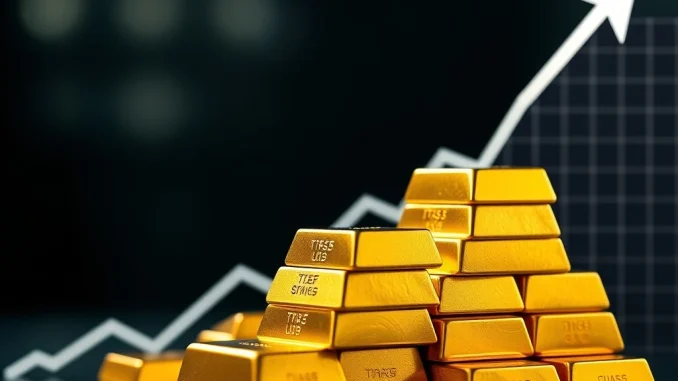
For investors accustomed to the volatility of digital assets, the stability and recent performance of traditional safe havens offer a compelling narrative. The **gold price** has recently captured significant attention, demonstrating its enduring appeal amidst global economic shifts. This latest surge highlights gold’s role as a critical asset in diversified portfolios, particularly when other markets face uncertainty.
Gold Price Reaches Historic $4,100 Mark
The global financial landscape witnessed a significant event. The price of **spot gold** touched an astonishing $4,100 per ounce. This monumental achievement marks a new **all-time high gold** record. It underscores gold’s consistent strength as a store of value. Investors worldwide are observing this trend closely. The milestone reflects a culmination of various macroeconomic factors.
Many analysts had predicted this upward movement. However, the speed of the ascent surprised some market watchers. This new peak surpasses all previous records. It reinforces gold’s reputation as a reliable asset during turbulent times. The precious metal continues to attract significant capital inflows. Therefore, its performance remains a key indicator for the broader economy.
Understanding the Forces Behind the All-Time High Gold Rally
Several key factors contribute to gold’s remarkable performance. Firstly, persistent inflation concerns are driving investors towards tangible assets. Central banks globally have implemented aggressive monetary policies. Consequently, these actions have devalued fiat currencies. Gold, conversely, maintains its purchasing power. This makes it an attractive hedge against rising costs.
Secondly, geopolitical tensions worldwide increase demand for safe-haven assets. Conflicts and political instability create uncertainty. Investors often seek refuge in gold during such periods. It offers a sense of security that volatile equity markets cannot provide. This flight to safety boosts its appeal significantly.
Thirdly, a weakening U.S. dollar typically supports higher gold prices. Gold is denominated in dollars. Therefore, a weaker dollar makes gold cheaper for international buyers. This increases global demand. Central bank buying also plays a crucial role. Many nations are diversifying their reserves away from the dollar. They are adding more gold to their holdings. This institutional demand provides a strong floor for the **gold market**.
Spot Gold: A Key Indicator in the Gold Market
The term “**spot gold**” refers to the current market price for immediate delivery of gold. It represents the most liquid and actively traded form of gold. This price reflects real-time supply and demand dynamics. When the **spot gold price** rises, it indicates robust investor confidence in the metal. It also signals strong underlying market conditions.
Futures contracts and other derivatives often derive their value from the spot price. Thus, tracking spot gold offers crucial insights. It reveals immediate market sentiment. Furthermore, it helps forecast future price movements. This immediate pricing mechanism makes spot gold a benchmark for the entire **precious metals** sector. It guides both institutional and retail investors in their decisions.
Historical Context of Gold’s Performance
Gold has a long history as a valuable commodity. It served as currency for centuries. Its role evolved into a global reserve asset. Historically, gold prices tend to rise during economic crises. They also surge during periods of high inflation. For instance, the 1970s saw a significant gold rally. This occurred amidst high inflation and geopolitical turmoil. Similarly, the 2008 financial crisis spurred another surge.
The current **all-time high gold** record echoes these past patterns. However, the present environment presents unique challenges. Unprecedented global debt levels and ongoing supply chain disruptions are prevalent. These factors create a complex backdrop for the **gold market**. Therefore, understanding historical precedents helps interpret current trends. It also informs future investment strategies.
The Broader Implications for Precious Metals and Investors
The surge in **gold price** has ripple effects across the entire **precious metals** complex. Silver, platinum, and palladium often follow gold’s lead. While each metal has its unique demand drivers, gold’s strong performance can pull others higher. Investors seeking diversification beyond gold might consider these alternatives. However, they carry different risk profiles.
For individual investors, gold offers a tangible hedge against market volatility. It can preserve wealth during downturns. Many financial advisors recommend a small allocation to gold. This helps balance a portfolio. Furthermore, the accessibility of gold through ETFs, physical bullion, and mining stocks makes it easy to invest. This accessibility attracts a diverse range of participants to the **gold market**.
What Lies Ahead for the Gold Market?
Forecasting the future of the **gold market** involves analyzing several key indicators. Inflation rates will remain a primary driver. Should inflation persist or accelerate, gold demand will likely stay strong. Central bank policies also hold significant sway. Any shifts in interest rates or quantitative easing programs could impact prices.
Geopolitical stability is another critical factor. A de-escalation of global tensions might reduce safe-haven demand. Conversely, new conflicts could fuel further rallies. Ultimately, the **gold price** reflects a complex interplay of economic, political, and psychological forces. Investors must stay informed to navigate this dynamic market effectively. Continued vigilance is essential for making sound investment decisions.
In conclusion, gold’s ascent to $4,100 per ounce signifies a landmark moment. It reaffirms its status as a vital asset. This rally is driven by fundamental economic realities and geopolitical shifts. As the financial world evolves, gold continues to prove its resilience and enduring value.
Frequently Asked Questions (FAQs)
Q1: What does an all-time high gold price mean for investors?
An **all-time high gold** price indicates strong demand and potentially ongoing market uncertainty. For investors, it suggests gold’s continued role as a safe haven asset. It can also signal a need for portfolio diversification, especially for those heavily invested in more volatile assets.
Q2: Why is the gold price reaching new highs now?
The **gold price** is reaching new highs due to several factors. These include persistent inflation concerns, global geopolitical instability, a weakening U.S. dollar, and significant purchases by central banks worldwide. These elements collectively drive investors towards gold.
Q3: How does spot gold differ from gold futures?
**Spot gold** refers to the price for immediate delivery of the physical metal. Gold futures, conversely, are contracts to buy or sell gold at a predetermined price on a future date. Spot gold reflects the current market value, while futures reflect expectations of future prices.
Q4: Should cryptocurrency investors consider investing in gold?
Many cryptocurrency investors consider gold as a complementary asset. It offers diversification away from digital asset volatility. Gold can act as a hedge against traditional market risks. Therefore, a small allocation to **precious metals** like gold can enhance portfolio stability.
Q5: What impact does central bank buying have on the gold market?
Central bank buying has a substantial impact on the **gold market**. When central banks purchase gold, it increases overall demand. This supports higher prices. It also signals confidence in gold as a reserve asset. This institutional demand provides a strong foundation for the market.