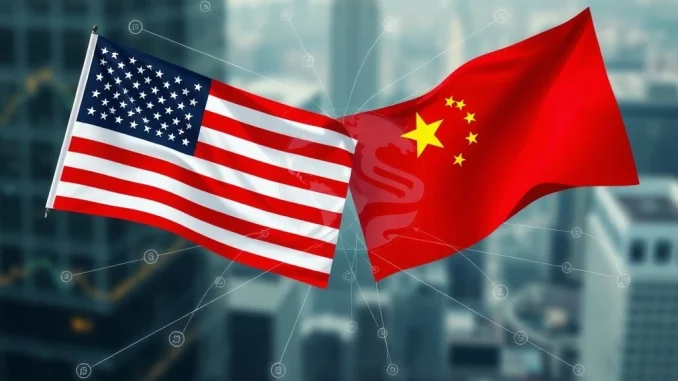
Global markets often react strongly to political statements. For instance, recent remarks from former U.S. President Donald Trump about his relationship with Chinese President Xi Jinping highlight persistent **Geopolitical Tensions**. These diplomatic nuances, though seemingly distant, directly influence investor sentiment across traditional and emerging financial landscapes. Therefore, understanding these dynamics is crucial for anyone monitoring the **Digital Asset Stability** within the broader global economy.
Understanding US-China Geopolitical Tensions
Former President Donald Trump recently described his relationship with Chinese President Xi Jinping as excellent, yet acknowledged moments of tension. This candid assessment reflects the intricate nature of the bond between the world’s two largest economies. Such high-level diplomatic commentary offers insights into the state of international relations. Moreover, it underscores the constant flux defining this critical bilateral partnership. Investors and analysts carefully monitor these statements. They seek clues about future policy directions and potential economic shifts.
The relationship between the U.S. and China has historically been complex. Periods of cooperation often intertwine with significant strategic competition. Key areas of contention include trade imbalances, technological dominance, human rights, and regional security issues. These factors contribute to an environment of ongoing **Geopolitical Tensions**. Consequently, these tensions create ripple effects that extend far beyond political circles, influencing global trade and financial markets.
The Dynamics of US-China Trade and its Global Reach
The state of **US-China Trade** significantly impacts the global economy. Past trade disputes, marked by tariffs and counter-tariffs, caused considerable disruption. These measures affected supply chains worldwide. Businesses faced increased costs and uncertainty. Consumers often saw higher prices for goods. Furthermore, these trade dynamics highlight the deep interdependence of national economies. Any shift in this relationship sends signals through international markets.
For example, a sudden escalation of trade rhetoric can cause immediate market jitters. Conversely, signs of de-escalation or cooperation might lead to a rally. Therefore, the rhetoric surrounding the U.S.-China relationship directly influences global economic confidence. This confidence, or lack thereof, shapes investment decisions across various asset classes. The interconnectedness means that no sector, including digital assets, remains entirely insulated.
Assessing Global Market Impact from Diplomatic Strains
Diplomatic strains between major powers like the U.S. and China inevitably create a **Global Market Impact**. Traditional financial markets, including stocks, bonds, and commodities, often react quickly to news of political friction. Increased uncertainty typically leads to greater market volatility. Investors may move funds from riskier assets to perceived safe havens. This reallocation can cause significant price swings.
Moreover, geopolitical developments influence currency valuations. A strong U.S. dollar might reflect a flight to safety during times of global instability. Conversely, the Chinese yuan’s stability or fluctuations can indicate internal economic health or external pressures. Therefore, these currency movements have broader implications for international trade and investment. They affect the purchasing power of various nations and the profitability of multinational corporations.
Analysts watch for specific indicators. These include manufacturing data, consumer confidence reports, and export figures from both countries. Such data provides tangible evidence of how political tensions translate into economic realities. A downturn in one major economy can easily spill over into others. This interconnectedness ensures that diplomatic rhetoric has real-world economic consequences for everyone.
Navigating Digital Asset Stability Amidst Geopolitical Shifts
The cryptocurrency market, known for its volatility, is not immune to **Geopolitical Tensions**. In fact, its nascent nature and lack of direct government backing can make it particularly sensitive. Some investors view Bitcoin and other digital assets as a hedge against traditional financial instability or inflation. They see them as ‘digital gold.’ However, others consider them high-risk assets, prone to sharp declines during global downturns.
Consider the impact of regulatory announcements. Major economies, including the U.S. and China, hold significant sway over global crypto adoption and regulation. China’s past crackdowns on mining and trading, for instance, caused substantial market dips. Therefore, any shift in their stance, or even rumors, can impact **Digital Asset Stability**. Similarly, U.S. regulatory clarity or uncertainty can dictate institutional investment flows.
Key factors affecting digital assets during geopolitical shifts include:
- Investor Sentiment: Fear or optimism directly influences buying and selling pressure.
- Regulatory Environment: Major economic powers’ policies shape market access and legality.
- Macroeconomic Trends: Inflation, interest rates, and economic growth indirectly affect crypto valuations.
- Capital Flows: Investors seeking alternative investments may turn to or away from digital assets.
Ultimately, the crypto market’s reaction depends on how investors perceive digital assets within the broader economic context. Are they a safe haven, or are they a risk-on asset? This perception often shifts with the global political climate.
The Economic Outlook: What Lies Ahead for Digital Assets?
The **Economic Outlook** for digital assets remains closely tied to global stability and the resolution of major geopolitical challenges. The future trajectory of U.S.-China relations will play a significant role. A continued ‘excellent but tense’ dynamic could lead to sustained market uncertainty. This might encourage some investors to seek the perceived decentralization of cryptocurrencies. Conversely, prolonged trade wars or technological competition could stifle innovation and economic growth, potentially dampening overall market enthusiasm.
Looking ahead, several scenarios could unfold:
- De-escalation: Improved U.S.-China relations could foster greater global economic stability. This might reduce the perceived need for ‘safe haven’ assets but could also boost overall market confidence, potentially benefiting growth-oriented digital assets.
- Continued Tension: Persistent friction might maintain market volatility. This scenario could see some investors favoring digital assets as a hedge, while others might retreat to more traditional, less volatile investments.
- Technological Competition: The race for technological supremacy, especially in AI and blockchain, will continue. This competition could drive innovation in digital assets, but also create regulatory fragmentation.
The long-term health of the digital asset market will depend on its ability to demonstrate utility and resilience. It must adapt to changing global economic conditions. Furthermore, clearer regulatory frameworks from leading nations will be essential for mainstream adoption. This will provide greater certainty for both institutional and retail investors.
In conclusion, the intricate dance between global superpowers, exemplified by the U.S.-China relationship, profoundly influences financial markets worldwide. While seemingly political, statements like those from Donald Trump carry significant weight. They signal potential shifts in trade, economic policy, and international cooperation. For the cryptocurrency sector, these **Geopolitical Tensions** are not just headlines. They are critical factors shaping market sentiment, regulatory landscapes, and ultimately, the path to **Digital Asset Stability**. Staying informed about these global dynamics is paramount for anyone navigating the evolving world of digital finance and understanding the broader **Economic Outlook**.
Frequently Asked Questions (FAQs)
Q1: How do Geopolitical Tensions specifically affect cryptocurrency prices?
A1: Geopolitical tensions create uncertainty. This can cause investors to move funds. Some may view cryptocurrencies like Bitcoin as a safe haven, driving prices up. Others see them as risky assets, leading to sell-offs and price declines. The market reaction often depends on the nature of the tension and prevailing investor sentiment regarding **Digital Asset Stability**.
Q2: What is the impact of US-China Trade relations on the global economy?
A2: **US-China Trade** relations significantly influence the global economy. Trade disputes, tariffs, or agreements affect supply chains, manufacturing costs, and consumer prices worldwide. These dynamics can lead to economic growth or contraction, impacting all sectors, including the financial markets where digital assets operate.
Q3: Can digital assets truly offer stability during times of Global Market Impact?
A3: The idea of **Digital Asset Stability** during a **Global Market Impact** is debated. While some proponents argue for crypto’s role as a hedge against inflation or traditional market downturns, cryptocurrencies have also shown high correlation with traditional risk assets. Their stability often depends on the specific market conditions and investor perception at the time.
Q4: How do regulatory actions by major powers influence digital assets?
A4: Regulatory actions by major economic powers, such as the U.S. or China, have a profound impact. Strict bans or unclear regulations can suppress adoption and innovation, causing market downturns. Conversely, clear, supportive regulations can foster growth and institutional investment, enhancing the overall **Economic Outlook** for digital assets.
Q5: What is the general Economic Outlook for cryptocurrencies given ongoing global uncertainties?
A5: The general **Economic Outlook** for cryptocurrencies is mixed but cautiously optimistic. While global uncertainties and **Geopolitical Tensions** introduce volatility, the underlying technology (blockchain) continues to develop. Increased institutional adoption and clearer regulatory frameworks could foster long-term growth. However, significant political or economic shocks could still pose challenges to **Digital Asset Stability**.