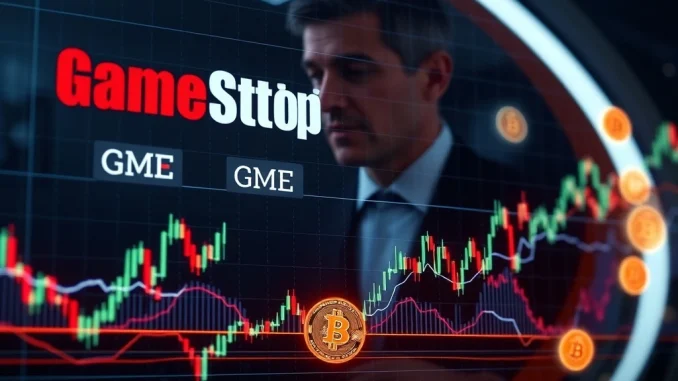
The financial world constantly evolves. Unexpected parallels often emerge. Recently, **Bill Gross**, the esteemed co-founder of PIMCO and widely known as Wall Street’s “Bond King,” made a remarkable observation. He stated that **GameStop (GME)**, once the quintessential **meme stock**, now surprisingly mirrors **Bitcoin (BTC)**. This compelling comparison suggests a significant shift. It moves GME from its highly volatile past towards a new era of price behavior. For anyone tracking the crypto market, this insight is particularly intriguing.
GameStop’s Surprising Evolution: Declining GME Volatility
Bill Gross’s comments, reported by Crypto Briefing, highlight a dramatic change. He noted that **GameStop’s** price behavior has fundamentally evolved. Over the past year, GME has consistently traded within a range of $20 and $35. This stable pattern sharply contrasts its explosive 2021 surge. Indeed, GME famously skyrocketed from approximately $1 in 2020 to a peak of $121 in January 2021. Such a meteoric rise was fueled by retail investor fervor. However, its current stability indicates significantly declining **GME volatility**.
Furthermore, Gross emphasized that this recent price action mirrors **Bitcoin’s** own movements. Bitcoin, too, has experienced periods of intense volatility. Yet, it often settles into trading ranges before major breakouts. This parallel suggests a maturing asset. It also points to less speculative, more predictable trading patterns for GameStop. Therefore, investors are now re-evaluating GME’s market profile. It is no longer just a symbol of retail rebellion.
Understanding the Shift: From Meme Stock to Market Stability
To fully grasp Gross’s perspective, one must understand the nature of a **meme stock**. These assets gain popularity through social media and online communities. Their prices often surge rapidly. This is due to coordinated buying efforts. Fundamentals usually play a minor role. The 2021 **GameStop** phenomenon perfectly exemplified this. Its price swings were unprecedented. They often defied traditional market logic. Consequently, GME became synonymous with extreme market volatility.
However, the current situation presents a stark contrast. The consistent $20-$35 trading range suggests a different market dynamic. This stability indicates several potential factors:
- **Reduced Speculative Trading:** Fewer short-term, high-risk traders might be involved.
- **Increased Institutional Interest:** More stable price action could attract traditional investors.
- **Market Maturation:** The asset might be finding its true valuation, independent of hype.
Bill Gross’s observation underscores this profound shift. He effectively redefines **GameStop’s** place in the financial landscape. It moves away from pure speculation. It leans towards more established asset behavior.
Bitcoin’s Journey: A Precedent for Declining Volatility
The comparison to **Bitcoin** is particularly insightful. Bitcoin, the leading cryptocurrency, also endured periods of extreme volatility. In its early years, BTC experienced wild price swings. These movements were often triggered by news, regulatory uncertainty, or market sentiment. However, as the cryptocurrency market matured, Bitcoin’s volatility generally declined. This occurred especially relative to its early days. Institutional adoption played a crucial role. More sophisticated trading mechanisms emerged. Regulatory frameworks began to take shape. All these factors contributed to Bitcoin’s increased stability.
Indeed, Bitcoin’s journey offers a roadmap. It shows how a nascent, volatile asset can evolve. It can become a more predictable, widely accepted financial instrument. Bill Gross sees **GameStop** mirroring this very path. He believes GME is transitioning beyond its initial **meme stock** phase. It is moving towards a more mature market presence. This comparison is not about GME becoming a cryptocurrency. Rather, it concerns the *pattern* of its price movements. It highlights its evolving market behavior.
Implications for Investors: What GME’s New Profile Means
This evolving profile of **GameStop** carries significant implications for investors. Traditionally, meme stocks are associated with high risk and potential for quick, but often fleeting, gains. A more stable **GameStop** might appeal to a broader investor base. It could attract those seeking less volatile opportunities. This shift might also reduce the likelihood of massive short squeezes. Furthermore, it could signal a more fundamental valuation. Investors might begin to assess GME based on its business performance. They might focus less on social media trends.
Therefore, this observation by **Bill Gross** is pivotal. It encourages a re-evaluation of investment strategies for GME. It suggests a potential shift from speculative trading to long-term investment. This does not imply zero risk. All investments carry inherent risks. However, the nature of the risk changes. It moves from extreme, unpredictable swings to more measured market fluctuations. This makes **GameStop** a fascinating case study. It bridges the gap between traditional and new-age market phenomena.
Expert Insights and Market Dynamics: Bill Gross’s Unique Perspective
**Bill Gross** brings unparalleled experience to this discussion. His career at PIMCO established him as a titan in fixed-income investing. His insights carry immense weight in financial circles. His ability to draw parallels between seemingly disparate assets is noteworthy. It showcases his deep understanding of market dynamics. His comments to Business Insider underscore this expertise. They highlight how market behaviors can transcend asset classes. This perspective is particularly valuable. It helps decipher complex market shifts. It connects the world of traditional bonds and stocks with emerging digital assets.
Moreover, Gross’s analysis transcends simple observation. It challenges conventional wisdom. It forces market participants to reconsider their classifications. Is a **meme stock** forever a meme stock? Or can it evolve? The case of **GameStop** suggests the latter. Its journey reflects broader trends in market efficiency. It shows how speculative bubbles can deflate. Then, assets can find a more stable equilibrium. This dynamic interplay between retail enthusiasm and fundamental valuation remains a key theme. It will undoubtedly continue to shape future market narratives.
Conclusion: A New Era for GameStop and Market Perceptions
The observation by **Bill Gross** is indeed compelling. **GameStop’s** transformation from a highly volatile **meme stock** to an asset mirroring **Bitcoin’s** stability is remarkable. This highlights changing market behaviors. It also signals a potential new era for both digital and traditional assets. The decline in **GME volatility** suggests a maturing market. It points towards more predictable price patterns. This shift could redefine how investors perceive such assets. It also offers valuable lessons in market evolution. Ultimately, GME’s journey continues to captivate the financial world. It stands as a testament to the dynamic nature of investment markets. Only time will tell if this fascinating trend continues to unfold.
Frequently Asked Questions (FAQs)
Q1: Who is Bill Gross and why are his comments significant?
Bill Gross is the co-founder of PIMCO, a major investment management firm. He is widely known as Wall Street’s “Bond King” due to his profound influence in the fixed-income market. His comments are significant because he is a highly respected financial expert. His insights often provide unique perspectives on market trends and asset behavior.
Q2: What does Bill Gross mean by GameStop mirroring Bitcoin?
Bill Gross means that **GameStop’s** recent price behavior, specifically its declining volatility and trading within a defined range ($20-$35), now resembles the more mature and somewhat predictable price movements of **Bitcoin**. He is not suggesting GME is becoming a cryptocurrency. Instead, he highlights a similar pattern of market maturation and reduced erratic swings.
Q3: How has GameStop’s volatility changed?
**GameStop (GME)** experienced extreme volatility in 2021, surging from $1 to $121. This was characteristic of a **meme stock**. Now, its volatility has significantly declined. Over the past year, GME has traded within a much narrower and more stable range, indicating a shift towards more predictable price patterns.
Q4: What are the implications for GME investors if it becomes more stable?
If **GameStop** continues to exhibit more stable price patterns, it could attract a broader range of investors. It might appeal to those seeking less speculative opportunities. This shift could move GME from being primarily a high-risk, short-term trade to a potentially more stable, longer-term investment. However, all investments carry inherent risks.
Q5: Is GameStop now considered a cryptocurrency like Bitcoin?
No, **GameStop** is not a cryptocurrency. It remains a traditional equity stock. Bill Gross’s comparison focuses solely on the *price behavior* and *volatility patterns* of GME. He notes their resemblance to **Bitcoin’s** market maturation, not that GME has adopted blockchain technology or functions as a digital currency.
Q6: What is a “meme stock” and how does GameStop’s evolution affect this concept?
A “**meme stock**” is a stock that gains significant popularity and experiences rapid price surges driven by social media hype and retail investor coordination, rather than traditional financial fundamentals. **GameStop’s** evolution, as observed by Bill Gross, suggests that even meme stocks can transition. They can move from extreme volatility to more stable, predictable trading. This challenges the idea that meme stocks are permanently defined by erratic behavior.