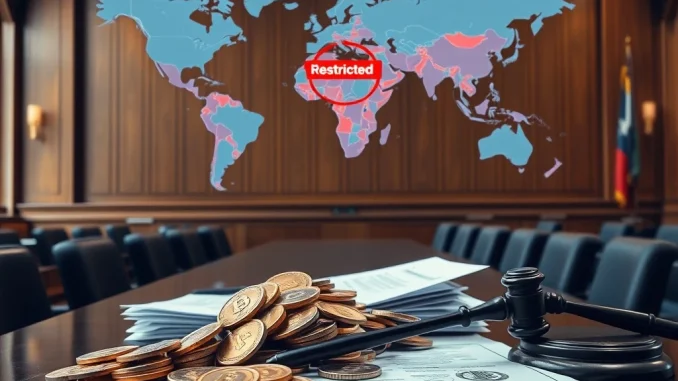
The saga of FTX, once a titan in the crypto world, continues to unfold with new complexities. In its latest chapter, the bankrupt crypto exchange is seeking a critical delay in resolving a substantial $470 million in foreign claims. This move highlights the intricate legal and regulatory hurdles inherent in winding down a global cryptocurrency empire. For many, this isn’t just a legal maneuver; it’s a pivotal moment for those anxiously awaiting the return of their assets.
FTX’s $470 Million Headache: Unpacking the Foreign Claims Dispute
At the heart of FTX‘s latest legal plea is a request to postpone its response to over 90 objections concerning its plan to halt $470 million in repayments. These funds are owed to creditors in 49 designated “restricted” countries. The sheer scale of this particular segment of claims is staggering, with China alone accounting for a significant $380 million of the total. But why are these countries considered “restricted”? Typically, this designation arises from local prohibitions or stringent controls on cryptocurrency activities, capital movement, or even international financial sanctions.
The estate’s primary objective is to consolidate and distribute assets fairly to all legitimate claimants. However, the diverse legal landscapes across these 49 nations present unique challenges. The decision to halt repayments, even temporarily, is a strategic one, aiming to navigate these complexities without inadvertently violating local laws or jeopardizing the overall recovery process. This is a delicate balancing act, as the estate strives to ensure compliance while also addressing the pressing needs of its global creditor base.
The Regulatory Minefield: Why Crypto Regulations Are Causing Delays for FTX Creditors
The primary justification for FTX‘s requested delay centers on the significant “legal risks tied to crypto regulations.” This isn’t just a blanket statement; it reflects the fragmented and often contradictory nature of cryptocurrency laws worldwide. Unlike traditional finance, where international agreements and established frameworks provide some level of predictability, crypto operates in a patchwork of national rules, many of which are still evolving.
Consider the challenges:
- Varying Legal Status: Some countries have outright banned crypto, while others regulate it as property, currency, or securities. Repaying in a jurisdiction where crypto is illegal could expose the estate to criminal charges or asset forfeiture.
- Anti-Money Laundering (AML) & Know Your Customer (KYC) Compliance: Ensuring that repayments are not inadvertently sent to sanctioned entities or used for illicit purposes requires rigorous due diligence, which is complicated by differing national standards and data privacy laws.
- Capital Controls: Many countries, particularly those with “restricted” status, impose strict controls on the outflow of capital. Transferring large sums, even as bankruptcy repayments, could trigger complex regulatory reviews or require special permissions.
- Tax Implications: The tax treatment of crypto assets and their recovery varies wildly, adding another layer of complexity for both the estate and the individual FTX creditors receiving funds.
Navigating this labyrinth of regulations requires meticulous legal review and careful strategizing. A misstep could lead to further complications, prolonged litigation, and even a reduction in the overall funds available for distribution.
The Broader Impact: Navigating the FTX Bankruptcy Dispute
This particular request for a delay is more than just a procedural hiccup; it has profound implications for all parties involved in the FTX bankruptcy dispute. For the hundreds of thousands of FTX creditors, especially those in the affected 49 countries, it means continued uncertainty and a potentially longer wait for resolution. While the estate argues it’s for their long-term benefit (to ensure legitimate, legally sound repayments), the immediate impact is undoubtedly frustrating.
For the FTX estate, led by CEO John Ray III, this highlights the immense operational and legal burden of managing such a complex, global bankruptcy. Every decision must be weighed against its legal ramifications across multiple jurisdictions, often with conflicting laws. This process is resource-intensive, adding to the already significant legal and administrative costs of the bankruptcy.
Moreover, this case could set a significant precedent for future cross-border crypto bankruptcies. As the crypto industry continues to mature and globalize, the likelihood of more exchanges or platforms facing similar insolvency issues increases. How the FTX estate successfully (or unsuccessfully) navigates these international regulatory challenges will provide valuable lessons and potentially shape future legal frameworks for digital asset insolvencies.
What’s Next for FTX? The Road Ahead for Repayments
The immediate focus for the FTX estate and its creditors is the upcoming court hearing, reportedly set for Tuesday. During this hearing, the court will consider FTX’s request for a delay and the objections raised against it. The outcome of this hearing will be pivotal.
Possible scenarios include:
- Delay Granted: If the court agrees with FTX’s reasoning regarding legal risks and the need for more time, the estate would gain a crucial window to develop a more robust, compliant repayment strategy for these specific claims. This would likely involve extensive legal analysis, potentially engaging with authorities in the affected countries.
- Delay Denied: If the court rejects the request, FTX would be compelled to proceed with addressing the objections and potentially processing repayments to these countries sooner, even amidst the stated regulatory concerns. This could force the estate to take on higher risks or seek alternative, perhaps more complex, legal workarounds.
Regardless of the immediate outcome, the path to full resolution for FTX’s creditors remains long and fraught with challenges. The interplay between traditional bankruptcy law and the nascent, diverse world of crypto regulations will continue to be a defining feature of this historic case.
Conclusion
The request by FTX to delay $470 million in foreign claims underscores the unprecedented complexities of crypto bankruptcies in a globally interconnected, yet legally fragmented, digital landscape. This is not merely about delaying payments; it’s about meticulously navigating a minefield of international crypto regulations to ensure that eventual repayments are both legally sound and sustainable. As the court hearing approaches, all eyes will be on the decision, which will not only impact thousands of FTX creditors but also contribute to the evolving jurisprudence surrounding digital assets and cross-border financial disputes. The journey to recover assets from the collapsed exchange remains a testament to the challenges and legal innovations required in the crypto age.
Frequently Asked Questions (FAQs)
1. Why is FTX seeking a delay in foreign claims repayments?
FTX is seeking a delay primarily due to significant legal risks associated with varying crypto regulations in 49 “restricted” countries. The estate needs more time to ensure that repayments comply with diverse national laws, including those related to crypto legality, anti-money laundering (AML), know-your-customer (KYC) requirements, and capital controls, to avoid further legal complications.
2. Which countries are considered “restricted” in this context, and how much is involved?
There are 49 countries designated as “restricted” by FTX, implying local prohibitions or strict regulations on crypto or capital movement. Of the total $470 million in foreign claims, China accounts for a substantial $380 million, making it the largest single component of this dispute.
3. What are the main challenges for FTX creditors in these restricted countries?
For FTX creditors in restricted countries, the main challenges include prolonged uncertainty regarding their repayments, the potential for further delays, and the complex legal landscape that might affect how or even if they can ultimately receive their funds due to local regulations on crypto or international transfers.
4. How do crypto regulations complicate the FTX bankruptcy dispute?
Crypto regulations complicate the FTX bankruptcy dispute by creating a patchwork of conflicting laws across different jurisdictions. This makes it challenging for the estate to distribute assets without violating local prohibitions, navigating diverse AML/KYC standards, or overcoming capital controls, all of which add significant legal complexity and cost to the process.
5. What is the significance of the upcoming court hearing for FTX?
The upcoming court hearing is significant because it will determine whether FTX is granted the requested delay. If approved, it provides the estate crucial time to develop compliant repayment strategies. If denied, FTX may be forced to proceed with addressing objections and repayments under more immediate regulatory pressure, potentially increasing risks.
6. Will this delay affect all FTX creditors globally?
No, this specific delay request primarily affects the $470 million in claims from the 49 “restricted” countries. While the overall bankruptcy process is interconnected, the direct impact of this particular delay is localized to creditors in those specific jurisdictions. However, any major legal or financial hurdle can indirectly affect the overall timeline and complexity of the bankruptcy for all stakeholders.