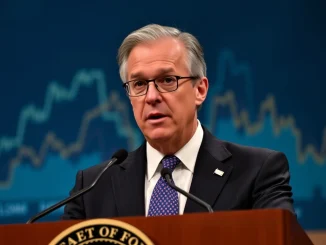
The financial world constantly monitors the U.S. Federal Reserve. Its decisions often send ripples across global markets. This includes the volatile cryptocurrency sector. Therefore, understanding the Fed’s internal dynamics is crucial for crypto investors. A recent report suggests the Federal Open Market Committee (FOMC) faces a significant hurdle. A lack of comprehensive economic data could prevent a clear consensus on future interest rates. This situation creates substantial uncertainty for all asset classes, including digital assets.
Unpacking the FOMC’s Deliberation Challenge
The Federal Open Market Committee (FOMC) serves as the monetary policy-making body of the U.S. Federal Reserve System. Its primary role involves setting the federal funds rate. This rate influences other interest rates throughout the economy. Decisions by the FOMC directly impact borrowing costs, inflation, and economic growth. Consequently, these decisions shape the investment landscape. This directly affects the capital available for riskier assets like cryptocurrencies.
Nick Timiraos, a respected reporter for The Wall Street Journal, recently shed light on internal divisions within the committee. Timiraos is often seen as the unofficial spokesperson for the Federal Reserve. His insights therefore carry significant weight. He explained that achieving a unified stance on interest rates has become increasingly difficult. This internal disagreement stems from differing views on the current economic outlook. It also highlights varying approaches to risk management.
The September Summary of Economic Projections (SEP) revealed these deep divisions. Some committee members advocated for further rate cuts. They cited risk management as their primary concern. Conversely, a substantial number of members saw no immediate need for such adjustments. This divergence presents a challenge for clear policy direction. Typically, fresh economic data helps bridge these gaps. However, current circumstances have complicated this process.
The Critical Role of Economic Data in Policy Making
Accurate and timely economic data forms the bedrock of the Federal Reserve‘s policy decisions. The FOMC relies heavily on various metrics. These include inflation rates, employment figures, GDP growth, and consumer spending. Such data provides a clear picture of economic health. It allows policymakers to make informed adjustments to interest rates. Without this vital information, decision-making becomes significantly more complex. Furthermore, it introduces a higher degree of speculation into market forecasts.
Unfortunately, a recent government shutdown has halted the collection of several key metrics. This disruption creates a significant blind spot for the FOMC. Key reports from agencies like the Bureau of Labor Statistics (BLS) and the Census Bureau become unavailable. Therefore, members have limited new information to evaluate. This situation makes it hard for them to change their existing opinions. Essentially, the data void reinforces pre-existing biases rather than fostering new consensus. As a result, the path forward for monetary policy becomes less clear. This ambiguity can fuel market volatility, impacting crypto prices.
Nick Timiraos: The Fed’s Unofficial Barometer
Nick Timiraos holds a unique position within financial journalism. His reporting often precedes official announcements or provides crucial context. This has earned him the moniker of the Federal Reserve‘s unofficial spokesperson. His analyses are closely watched by investors, analysts, and policymakers alike. When Timiraos speaks about internal Fed dynamics, markets pay attention. His recent observations underscore a growing problem. The absence of critical economic data creates a vacuum. This vacuum directly impacts the FOMC’s ability to forge a unified path on interest rates.
Timiraos’s insights are particularly valuable during periods of uncertainty. He often translates complex central bank language into digestible information. His recent reporting indicates that without fresh inputs, members are unlikely to shift their positions. This stalemate could lead to prolonged policy ambiguity. Such uncertainty often prompts investors to seek safer assets. However, it can also lead to increased speculation in high-risk markets, including crypto.
Interest Rates and Their Ripple Effect on Crypto Markets
Decisions regarding interest rates by the Federal Reserve profoundly influence financial markets. Higher rates generally increase the cost of borrowing. They also make traditional savings more attractive. This can divert capital away from riskier assets. Cryptocurrencies, being a relatively new and volatile asset class, are particularly sensitive to these shifts. Conversely, lower rates tend to encourage borrowing and investment in risk assets. This often benefits the crypto market.
The current lack of consensus within the FOMC creates a challenging environment. Investors thrive on clarity and predictability. When the future direction of interest rates is uncertain, market participants become cautious. This caution can lead to reduced liquidity in crypto markets. It may also result in increased price volatility. Furthermore, the perceived stability of the broader economy, influenced by Fed policy, directly affects investor sentiment towards digital assets. Stablecoin dynamics are also impacted, as their peg often relies on the stability of traditional financial systems influenced by the Fed.
Navigating Policy Uncertainty: What Lies Ahead?
The immediate future for the Federal Reserve looks complex. Without a complete set of economic data, the FOMC must navigate uncharted waters. Several scenarios could unfold:
- Delayed Decisions: The committee might postpone significant policy shifts. They could wait until more reliable data becomes available.
- Status Quo Maintenance: They might choose to maintain current interest rates. This would avoid making decisions based on incomplete information.
- Increased Dissent: Without data to sway opinions, internal disagreements could intensify. This makes future meetings even more challenging.
- Reliance on Alternative Metrics: The Fed might explore alternative, less traditional data sources. This could help fill the current information gap.
Each of these paths carries implications for market stability. Prolonged uncertainty can erode investor confidence. This sentiment often translates into cautious behavior across all asset classes. For cryptocurrency markets, this could mean continued sideways movement or heightened sensitivity to minor news events. Therefore, market watchers will closely monitor any statements from the Federal Reserve. They will look for clues about how the committee plans to proceed.
In conclusion, the U.S. Federal Reserve faces a formidable challenge. A critical lack of economic data is hindering the FOMC‘s ability to achieve consensus on interest rates. This situation, highlighted by Nick Timiraos, introduces significant uncertainty into global financial markets. Crypto investors must remain vigilant. Fed policy directly influences liquidity, risk appetite, and overall market sentiment. The path forward for monetary policy remains obscured. Therefore, understanding these dynamics is essential for navigating the evolving economic landscape.
Frequently Asked Questions (FAQs)
Q1: Who is Nick Timiraos and why is his reporting important?
A1: Nick Timiraos is a reporter for The Wall Street Journal. He is widely considered the U.S. Federal Reserve‘s unofficial spokesperson. His articles often provide early insights into the Fed’s thinking. Therefore, his reporting is crucial for understanding future monetary policy directions.
Q2: What is the FOMC’s primary function?
A2: The FOMC (Federal Open Market Committee) is the monetary policy-making body of the U.S. Federal Reserve System. Its main function is to set the federal funds rate. This decision influences overall interest rates and the nation’s money supply.
Q3: How does a lack of economic data affect the FOMC?
A3: The FOMC relies on comprehensive economic data to make informed decisions about interest rates. Without current and accurate data, committee members lack a common basis to evaluate the economy. This makes it difficult to achieve consensus and adjust policy effectively.
Q4: What impact do Federal Reserve interest rate decisions have on cryptocurrency markets?
A4: Federal Reserve interest rates decisions significantly impact crypto markets. Higher rates can reduce investor appetite for riskier assets like cryptocurrencies. Conversely, lower rates may encourage investment in digital assets. Policy uncertainty can also increase crypto market volatility.
Q5: What was the key takeaway from the September Summary of Economic Projections (SEP)?
A5: The September SEP showed a clear division among FOMC members regarding future interest rates. A notable minority favored further rate cuts for risk management. However, a significant number saw no need for such cuts, indicating a lack of clear consensus.
Q6: What is the significance of the government shutdown in this context?
A6: The government shutdown halted the collection and release of crucial economic data. This data is essential for the Federal Reserve‘s decision-making process. Without these metrics, FOMC members have less information to potentially change their existing opinions on monetary policy.