The financial world consistently monitors signals from central banks. For cryptocurrency enthusiasts and investors, understanding macroeconomic trends is crucial. Traditional finance decisions, especially those concerning the Federal Reserve’s monetary policy, often ripple through all asset classes. This includes digital assets. A recent **JPMorgan forecast** offers vital insights into the potential path of future **Fed rate cuts**, impacting everything from bond yields to investor sentiment.
JPMorgan’s Steady Prediction for Gradual Fed Rate Cuts
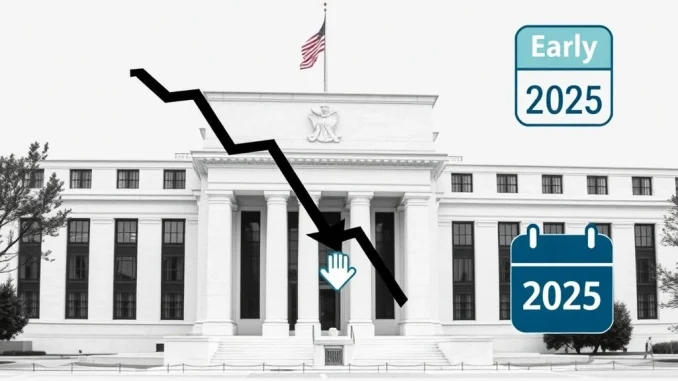
JPMorgan Chief Economist Michael Feroli recently reaffirmed a significant prediction. He maintains his forecast that the **Federal Reserve** will implement gradual interest rate reductions. Specifically, Feroli anticipates 25 basis point cuts. These adjustments are expected to continue until the federal funds rate settles between 3.25% and 3.5%. This target range should be reached early next year.
- Feroli’s projection emphasizes a measured approach.
- The central bank aims for stability, not abrupt changes.
- Each cut will likely be 25 basis points.
- The target range is 3.25% to 3.5%.
- This level is expected by early 2025.
Such gradualism aims to prevent market shocks. Furthermore, it allows the economy to adapt. Feroli’s analysis provides a clear perspective on the anticipated monetary policy trajectory. This measured approach suggests a cautious optimism within JPMorgan regarding economic stability. Investors should closely watch these developments. They directly influence broader market conditions.
Key Variables Influencing Future Interest Rates
Several factors could complicate the **Federal Reserve**’s path to lowering **interest rates**. Michael Feroli highlighted a significant variable: a potential Supreme Court case. This case involves Fed Governor Lisa Cook. An unfavorable ruling against her could establish a precedent. Consequently, it might threaten other governors. This situation introduces an element of legal and political uncertainty into the Fed’s operational environment.
Moreover, Feroli also pointed to the risk of a politicized Fed. A central bank perceived as politically influenced becomes more vulnerable. Specifically, it could face increased pressure from an administration, such as a future Trump administration. This scenario raises concerns about the Fed’s independence. Its ability to make purely economic decisions could be compromised. Such external pressures introduce significant volatility. They could derail carefully planned monetary policy. Therefore, these variables are critical considerations for the overall **economic outlook**.
Understanding the Broader Economic Outlook and Market Impact
The anticipated **Fed rate cuts** are not isolated events. They form part of a larger **economic outlook**. Lower **interest rates** typically aim to stimulate economic activity. They make borrowing cheaper for businesses and consumers. This can boost investment and spending. However, the context of these cuts matters greatly. If cuts occur amidst persistent inflation or geopolitical instability, their impact may vary. Consequently, markets will react based on the underlying economic health.
For the cryptocurrency market, lower interest rates often signal a shift. Investors might seek higher returns in riskier assets. This could potentially benefit digital currencies. Conversely, uncertainty surrounding the Fed’s independence or legal challenges could deter investment. The gradual nature of the projected cuts suggests the Fed seeks a soft landing. This means avoiding a recession while managing inflation. Feroli’s **JPMorgan forecast** thus offers a critical lens. It helps understand the potential trajectory of the US economy and its global repercussions.
Conclusion: Navigating the Future of Monetary Policy
JPMorgan’s consistent **economic outlook** regarding **Fed rate cuts** provides valuable guidance. Michael Feroli’s forecast for gradual 25 basis point reductions, reaching 3.25%-3.5% by early next year, underscores a cautious approach. However, external variables like the Supreme Court case involving Governor Lisa Cook and the potential for a politicized **Federal Reserve** introduce complexities. These factors could significantly influence the central bank’s independence and decision-making. As such, market participants, including those in the crypto space, must remain vigilant. Understanding these nuanced shifts in monetary policy is essential for informed investment strategies. The path ahead requires careful observation of both economic indicators and political developments.
Frequently Asked Questions (FAQs)
Q1: What is JPMorgan’s current forecast for Fed rate cuts?
A1: JPMorgan Chief Economist Michael Feroli forecasts gradual 25 basis point Fed rate cuts. He expects the federal funds rate to reach between 3.25% and 3.5% by early next year (2025).
Q2: What factors could influence the Federal Reserve’s decisions on interest rates?
A2: Key factors include economic data (inflation, employment), geopolitical events, and internal challenges. Michael Feroli specifically mentioned a Supreme Court case involving Fed Governor Lisa Cook and the potential for increased political pressure from a future administration.
Q3: How do Fed rate cuts typically impact the broader economy?
A3: Fed rate cuts generally aim to stimulate economic growth. They make borrowing cheaper for consumers and businesses, encouraging spending and investment. This can lead to increased liquidity and potentially higher valuations for risk assets, including cryptocurrencies.
Q4: What is the significance of the Supreme Court case involving Lisa Cook?
A4: An unfavorable ruling in the Supreme Court case involving Fed Governor Lisa Cook could set a precedent. This might threaten other Federal Reserve governors. Such an outcome could introduce legal and operational uncertainty for the central bank.
Q5: How might a politicized Federal Reserve affect monetary policy?
A5: A politicized Federal Reserve could become more vulnerable to external pressure. For example, a future administration might influence its decisions. This could compromise the Fed’s independence and its ability to make purely economic, data-driven monetary policy choices.
Q6: Why is the ‘gradual’ nature of the Fed rate cuts important?
A6: The ‘gradual’ nature of the Fed rate cuts indicates a cautious approach. It aims to avoid market shocks and allows the economy to adjust smoothly. This measured strategy helps prevent abrupt shifts that could destabilize financial markets or trigger unwanted economic outcomes.