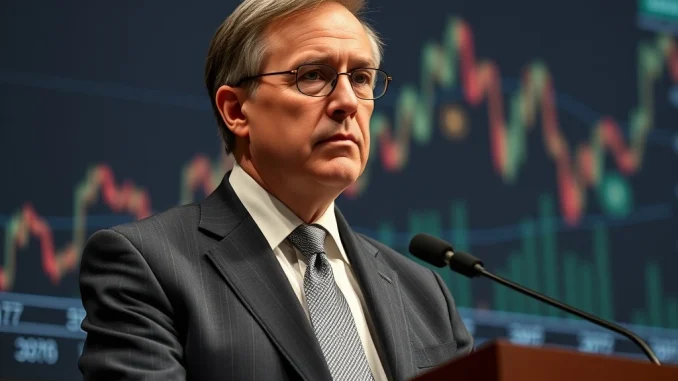
The financial world recently experienced a moment of heightened anticipation. New York Fed President John Williams notably declined to comment on the likelihood of a September Fed rate cut. This silence has immediately amplified market speculation. Such ambiguity often sends ripples through global markets. It particularly impacts the volatile world of cryptocurrencies. Understanding the Federal Reserve’s stance is vital for all investors. Therefore, this development carries significant weight for the entire financial ecosystem.
John Williams Fed: A Strategic Silence Amidst Speculation
John Williams, the influential President of the Federal Reserve Bank of New York, recently faced direct questions. He was asked about market expectations for a September interest rate reduction. His response was a deliberate non-comment. This action, while seemingly minor, holds considerable importance. As a permanent voting member of the Federal Open Market Committee (FOMC), Williams’ words often provide insight. His public statements are usually carefully weighed. They can signal future shifts in monetary policy.
His refusal to engage on the specific timing of a Fed rate cut is noteworthy. It suggests a desire to maintain policy flexibility. The Fed aims to avoid pre-committing to any specific action. This approach allows the committee to react dynamically. They can respond to incoming economic data. Furthermore, it prevents market participants from locking in expectations too early. Such a strategy helps the Fed manage market volatility. It also preserves its optionality in a rapidly changing economic environment. Analysts are now dissecting this silence. They seek clues about the Fed’s internal deliberations.
Williams’ role extends beyond just voting. He also oversees the New York Fed’s market operations. This includes implementing the FOMC’s decisions. Therefore, his perspective is deeply rooted in market realities. His caution reflects the complex economic landscape the Fed currently navigates. It highlights the ongoing debate within the central bank. This debate centers on the appropriate path for interest rates. The goal remains to achieve both price stability and maximum employment. However, the exact method to achieve these goals is still under review.
The Broader Interest Rate Outlook: Data Dependence Reigns Supreme
Market participants eagerly monitor the interest rate outlook. Current expectations, as reflected by tools like the CME FedWatch Tool, show varying probabilities. These probabilities for a September Fed rate cut fluctuate daily. They respond directly to new economic reports. Several key factors influence the Federal Reserve’s decisions. These factors include:
- Inflation Data: The Consumer Price Index (CPI) and Personal Consumption Expenditures (PCE) index are crucial. Persistent inflation pressures would likely delay rate cuts. Conversely, sustained disinflation supports rate reductions.
- Employment Figures: Strong job growth and low unemployment might suggest the economy can handle higher rates. A weakening labor market, however, could prompt the Fed to ease policy.
- Economic Growth: Gross Domestic Product (GDP) reports indicate the overall health of the economy. Robust growth might lessen the urgency for cuts. A slowdown could accelerate them.
- Global Economic Conditions: International economic stability and geopolitical events also play a role. They can influence the Fed’s assessment of risks.
The Fed maintains a data-dependent approach. This means future policy moves are not predetermined. Instead, they rely heavily on the evolving economic picture. The narrative of “higher for longer” interest rates has dominated discussions. This view suggests that inflation remains sticky. It also implies that economic growth is resilient. However, some economists argue for preemptive cuts. They fear a potential economic slowdown. This ongoing tension defines the current interest rate outlook. It creates a climate of uncertainty for investors.
Monetary Policy’s Delicate Balance: Navigating Economic Headwinds
The Federal Reserve’s primary mandate involves a delicate balancing act. They aim for both price stability and maximum sustainable employment. Achieving these goals simultaneously is often challenging. Especially in an economy still recovering from recent shocks. The Fed uses its monetary policy tools to influence the economy. These tools primarily include adjusting the federal funds rate. This rate affects borrowing costs across the entire financial system. It impacts everything from mortgages to business loans.
When interest rates are high, borrowing becomes more expensive. This can slow down economic activity. Businesses may delay expansion plans. Consumers might reduce spending on big-ticket items. Conversely, lower rates stimulate borrowing and spending. This encourages investment and job creation. The current challenge for the Fed is complex. They must combat inflation without triggering a severe recession. This requires careful calibration of their policy actions. Over-tightening could stifle growth too much. Under-tightening could allow inflation to re-accelerate.
Beyond interest rates, the Fed also employs quantitative tightening (QT). This involves reducing its balance sheet. It means selling off bonds it acquired during previous easing periods. QT further removes liquidity from the financial system. This action complements interest rate hikes. Together, they work to cool the economy. The ongoing debate centers on the effectiveness and timing of these measures. Analysts continually assess how these tools shape the economic landscape. The impact of these policies is far-reaching. It touches every sector of the economy. Therefore, the trajectory of monetary policy is a critical concern.
Crypto Market Impact: Decoding Rate Cut Signals
The cryptocurrency market is highly sensitive to shifts in global monetary policy. Expectations around a Fed rate cut significantly influence investor sentiment. Historically, lower interest rates tend to benefit risk assets. This category includes cryptocurrencies like Bitcoin and Ethereum. When rates are low, traditional investments like bonds offer lower returns. This encourages investors to seek higher yields elsewhere. Consequently, they often turn to more volatile assets. These assets include stocks and digital currencies.
Conversely, a “higher for longer” rate environment can depress crypto prices. Higher rates make it more attractive to hold cash or invest in safer, yield-bearing assets. This reduces the appeal of speculative investments. The opportunity cost of holding non-yielding assets like Bitcoin increases. Therefore, any indication of a delayed or cancelled Fed rate cut can trigger sell-offs. It can also lead to reduced trading volumes in the crypto space. The market’s reaction is often swift and dramatic. This highlights the interconnectedness of traditional finance and digital assets.
Consider these points regarding the crypto market impact:
- Bitcoin as a Bellwether: Bitcoin, the largest cryptocurrency, often acts as a proxy. Its price movements reflect broader sentiment. It also shows how investors perceive economic conditions.
- Correlation with Tech Stocks: Cryptocurrencies frequently exhibit a correlation with growth-oriented tech stocks. These stocks are also sensitive to interest rate changes.
- Liquidity Flows: Lower rates typically increase overall market liquidity. This extra capital can flow into riskier assets, including crypto. Higher rates do the opposite.
- Investor Psychology: Uncertainty about rates can lead to cautious behavior. This often results in reduced risk-taking. Clearer signals, whether positive or negative, can spur more decisive action.
Crypto investors must therefore closely monitor Fed communications. They need to understand the nuances of the interest rate outlook. These factors directly shape the investment landscape for digital assets. Furthermore, the future of decentralized finance (DeFi) also hinges on these broader economic trends. DeFi platforms often rely on stablecoin liquidity and lending protocols. These are indirectly affected by central bank policies.
Historical Precedents and Future Projections for Monetary Policy
Looking back, historical data provides valuable context. Past cycles of Fed tightening and easing offer insights. During periods of aggressive rate hikes, risk assets typically face headwinds. For example, the tightening cycle of 2022 saw significant drawdowns in both traditional markets and crypto. Conversely, periods of monetary easing often precede rallies. This pattern suggests a strong link between central bank actions and asset performance. However, past performance does not guarantee future results. Each economic cycle presents unique challenges and variables.
Analysts are now projecting various scenarios for the remainder of the year. If the Fed indeed holds rates steady through September, attention will shift to later meetings. October and December FOMC meetings will become critical. The path of inflation will be paramount. If inflation cools faster than expected, a Fed rate cut might still be on the table for Q4. Conversely, a re-acceleration of inflation could push cuts further into 2025. These projections directly inform investment strategies. They influence decisions for both institutional and retail investors.
The communication from officials like John Williams Fed will remain vital. Investors will scrutinize every word. They will look for any deviation from the current cautious stance. The global economic environment also plays a role. International trade, geopolitical stability, and commodity prices all feed into the Fed’s models. Therefore, a holistic view is necessary. This includes understanding both domestic and international economic forces. Ultimately, the Fed’s actions will shape the economic trajectory. They will also influence the direction of the crypto market for months to come.
Conclusion: Navigating the Uncharted Waters of Interest Rate Outlook
New York Fed President John Williams’ decision not to comment on a September Fed rate cut underscores ongoing uncertainty. This strategic silence reflects the Federal Reserve’s commitment to data dependence. It also highlights the complex economic environment. The broader interest rate outlook remains a critical determinant for global financial markets. Every economic indicator, from inflation to employment, will inform future monetary policy decisions. Consequently, investors must stay vigilant. They need to monitor these developments closely.
The crypto market impact of these decisions cannot be overstated. Digital assets thrive in environments of lower rates and ample liquidity. They face challenges when borrowing costs rise. As the Fed continues its delicate balancing act, market participants must adapt. They need to prepare for various potential scenarios. The future trajectory of interest rates will undoubtedly shape investment opportunities. It will also define risks across all asset classes, including the dynamic world of cryptocurrencies.
Frequently Asked Questions (FAQs)
Q1: Why did New York Fed President John Williams decline to comment on a September Fed rate cut?
John Williams likely declined to comment to maintain the Federal Reserve’s policy flexibility. The Fed aims to avoid pre-committing to specific actions. This allows them to react dynamically to incoming economic data. It also prevents markets from locking in expectations too early. This approach helps the Fed manage volatility and preserve its options.
Q2: How does a potential Fed rate cut impact the cryptocurrency market?
A Fed rate cut generally benefits the cryptocurrency market. Lower interest rates make traditional investments less attractive. This encourages investors to seek higher returns in riskier assets like cryptocurrencies. Conversely, higher rates can reduce crypto’s appeal. They make safer, yield-bearing assets more competitive. This can lead to decreased investment in digital assets.
Q3: What factors influence the Federal Reserve’s interest rate outlook?
The Federal Reserve’s interest rate outlook is data-dependent. Key factors include inflation data (CPI, PCE), employment figures, and overall economic growth (GDP). Global economic conditions and geopolitical events also play a role. The Fed assesses these indicators to determine the appropriate path for monetary policy.
Q4: What is the Federal Reserve’s dual mandate regarding monetary policy?
The Federal Reserve has a dual mandate for its monetary policy. It aims to achieve both price stability and maximum sustainable employment. Price stability means keeping inflation under control. Maximum employment means ensuring as many people as possible have jobs. The Fed uses tools like interest rate adjustments to balance these two goals.
Q5: How does John Williams’ position influence the Fed’s decisions?
As President of the Federal Reserve Bank of New York, John Williams is a permanent voting member of the FOMC. This committee sets interest rates. His perspective is highly influential. He also oversees market operations. Therefore, his insights and public statements are closely watched for clues about future policy direction. His role makes him a key voice in shaping the monetary policy landscape.
Q6: What should crypto investors monitor regarding the Fed’s future actions?
Crypto investors should closely monitor several aspects. These include upcoming inflation reports (CPI, PCE), employment data (jobs reports), and GDP figures. They should also pay attention to public statements from Fed officials. Any shifts in the Fed’s rhetoric or projections for the interest rate outlook will be crucial. These factors directly affect the crypto market impact and investor sentiment.