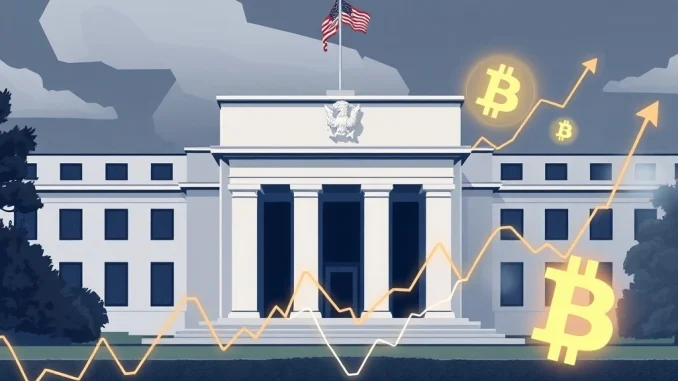
The financial landscape constantly shifts, impacting various asset classes. Recently, an intriguing analysis suggests that more active intervention by the U.S. Federal Reserve could offer significant **cryptocurrency benefits**. This potential shift in monetary policy warrants close attention from investors and enthusiasts alike. Understanding the nuances of this possibility is crucial for navigating future market dynamics.
Understanding the Federal Reserve’s Mandate and Potential Fed Intervention
The U.S. Federal Reserve, commonly known as the Fed, holds a dual mandate. It aims to maximize employment and maintain price stability. A lesser-known but equally important aspect involves ensuring “moderate long-term **interest rates**.” This mandate was recently highlighted by Steve Miran, a new member of the Federal Reserve Board of Governors. His remarks underscore the central bank’s ongoing commitment to managing the cost of borrowing money.
Historically, the Fed has employed various tools to achieve its objectives. These include adjusting the federal funds rate and engaging in open market operations. Cointelegraph’s analysis points to a potential for more aggressive action. The Trump administration, for instance, might push for increased intervention in the bond market. Such actions could include direct purchases of government bonds. This strategy aims to suppress yields and keep borrowing costs low. Consequently, this could reshape the economic environment for many years.
A key mechanism for managing interest rates is **quantitative easing**. This involves large-scale asset purchases by the central bank. It injects liquidity into the financial system. Furthermore, it lowers long-term interest rates. This policy was widely used during the 2008 financial crisis and the COVID-19 pandemic. Its re-introduction or expansion could have profound effects. Investors must understand these potential policy shifts. They directly influence asset valuations across the board.
The Impact of Low Interest Rates on Investment Flows
When government policies keep **interest rates** low, traditional safe-haven assets often yield less. Bonds, for example, become less attractive to investors seeking higher returns. This scenario typically encourages capital to flow into riskier, higher-growth assets. Cryptocurrencies, particularly Bitcoin, stand to gain from such an environment. Their potential for significant appreciation often outweighs the lower, more stable returns of conventional investments.
Moreover, persistently low interest rates can signal inflationary pressures. Central banks might implement these policies to stimulate economic growth. However, they can also devalue fiat currencies over time. Investors then seek assets that can preserve or grow their wealth. This search for alternative stores of value directly contributes to the rise of digital assets. Consequently, crypto markets could experience substantial inflows.
The current economic climate, marked by high national debt and ongoing stimulus measures, reinforces this trend. Traditional financial institutions are also exploring digital assets. This further legitimizes cryptocurrencies as an investment class. Therefore, the Fed’s stance on interest rates directly influences this dynamic. Its actions could accelerate the adoption of digital currencies. This represents a significant shift in global finance.
Bitcoin as a Robust Inflation Hedge
The analysis concludes that if government policies maintain low interest rates, **Bitcoin could attract substantial capital as an inflation hedge**. An inflation hedge is an asset that is expected to protect or increase in value during periods of rising prices. Bitcoin’s fixed supply of 21 million coins makes it inherently scarce. This scarcity contrasts sharply with fiat currencies, which central banks can print indefinitely. Therefore, its limited supply provides a strong argument for its role as a hedge against inflation.
Many investors view Bitcoin as “digital gold.” Gold has historically served as a reliable inflation hedge. Like gold, Bitcoin operates outside the traditional banking system. It is not subject to the monetary policies of any single government. This decentralized nature enhances its appeal during times of economic uncertainty. Furthermore, its global accessibility allows for seamless transfer and storage.
The growing institutional adoption of Bitcoin further strengthens its position. Major corporations and investment funds now hold Bitcoin on their balance sheets. This widespread acceptance boosts its credibility. It also increases its liquidity. Consequently, more investors are comfortable allocating capital to this digital asset. This trend is likely to continue as global economic conditions evolve. The demand for reliable inflation hedges will only grow.
The Role of Quantitative Easing in Boosting Crypto Markets
Expanded **quantitative easing** (QE) directly impacts asset prices. When the Fed buys bonds, it increases the money supply. This influx of capital into the economy seeks returns. With traditional investments offering low yields, a significant portion of this money could flow into alternative assets. Cryptocurrencies, known for their high growth potential, become particularly attractive in this scenario.
QE effectively lowers the cost of capital. Businesses and individuals can borrow more cheaply. This stimulates economic activity. However, it also creates an environment where cash loses purchasing power. Holding large sums of cash becomes less appealing. Investors actively seek assets that can outpace inflation. Bitcoin and other digital assets often fit this description perfectly.
The previous rounds of quantitative easing have often coincided with periods of growth in the crypto market. While correlation does not equal causation, the historical data suggests a link. As more money enters the financial system, a portion inevitably finds its way into speculative and high-growth assets. This pattern could repeat with future Fed interventions. Therefore, monitoring the Fed’s QE policies is essential for crypto investors.
Potential for Substantial Capital Inflows and Cryptocurrency Benefits
The scenario painted by Cointelegraph suggests a significant opportunity for **cryptocurrency benefits**. If the Fed actively manages interest rates to keep them low, capital will likely shift. This shift would move away from low-yielding bonds and towards assets with higher growth potential. Bitcoin, with its strong narrative as an inflation hedge, stands to be a primary beneficiary.
Such a development could lead to substantial capital inflows into the crypto market. Increased demand typically drives up prices. This would create a positive feedback loop, attracting even more investors. The overall market capitalization of cryptocurrencies could expand considerably. This growth would benefit not only Bitcoin but also the broader altcoin market.
Moreover, sustained low interest rates could encourage innovation within the crypto space. Developers and entrepreneurs might find it easier to secure funding for new projects. This fosters further technological advancements. Consequently, the entire digital asset ecosystem could mature rapidly. This robust growth would cement cryptocurrencies as a vital component of the global financial system.
Navigating Future Economic Policies and Their Crypto Implications
Investors must remain vigilant regarding future economic policies. The Federal Reserve’s decisions profoundly influence market conditions. A proactive approach to managing **interest rates** could signal a new era for crypto. Staying informed about the Fed’s communications and actions is paramount. This vigilance allows investors to adapt their strategies effectively.
The relationship between traditional finance and cryptocurrencies is evolving. Macroeconomic factors, once considered peripheral, now directly impact digital asset valuations. Understanding these connections is key to making informed investment decisions. As the global economy navigates inflation and growth challenges, the role of cryptocurrencies becomes increasingly prominent. Therefore, investors should continue to monitor these developments closely.
Ultimately, the analysis highlights a compelling narrative. Active Fed intervention, aimed at maintaining moderate long-term interest rates, could inadvertently create a bullish environment for crypto. The potential for Bitcoin to serve as a robust inflation hedge positions it favorably. This makes the digital asset market an exciting space to watch. Its future trajectory remains intertwined with global monetary policy decisions.
Frequently Asked Questions (FAQs)
Q1: What is the Federal Reserve’s mandate regarding interest rates?
A1: The Federal Reserve has a mandate to ensure “moderate long-term interest rates,” alongside maximizing employment and maintaining price stability. This means they aim to keep borrowing costs at levels that support economic growth without causing instability.
Q2: How could Fed intervention to keep interest rates low benefit cryptocurrencies?
A2: When interest rates are low, traditional investments like bonds offer lower returns. This encourages investors to seek higher-yielding assets, including cryptocurrencies. Low rates can also signal inflation, prompting investors to look for inflation hedges like Bitcoin.
Q3: What is quantitative easing, and how does it relate to crypto?
A3: Quantitative easing (QE) involves the Fed buying large quantities of government bonds and other assets to inject money into the financial system. This increases the money supply, lowers interest rates, and can lead to capital flowing into assets like cryptocurrencies as investors seek to preserve or grow wealth against potential inflation.
Q4: Why is Bitcoin considered an inflation hedge?
A4: Bitcoin is considered an inflation hedge primarily due to its fixed supply cap of 21 million coins. This scarcity contrasts with fiat currencies, which can be printed indefinitely, making Bitcoin potentially more resilient against the devaluation effects of inflation.
Q5: What does “substantial capital” mean in the context of Bitcoin?
A5: “Substantial capital” refers to significant amounts of money flowing into Bitcoin from institutional and retail investors. This influx would likely drive up its price and market capitalization, further solidifying its position as a major asset class.
Q6: Should investors adjust their strategies based on potential Fed actions?
A6: Yes, investors should always stay informed about Federal Reserve policies and macroeconomic trends. Understanding how Fed actions, especially regarding interest rates and quantitative easing, can impact different asset classes is crucial for making informed investment decisions in the dynamic crypto market.